המעטפה הכחולה / The Blue Envelope
My Dear Friends in Israel,
I have been thinking about you, about everything these last three years have held, and about the election now only weeks away. Three years after the worst day in Israel’s history, the task now falls to you to write the next chapter of the State of Israel.
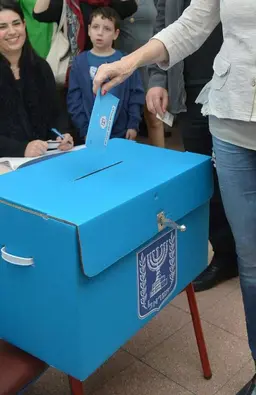
Soon you will walk into a school or community center, receive a blue envelope, and step behind the screen. For a moment, you will be alone. Though, of course, you will not be alone.
October 7th will be there. The hostages. The funerals. Friends who disappeared again and again into reserve duty. Families driven from their homes. Gaza. Hezbollah. Nights when missiles came from Iran and you sat with your children in shelters or stairwells. You will bring your anger, exhaustion, fears, and whatever hope you still carry for the country your children will inherit.
I hope, somewhere in that small space, you will remember us too: your family beyond Israel who loves you.
After October 7th, our community did not waste any time. We gathered immediately, rallied, raised money, hung photographs of hostages in our windows. When communities in Israel needed help, people here asked: What can we do?
Kol Yisrael aravim zeh bazeh. All Israel is responsible for one another.
For years we talked about the growing distance between us. Then something deeper became clear, requiring no explanation. In the moment of truth, we belong to one another.
We have felt the consequences of these long years of war too. There are more armed guards outside the places where our children learn and pray. Jews have been murdered and attacked in America because they were Jews. Our children calculate whether to wear a Star of David or mention Israel. Friendships have changed. Students discover that calling themselves Zionists can make them unwelcome in places where they once belonged.
And this puts us in an almost impossible position. Because we are Jews, we are expected to answer for Israel. Because we are Americans, we have no vote in what Israel does. We are called to account for decisions we did not make, ministers we did not elect, and words we would never say.
There is something especially painful about this because we actually do believe that Jews are responsible for one another. That is why October 7th pierced us. That is why we got up and acted. That is why people we had never met immediately became ours. But responsibility for one another cannot mean that every Jew is personally responsible for every decision made by a government in Israel.
And some of those decisions reach us. When powerful ministers speak openly about removing Palestinians from Gaza, annexing the West Bank, or treating Palestinian lives and aspirations as though they hardly matter, those words do not stay in Israel. When settlers attack Palestinian families and the state fails to stop them, or when those who hold authority attack courts, investigators, journalists, and other democratic institutions, those choices do not stop at Israel’s borders either.
They arrive here.
They arrive in the classroom where a Jewish student is asked to defend something she does not defend. They arrive in conversations between friends where a Jew is asked how he can still call himself a Zionist. They arrive in the synagogue where we are trying to teach our children that they can love Israel without surrendering their conscience and moral instincts. And people who already believe that Israel has no right to exist as a Jewish state use those arguments against us.
We need Israel deeply. We need a Jewish state that is strong and safe, somewhere our children know will always receive them. We need Israel to be a source of Jewish confidence when so much around us asks Jews to become smaller, quieter, or ashamed. We need to be able to point toward Israel and say: this is ours.
Your first responsibility when you vote is to the country where you raise your families, send children into the army, build lives, and bury people you love. I would never pretend that the price you pay and the price we pay are the same. But because we really do belong to one another, Israel’s choices do not remain inside Israel. We live with some of their consequences here, without the ability to influence them at the ballot box.
You do.
There is another danger too: the slow disappearance of the word “we.”
You feel it in Israel. After years in which reservists have given hundreds of days to the country, you are still fighting over whether the burden of defending it will be shared. Religious and secular Israelis struggle over what kind of country they share. Right and left increasingly speak about one another as though they inhabit different countries.
We feel it here too. American Jews sort one another into camps by the words we use, the statements we sign, even by whether we call ourselves Zionists. Some feel abandoned by those who cannot see the danger Israel faces. Others wonder whether there is room in Jewish communal life for their anguish about decisions made by Israel’s government. Too often, disagreement becomes a test of belonging.
And that frightens me because the deepest truth these three years have revealed is the opposite: what unites us is greater than what divides us.
Because in the end, who will be there for Jews if not other Jews?
Kol Yisrael aravim zeh bazeh has to mean more than standing together when Jews are attacked. It has to mean remaining responsible for one another when we are angry with one another, when the people with whom we share a future see that future differently. Disagreement should be the beginning of a conversation and a relationship, not its end.
There is an Israel I recognize in the audacity of its founding: a Jewish home that gathered our people from across the earth and gave us responsibility for our own destiny. Jews from Baghdad and Warsaw, Casablanca and Moscow, Addis Ababa and Buenos Aires somehow made a country together. We built universities, hospitals, laboratories, farms, cities, culture, and a home.
Israel is the great project of Jewish self-determination, still unfinished, still asking what kind of society Jews will build.
We need an Israel that dreams big again. A country building toward something larger than the next war or the next election. A place where young people can imagine a future worth staying for, where families can build lives with confidence, and where the extraordinary energy Israelis bring to solving problems is turned again toward the problems of living: education, medicine, science, technology, culture, the environment, and the work of making a society flourish.
We need an Israel ambitious about what it can contribute to the world. A country known for the lives it saves, the discoveries it makes, the ideas it produces, the art it creates, and the ways it finds to make human life better. An Israel that remembers that Jewish history brought us home for more than refuge.
We came home to build.
And we need an Israel that can imagine peace again. Perhaps differently than we once did, with fewer illusions and a harder understanding of the dangers around you. But still with the conviction that our children should not inherit war as their permanent condition, and that Israel’s strength should ultimately serve the possibility of a different future.
We need an Israel our children will want to be connected to, and your children will want to stay and build. An Israel that gives all of us reason to believe its greatest chapters have not yet been written.
October 7th did not make that dream naive. Israel’s enemies are real. I have faith that Israel will survive. The question before you is what Israel will survive to become.
Soon you will stand alone with that blue envelope. We will not be there. We cannot cast a ballot or help choose the government whose decisions will shape Israel and reverberate through Jewish lives far beyond it.
You can.
So when you stand behind that screen, I hope you will bring us with you too. Remember all of us who live thousands of miles away, who need Israel, worry about Israel, argue about Israel, are called upon to answer for Israel, and love Israel.
And when you are standing there alone, remember that you are not really alone.
We belong to one another.
With love,
Asher