Expose hate. Educate with integrity. Empower through action.
Antizionism Is a Stage-Four Cancer
Antizionism is a Stage Four Cancer
In 2025, Jews are being attacked for being Jewish in places that once promised “never again.”
A Hanukkah celebration turns into a massacre in Australia.
A synagogue is targeted on Yom Kippur in Manchester.
A father is beaten in front of his children in a Montreal park.
A woman is stabbed in the kosher aisle of a supermarket in Ottawa.
A young couple is murdered inside the Jewish Museum in Washington, D.C.
Fifty Jewish teenagers are removed from a Spanish airline for singing in Hebrew.
These events are frequently described as “isolated incidents,” “hate crimes,” or spontaneous reactions to geopolitical tensions. Such descriptions are analytically inadequate. These attacks do not occur randomly, nor do they arise independently of one another. They are the visible symptoms of a systemic ideological disease, engineered, cultivated, and globally disseminated over more than a century.
What the world is witnessing is not a sudden resurgence of antisemitism, but the late-stage manifestation of antizionism as an ideological cancer. It is a mutating system of Jew-hatred, engineered to survive moral scrutiny, evade accountability, and mobilize violence while claiming virtue. Today, that disease has reached Stage Four.
How the Antizionist Ideological Cancer Was Engineered and Allowed to Spread
Cancer does not suddenly appear at Stage Four. It develops quietly, spreads gradually, mutates to evade detection, and embeds itself into vital systems. By the time the symptoms are undeniable, the disease has already metastasized. Antizionism followed the same path.
The violence observed since October 7, 2023, did not begin on that day. October 7 exposed what had already taken root. The attacks that followed are the predictable outcome of decades of ideological conditioning that normalized the dehumanization of Jews under political, academic, and moral cover.
Antizionism was not discovered; it was designed in the early 20th century. Its genealogy traces back to the Soviet Union. Under Lenin, Zionism was labelled “bourgeois nationalism” and “bourgeois imperialism.” Under Stalin, Jews were branded “rootless cosmopolitans,” cast as disloyal, elitist, and foreign. Antisemitism was masked as ideological purity. The Soviet ideology portrayed Jewish national identity as illegitimate, reframed and criminalized Jewish self-determination as a political crime following Israel’s alignment with the Western democratic world rather than with socialism.
The Doctors’ Plot represented the high point of this campaign, recycling ancient conspiracy libels into modern political language. The accusation remained unchanged: Jews were “dangerous, disloyal, and conspiratorial.” Only the vocabulary evolved. Under Stalin, this campaign went beyond the Doctors’ Plot, culminating in the 1952 execution of leading Jewish poets and intellectuals, the so-called Night of the Murdered Poets, a systematic effort to erase and eradicate Jewish cultural and national identity. From there, the Soviets cultivated, exported, and embedded the ideology into the Arab and Muslim world, and later into Western institutions, mutating at each stage into a more potent and dangerous form.
The events we are witnessing today are not anomalies. They are Stage Four symptoms: normalized hostility, institutional paralysis, organized intimidation, and escalating violence.
Mutation One: The Arab and Islamist World
The next mutation occurred when the Soviets exported antizionism into the Arab and Muslim world.
Importantly, the Soviets did not export Marxism as theology, which would have failed. Instead, they weaponized grievance, humiliation, and identity politics. Antizionism was embedded into Arab nationalism and later fused with Islamist ideology, producing a far more aggressive mutation. This mutation transformed antizionism from a political stance into an existential doctrine, one that framed Jewish sovereignty itself as illegitimate. Here, antizionism became absolute. It became sacred. It became non-negotiable.
Organizations like Hamas and Hezbollah did not originate antizionst ideology; they inherited, radicalized it and amplified by religious absolutism and sanctified violence. This mutation transformed antizionism from a political weapon into an existential one.
Each mutation strengthened the cancer and made antizionism more resistant to challenge and critique. From there, antizionism went global.
Mutation Two: The Western World and the Role of DEI
The most dangerous mutation occurred when antizionism entered the Western world.
By the 1970s and 1980s, antizionist ideology had penetrated Western universities, NGOs, media, and international institutions. The UN’s “Zionism is Racism” Resolution 3379 (1975) institutionalized propaganda as moral consensus and marked a critical breach in democratic immune defences. An ideology rooted in totalitarian political warfare was absorbed into liberal institutions without recognition of its pathological nature.
The Soviet Union formally collapsed in December 1991, yet the ideology of Soviet antizionism persisted. Yevgeny Primakov, a KGB foreign intelligence operative and Middle East specialist, played a central role in preserving and adapting Soviet antizionist doctrine before and after the collapse. Prior to 1991, Primakov embedded Soviet antizionist narratives into Arab political, academic, and diplomatic elites, helping transform Zionism-as-colonialism from Soviet propaganda into locally adopted ideology. After 1991, as head of Russia’s foreign intelligence service and later foreign minister, he ensured continuity by reframing antizionism within a multipolar, anti-Western foreign policy framework, allowing it to persist, mutate, and later fuse with Islamist and Western progressive discourses.
DEI as the Conduit of Antizionist Cancer
Antizionism could not have spread so successfully without a delivery system. That system was the Diversity, Equity, and Inclusion, DEI.
DEI did not invent antizionism. It became the perfect conduit for its spread.
This is not accidental. Antizionism was born in Marxist ideology, where Jewish peoplehood and self-determination were framed as illegitimate—first as “bourgeois nationalism,” later as “imperialism,” and eventually as “racism.” From its earliest Soviet formulations, antizionism reduced Jewish identity to power, stripped Jews of national legitimacy, and cast Jewish sovereignty as a moral crime.
Because modern DEI frameworks are also rooted in Marxist-derived power analysis, they provide an ideal vehicle for antizionist ideology. DEI reorders society through rigid oppressor–oppressed binaries, not through universal civic or moral principles. Within that framework, Jews are increasingly classified as “privileged,” “colonial,” or “white,” and therefore excluded from the category of protected minorities.
Once Jews are removed from moral protection by definition, antizionism can circulate freely, shielded from scrutiny and enforced institutionally. What once required overt propaganda can now be delivered as policy, training, curriculum, and conduct code.
In biological terms, DEI did not create the cancer. It became the circulatory system that allowed antizionist ideology to metastasize rapidly and invisibly throughout Western institutions.
As long as this delivery mechanism remains intact, the disease will regenerate.
Why Stage Four Is So Dangerous
Ideologies spread in stages.
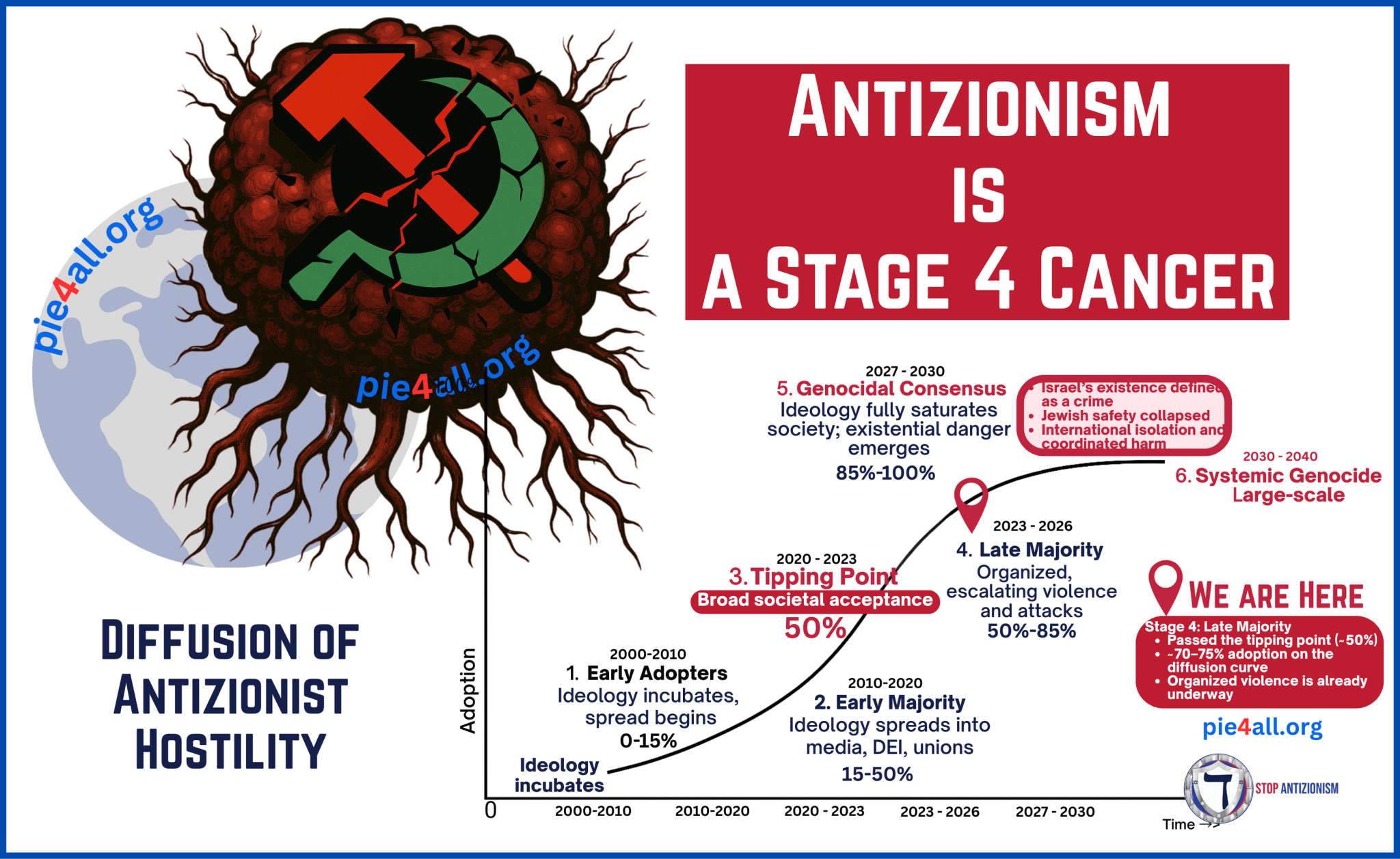
The global diffusion curve of Jew-hatred shows that this ideological cancer has reached Stage Four and is beginning to edge toward Stage Five. Understanding the stages of the Jew-hatred hostility curve is essential for grasping what comes next.
The diffusion curve describes how an ideology spreads from fringe adoption to mass acceptance and, ultimately, to dangerous societal consensus. Applied to modern Jew-hatred, particularly antizionism, this model illustrates how ideas once confined to radical academic and activist circles gradually entered mainstream institutions, public discourse, and political life.
Crucially, the diffusion curve tracks social adoption, not ideological origin. While antizionism predates the 2000s, its large-scale diffusion in Western societies began when it was reframed as a moral, anti-racist cause and embedded in universities, NGOs, media, and political movements.
Today, we are no longer in the early warning stages. We are in Stage Four: the Late Majority, where hostility has become normalized, organized, and increasingly violent. At this stage, Jews are no longer merely stigmatized rhetorically. Jews are targeted physically, politically, and institutionally, while the systems meant to protect them increasingly fail, or withdraw protection altogether. Jewish self-defence is reframed as aggression, and speaking out carries social and professional costs.
Stage Four is when the cancer no longer needs permission.
As scholars of contemporary antisemitism and antizionism, such as Dr. Naya Lekht, have noted, this stage reflects not a sudden rupture but the culmination of a long ideological evolution in which antizionism mutates and embeds itself within dominant moral frameworks.
The following five stages illustrate how Jew-hatred, particularly antizionism, diffused through Western societies in parallel with the institutional rise of DEI, moving from fringe ideology to enforced moral consensus.
- Early Adopters (2000–2010): DEI emerges in academia alongside critical power theories. Antizionism gains early traction by framing Zionism as colonial and racialized, incubating in fringe academic and NGO spaces. Hostility remains largely rhetorical.
- Early Majority (2010–2020): DEI becomes institutionalized. Antizionism is reframed as social justice and embedded in curricula, media, and NGOs, spreading into politics and public discourse. Anti-Israel framing becomes mainstream, with early intimidation.
- Tipping Point (2020–2023): DEI solidifies as the dominant moral framework. Antizionism is treated as an ethical stance, dissent is stigmatized, and Jews are reframed as oppressors. Anti-Israel hostility becomes the default position.
- Late Majority (2023–2026): DEI enforcement shapes policy and institutional responses. Antizionist hostility becomes organized and normalized, Jewish safety is systematically neglected, attacks escalate, and institutions increasingly fail to protect Jews.
- Genocidal Consensus (Projected 2027–2030): DEI-aligned frameworks shape policy, delegitimizing Jewish sovereignty and self-defense. Antizionism is enforced institutionally, Israel’s existence is widely challenged, and violence becomes collectively justified.
The UK: A Stage-Four Case Study
The United Kingdom provides a stark case study of what Stage Four antizionist cancer looks like inside a Western democracy.
Islamist ideology entered Britain through decades of immigration policy, foreign funding, and political appeasement. It then fused with progressive institutional frameworks, particularly DEI and multicultural relativism, which discouraged scrutiny under the guise of tolerance. Criticism was labelled “Islamophobia,” and Jewish concerns were frequently minimized or dismissed as mere political inconvenience.
The result is a society where:
- Jews are harassed openly in public spaces,
- Campuses and streets are dominated by intimidation,
- Speech is increasingly policed selectively,
- Citizens are questioned, arrested, or censored for expressing lawful views, and
- Jew-hatred has reached historic highs.
Many people in the UK now recognize what is happening and are trying to push back. However, this is precisely what makes Stage Four so dangerous. When the cancer controls institutions such as education, policing, media, and the civil service, the body no longer has enough healthy cells to recover.
At Stage Four, rebellion often fails not because people are wrong, but because the systems meant to protect freedom have already been captured. The UK is no longer merely at Stage Four. It is showing early signs of Stage Five, where societal breakdown accelerates, and recovery becomes increasingly unlikely.
At Stage Five, recovery is not theoretically impossible, but the margin for survival becomes dangerously thin, as too few healthy institutions remain to counter a disease that now dominates the system.
The Red–Green Alliance: The Hardest Mutation to Defeat
Western antizionism today is increasingly powered by a fusion of two forces: Islamist absolutism and progressive moral legitimacy, forming a “red–green alliance.”
This fusion is uniquely dangerous because:
- Islamist ideology can supply intimidation and absolutism.
- Progressive language can supply moral cover.
- Together, they stigmatize dissent while presenting hostility as virtue.
This is why antizionism today is more complex to confront than earlier forms of antisemitism: Antizionism does not always look hateful. It often looks righteous.
And that combination makes it lethal.
This Hanukkah: Remember How Cancers Are Defeated
This Hanukkah arrives at a moment of profound moral clarity.
Hanukkah is not just a story about miracles. It is a story about standing up for Jewish values, Jewish identity, and Jewish self-determination. It is the story of a people who refused to abandon their covenant, refused cultural erasure, and rejected imposed idol worship that demanded Jews dissolve themselves into someone else’s worldview.
The Maccabees understood that identity, dignity, and self-determination do not survive on hope alone; they survive because people are willing to stand up and defend them.
The Maccabees did not fight for abstraction or ideology. They fought for the right of the Jewish people to live as Jews in their ancestral homeland, as a nation in Judea, governed by their own laws, faith, and moral commitments. Hanukkah commemorates the defence of Jewish sovereignty, dignity, and continuity in the face of a system that sought to strip Jews of their identity while claiming moral superiority.
That struggle was not about power for its own sake. It was about the right of a people to exist on their own terms, a right antizionism still seeks to deny today.
It is also important to remember that even then, not all Jews stood with the Judeans. There were Hellenistic Jews, the token Jews, who aligned themselves with Greek–Macedonian power, embraced assimilation, and believed Judaism could survive as a purely private faith, detached from land, sovereignty, and national self-determination. They saw Jewish particularism as an obstacle to progress and imagined that acceptance would come through the separation of Judaism from peoplehood.
History proved them wrong.
Those Hellenistic Jews were not the future of the Jewish people. They were a minority, and they misjudged the danger. They believed identity could be negotiated away without consequence. The Maccabees understood what they did not: that a Judaism stripped of self-determination does not survive indefinitely; it dissolves.
Every generation has its version of this temptation. Today, we see modern echoes of the same mindset among Jews who believe that separating Judaism from Jewish sovereignty will earn moral approval and safety. The names and language change, but the logic is the same, and so is the outcome.
Jewish history did not endure because of accommodation.
It endured because there were Jews who recognized existential danger early, refused comforting illusions, and dared to defend the Jewish people as a people.
The Maccabees did not debate whether the threat was “too political.” They did not wait for consensus. They recognized a force that sought to erase Jewish identity and sovereignty, and they fought it.
Today, the threat takes a different form, but not in essence.
Antizionism is an ideology that seeks to strip Jews of the right to define themselves, to defend themselves, and to exist as a people. It does so not always with swords, but with language, institutions, and moral intimidation. And like any advanced cancer, it cannot be treated with half-measures or denial.
Some cancers are fought by starving them, by cutting off the nutrients that allow them to grow and spread. Antizionism is no different.
It thrives because it is fed by robust delivery systems: academic frameworks, institutional policies, and ideological conduits that normalize hatred while calling it virtue. Chief among these is DEI, which has functioned not merely as a bystander, but as a circulatory system, delivering antizionist ideology into schools, workplaces, governments, and cultural institutions under the banner of justice.
As long as these conduits remain intact, the cancer will continue to spread.
To fight antizionism, therefore, is not only to condemn violence after it occurs, but to remove its life support:
- Expose the ideology for what it is,
- Dismantle the systems that institutionalize it,
- Reject the moral frameworks that single out Jews as uniquely undeserving of protection.
- Declare that antizionism is Jew-hatred
Why the Declaration Matters
At Stage Four, treatment begins with diagnosis.
The world must declare what antizionism is: a modern form of Jew-hatred that endangers societies.
Antizionism’s ideological DNA is totalitarian, and thus it endangers the free world. It censors free speech, undermines democratic norms, and poses a direct threat to civic rights and pluralistic societies.
This declaration is not symbolic. It is foundational. Without naming the disease, institutions cannot reform. Laws cannot protect. Education cannot correct. Silence only accelerates the spread.
Antizionism is not only a Jewish problem. It is a civilizational one.
Cancer thrives in denial. So does antizionism.
The Jewish people have the right to exist, the right to a home, and the right to self-determination as a people in their ancestral homeland.
Stand up. Be a Maccabee.
Readers seeking a deeper understanding of the antizionist evolution, the antizionist era, and the case for defining antizionism as a modern hate movement, may consult the Global Declaration that Antizionism is Jew-Hatred, which elaborates on this framework: https://www.stopaz.org/declaration
Related Topics