
Children casualties in Gaza: Facts vs. perception
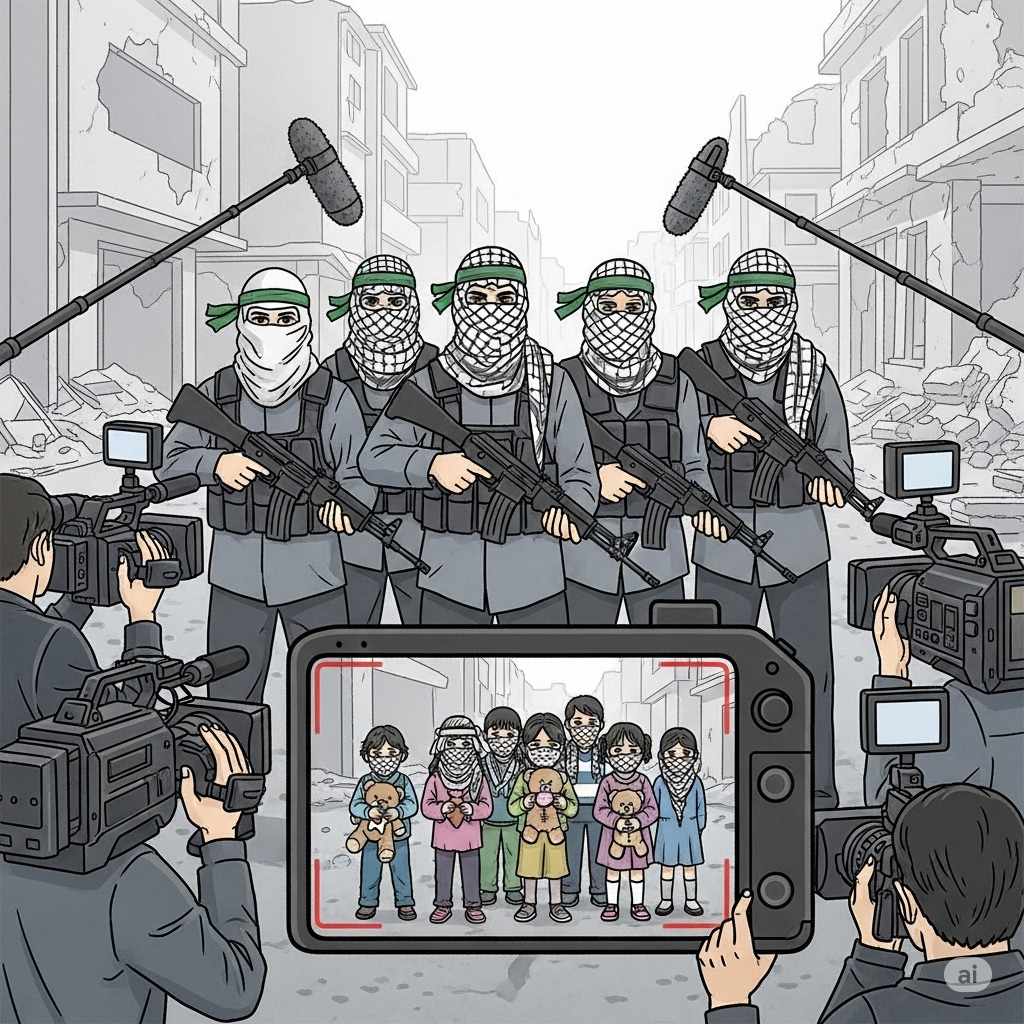
A powerful image, but is it accurate?
Since the outbreak of the war in Gaza on October 7, 2023, the image of the child victim has come to symbolize the suffering of the conflict. News reports, human rights organizations, and social media campaigns have repeatedly emphasized high child mortality, often describing Gaza as “the world’s most dangerous place to be a child.” The emotional impact of this framing is immense and has profoundly shaped global public opinion, political discourse and humanitarian priorities.
Yet emotional resonance and statistical reality are not always aligned. To understand what is really happening in Gaza, it is necessary to move beyond statements and headlines and examine the data itself. Given Gaza’s uniquely young demographic structure, where nearly half the population is under the age of 18, it is important to ask: Are children appearing in the casualty figures at rates higher than their proportion of the population would suggest? Or are they, as horrific as it is to say, proportionally represented in the casualty figures?
And if it turns out that children are not the most disproportionately affected group, then who is? Is there another segment of the population, less visible in media coverage but accounting for the highest number of fatalities, whose losses tell a different story?
These questions are not just academic. They shape how international actors evaluate the conduct of war, how journalists frame stories, and how humanitarian aid is directed. By grounding our understanding in empirics rather than perceptions or intuition, we gain a clearer, and perhaps more uncomfortable, view of of which demographics account for the majority of conflict-related deaths in Gaza.
What the data shows
To explore these questions, I analyzed age- and sex-disaggregated casualty data from the Gaza Ministry of Health, cross-referenced with population estimates from the CIA World Factbook. As of August 5, 2025, the Ministry reports 66,452 fatalities. It is important to note that this dataset does not distinguish between combatants, civilians, or those killed by Hamas’s own combat actions, which complicates the analysis of civilian harm specifically. While no dataset from an active war zone is without limitations, especially one produced by a government agency controlled by a designated terrorist organization like Hamas, this remains the most comprehensive source available and is widely cited by international media and institutions.
The method is straightforward: For each age and sex cohort, I compared their share of the total population to their share of reported fatalities. If a group is experiencing fatalities at the rate you’d expect given its size, its share of deaths should match its share of the population. If not, we have to ask why.
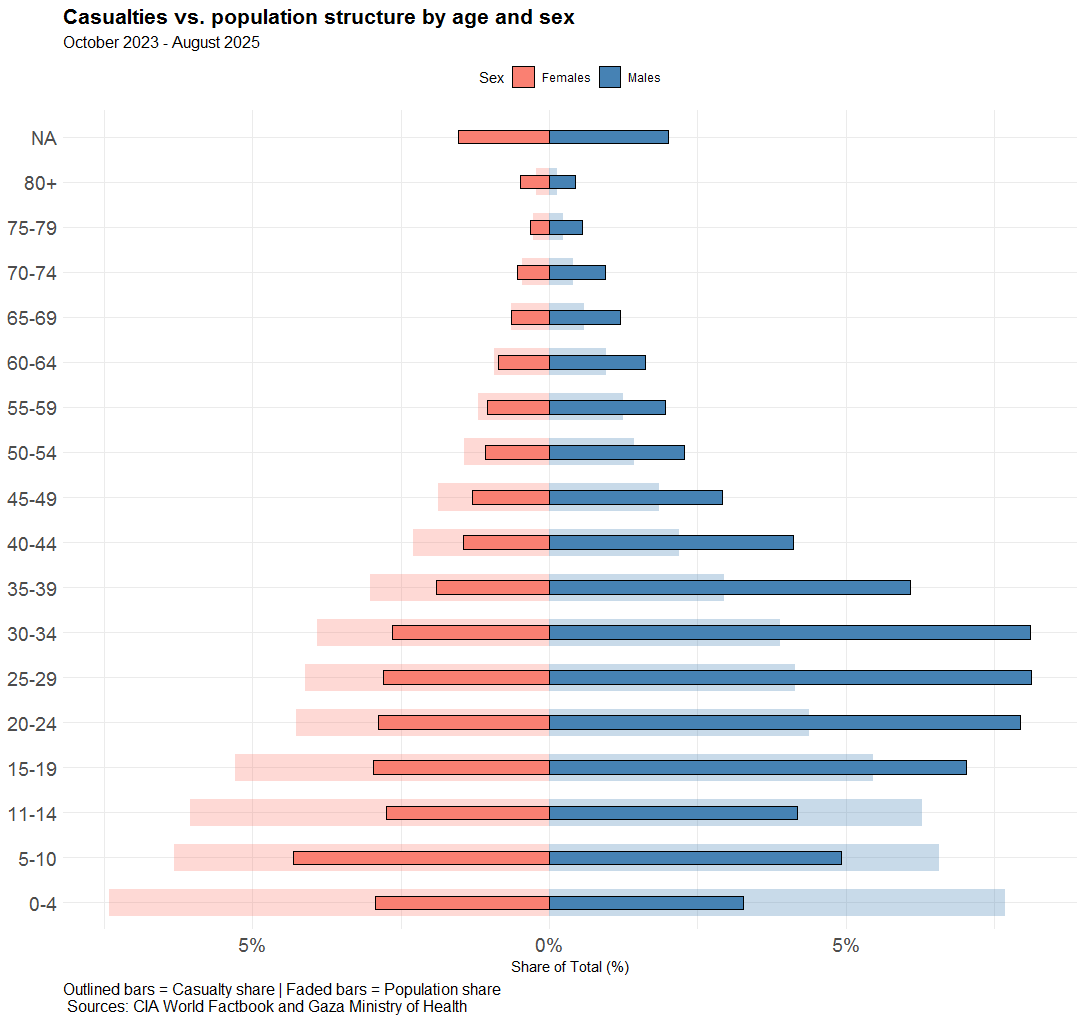
The results are striking. Children are not overrepresented among Gaza’s war dead. In fact, they are statistically less prevalent among the fatalities than one might expect based on their population size.
For girls aged 0-14, who make up nearly 40% of the female population, their share of female deaths is only about 31%. For boys aged 0-14, who account for over 40% of the male population, their share of male fatalities is just 18%. Even boys aged 0-4, often at the center of humanitarian concern, represent less than a third of the deaths we would expect based on their demographic weight.
The absolute number of child casualties is tragic. But from a statistical perspective, children are not dying at disproportionate rates. The dominant imagery of children as the primary victims of this war, while emotionally compelling, is not borne out in the data.
The most overrepresented group: military-age men
The group that is most clearly overrepresented in casualty figures is military-age males. Men aged 20-39 make up just under 25% of Gaza’s male population, but they account for almost half of male fatalities. Males aged 15-19, too, are dying at disproportionately high rates. While technically minors, in the context of Gaza, this age group includes many who are politically active, recruited by armed factions, or involved in street-level guerrilla warfare.
Taken together, as of early August 2025, males aged 15-39 account for 24,749 deaths, corresponding with 65% of all male fatalities and nearly 37% of total fatalities, despite making up just 35% of the male population and roughly 21% of the total population. This group, widely understood to be of combatant age, is overwhelmingly the one dying at the highest rates. It is also important to note that men over 39 are often active in combat roles in Gaza, particularly within paramilitary units and leadership positions. For this reason, the actual share of combatant-age male deaths is likely higher, exceeding 40%, and plausibly reaching 45% or more. This distribution is broadly consistent with the Israel Defense Forces’ estimates of the combatant-to-civilian fatality ratio in Gaza.
Among women, fatality patterns generally align more closely with population distribution. Most female age groups appear in the casualty data at rates consistent with (or lower than) their share of the population. However, older women, particularly those over 70, appear more frequently in the data than expected, likely due to increased physical vulnerability and greater difficulty evacuating during airstrikes. But the most striking deviation remains among young adult men.
Contrasting data and media narratives
It is important to note that even the official data, collected and released by Hamas’s own Ministry of Health, does not support the claim that children are disproportionately killed. Yet this claim dominates international headlines, NGO messaging, and social media content. Why?
One explanation is emotional salience. The death of a child evokes a universal response. Children symbolize innocence, and their suffering is often seen as the most incontrovertible evidence of injustice. In a media environment where attention is scarce and competition for outrage is fierce, child victims have a powerful rhetorical and visual impact.
Yet if the goal is to inform rather than inflame, accuracy is crucial. The focus on children has, unintentionally or otherwise, obscured the fact that the group dying in greatest excess is not infants, but young men.
It is unclear who is responsible for this gap between data and perception. The Hamas-controlled Ministry of Health itself publicly shares age-specific fatality lists that, when analyzed, reveal the patterns discussed above. The fact that these reports have not informed public narratives suggests either a failure of media literacy or a conscious editorial emphasis on stories that provoke the strongest emotional reaction.
Why this matters
This is not an attempt to minimize the horror of war or deny the suffering of Hamas’s population. Every death, child or adult, is a tragedy. But if public debate, humanitarian policy, and legal accountability are to be based on evidence, not only empathy, then we must understand the human impact of the conflict as it is actually occurring.
Legally, international humanitarian law requires that harm to civilians not be excessive in relation to military necessity. A casualty profile dominated by military-age males rather than children raises questions about claims that children are being deliberately or disproportionately targeted. It also bears directly on legal evaluations of proportionality and the conduct of hostilities under international humanitarian law.
Humanitarian organizations have a responsibility to uphold truth and impartiality, even in emotionally charged contexts. When they promote narratives that contradict the available evidence, such as portraying children as the primary victims despite data to the contrary, they risk abandoning their core ethical commitments. This politicization of humanitarian messaging not only undermines their own credibility but also endangers the integrity of the broader humanitarian sector. As public scrutiny grows, organizations seen as distorting facts for political ends may face a crisis of legitimacy, weakening both their moral authority and their capacity to operate effectively.
Finally, for the public: no democracy can make sound decisions when it is led by emotionally charged narratives instead of hard evidence. The claim that children are the primary victims in Gaza has been widely accepted, not because it is accurate, but because it has been relentlessly promoted by actors with a political agenda. When public perception is shaped by selective storytelling rather than comprehensive data, advocacy and policy risk becoming tools of manipulation. If we want action rooted in truth rather than propaganda, we must be willing to challenge even the most entrenched beliefs.
The deaths of children are always heartbreaking. But they do not define the statistical reality of this war.
This matters for justice, for truth, and for the possibility of peace. If the world hopes to act meaningfully in the face of tragedy, it must begin with a clear grasp of reality, not just a reaction to its most heartbreaking images.