
Executive Director, Center for Advanced Military Science (CAMS)
Evidence‑Based Peace Approach for Israel
An Intriguing Look into the Future of Military Defense

By Dr. David Leffler
The Limits of Conventional Peacebuilding
For decades, Israel has faced persistent intrastate and interstate violence, including regional conflicts, cross-border hostilities, terrorism, civil unrest, and cycles of retaliation. Despite extensive reliance on diplomacy, military deterrence, intelligence operations, and international mediation, these strategies often provide only temporary relief. The deeper causes of conflict remain unresolved, allowing tensions to resurface.
A growing body of scientific research points to a new paradigm for peace: reducing societal stress through collective consciousness‑based practices. At the heart of this approach is Invincible Defense Technology (IDT), a non‑lethal and scientifically validated method designed to neutralize violence at its source.
Invincible Defense Technology: A Name That Defines Its Mission
Invincible conveys the idea of being impossible to defeat or overcome. This captures the essence of IDT’s aim: fostering such deep societal harmony that former adversaries transform into allies, removing the desire to attack altogether.
Defense signifies protection from harm or aggression. IDT is not a reactive measure but a proactive approach. It shields nations by preventing conflict before it can arise.
Technology refers to the systematic application of knowledge and tools. In the case of IDT, this brain‑based “technology” is the structured use of the Transcendental Meditation program and the advanced TM‑Sidhi program. Large group practice of these consciousness‑based techniques reduces individual and collective societal stress, which is the underlying driver of war, terrorism, and crime, thereby promoting peace and stability.
In short, IDT represents a disciplined, consciousness‑driven strategy that strengthens nations against conventional threats and makes the very occurrence of war far less likely.
IDT operates through the Maharishi Effect, a phenomenon observed when large groups practice Transcendental Meditation® (TM) and the TM‑Sidhi® program together. Studies show that once a group reaches a critical threshold in size, the resulting coherence in collective consciousness produces measurable reductions in violence, crime, and social unrest. In essence, it demonstrates that cultivating inner peace on a large scale can generate outer peace across entire populations.
The Maharishi Effect: Recent Evidence
The most recent demonstration of IDT occurred during the Assembly of 10,000 for World Peace in India (December 2023–January 2024). During this period, a large civilian group practiced the Transcendental Meditation (TM) and TM–Sidhi program twice a day collectively.
Analysis of political violence data from the Armed Conflict and Location Event Data (ACLED) project revealed a statistically significant reduction (p < 0.001) in violent events across Palestine, Myanmar, and Syria—the world’s most unstable regions at the time. [“Quantification of the Global Maharishi Effect: A Quasi-Experimental Study of the Three Most Violent Countries in the World” by Kenneth L. Cavanaugh, Lee Fergusson] This quasi-experimental study provides compelling evidence that large-scale group meditation can measurably reduce violence.
Supporting Evidence from Past Studies
The India demonstration builds on decades of empirical peer-reviewed research. Here are some selected studies:
- Jerusalem Experiment (1983): Published in the Journal of Conflict Resolution, researchers found that increases in group TM-Sidhi practice correlated with statistically significant reductions in war-related fatalities, crime, and traffic accidents. Time-series analyses ruled out alternative explanations, confirming a causal link between meditation practice and improved societal outcomes.
TM-Sidhi Group Size Vs. Quality of Life in Israel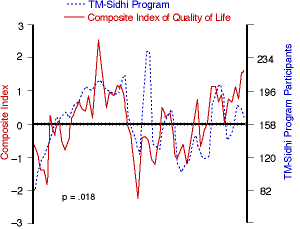
The figure above illustrates a highly statistically significant correlation between the number of participants in an IDT assembly and a composite index measuring progress toward peace and quality-of-life in Israel during August and September of 1983. When the number of participants rose, the intensity of the war in Lebanon decreased (p less than 10-7). - Global Terrorism and Conflict Study (1983–1985): During three large assemblies lasting 8–11 days, researchers tested whether group TM-Sidhi practice could reduce terrorism and international conflict. Time-series analyses revealed a 72% reduction in terrorism and an average 32% decrease in international conflict, with strong statistical significance. These results mirrored smaller-scale studies and suggested that sustained implementation of such groups could have a major global impact. Journal of Offender Rehabilitation.
- Washington, D.C. Demonstration (1993): Violent crime fell by 23.3% during a large-scale TM-Sidhi intervention. Independent researchers validated the findings, controlling for seasonal variations and external factors. Social Indicators Research.
- Longitudinal Study (2021): A 17-year study published in the World Journal of Social Science showed that sustained group practice of the TM-Sidhi program was associated with significant decreases in urban crime rates and social unrest.
- Health Outcomes (2023): Correlations between group meditation and reductions in drug-related mortality suggested that IDT’s benefits extend beyond violence prevention to broader public health improvements. Medicina.
Dozens of peer-reviewed studies confirm consistent reductions in crime, terrorism, and armed conflict when sufficient numbers of practitioners engage in group meditation. These findings have been replicated across cultures and contexts, underscoring the robustness of the Maharishi Effect.
Military Applications of IDT
Israel’s security environment—marked by asymmetric threats, regional instability, and ongoing tensions—makes the exploration of innovative, non‑lethal defense strategies especially relevant. Military organizations worldwide, as well as civilian groups, have already explored the use of IDT, recognizing its value as part of a “prevention wing of the military.” [See also: “The peace and well-being of nations: An analysis of improved quality of life and enhanced economic performance through the Maharishi Effect in New Zealand, Norway, USA, Cambodia, and Mozambique.”]
The IDT approach is currently in the early stages of global deployment, though many initiatives are not yet fully operational; see “New Solutions for Latin America: Transforming Lives and Changing Nations.” Across multiple countries, large numbers of personnel from different branches have been trained in IDT. Reports highlight measurable benefits, including improved performance, reduced stress, and heightened readiness. Elite security forces incorporated IDT training in preparation for a major international event, employing it as a tool to deter terrorism and enhance operational effectiveness. Defense institutions have also initiated pilot programs, with evidence pointing to reductions in violence and greater societal stability.
For Israel, with defense forces focused on readiness, innovation, and rapid adaptation, IDT adds a complementary non‑lethal capability that supports national security and addresses conflict at its psychological and societal roots.
Toward Invincible Defense
The implications are profound. By establishing permanent groups of trained practitioners within the military, Israel could create a shield of coherence that prevents violence before it erupts. Unlike conventional defense systems, IDT does not rely on weapons or deterrence. Instead, it addresses the root causes of conflict by reducing societal stress and tension through consciousness‑based practices.
The promise of IDT is both radical and practical: a defense system that is non‑lethal, cost‑effective, and sustainable. The evidence from India and decades of prior studies make one point clear: lasting peace is achievable when nations harness the power of coherent collective consciousness.
_____________________________________
Spotlight: Invincible Defense Technology Presented at the United Nations
The event drew an audience of approximately 500 diplomats, UN staff members, and representatives from international meditation organizations. The keynote address, titled “World Peace Through Inner Peace: An Evidence-Based Approach,” was delivered by Harvard-trained quantum physicist John Hagelin, PhD, who serves as the international president of the Global Union of Scientists for Peace (GUSP). Watch highlights (27 min) For a deeper exploration of the physics behind IDT, you can view Dr. Hagelin’s online presentation, “Important Message for the Military,” which includes a full transcript and high‑resolution visuals.
About the Author:

Dr. David Leffler has a Ph.D. in Consciousness-Based Military Defense and has served as an Associate of the Proteus Management Group at the Center for Strategic Leadership, US Army War College. Currently, he serves as the Executive Director at the Center for Advanced Military Science (CAMS) and lectures and writes worldwide about IDT. Dr. Leffler’s editorial “Creating an Invincible Military” was published by Real Clear Defense and later featured in Fox News.
Related Topics