Bridging faith. Defending truth. Confronting hate
How Khomeini Turned Shiʿi Eschatology into a Revolutionary Antisemitic Ideology
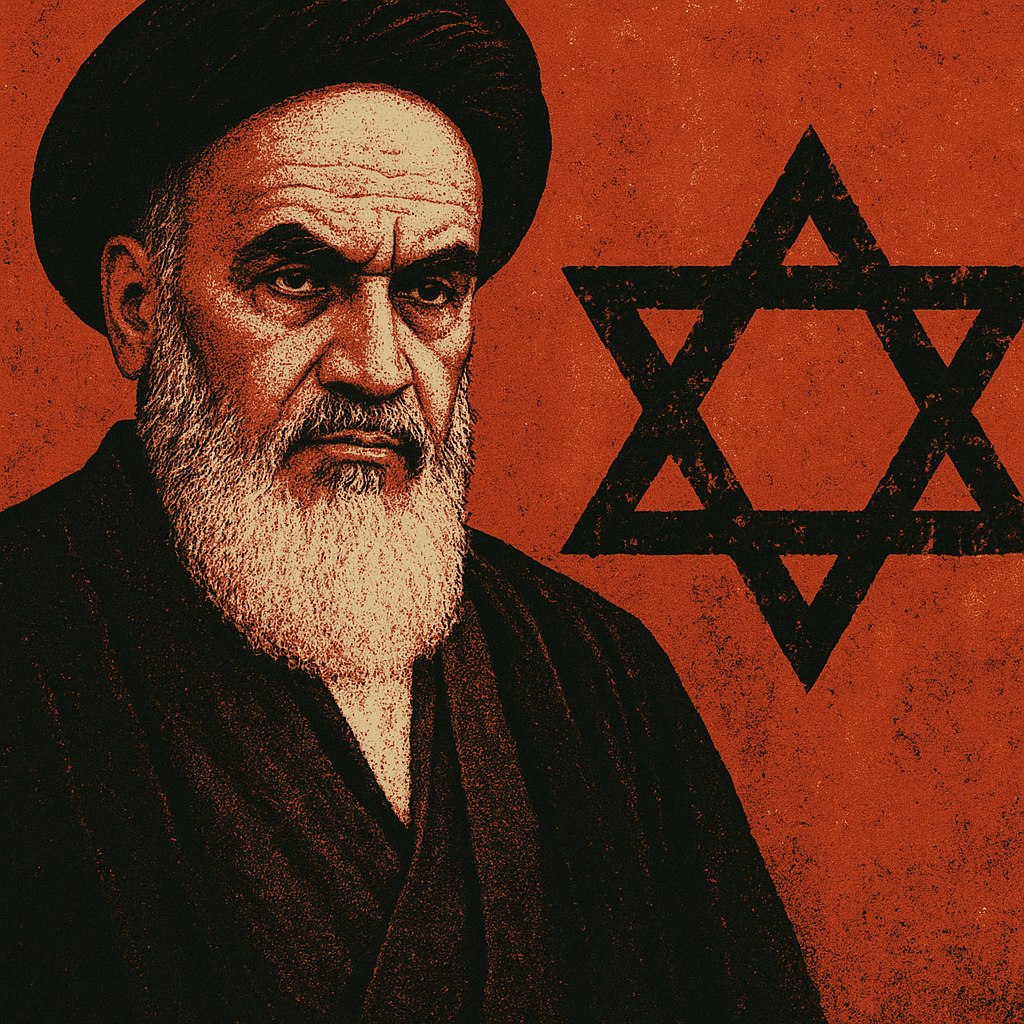
Illustration generated with AI, courtesy of the author
In 1942, a relatively unknown cleric named Ruhollah Khomeini published Kashf al-Asrar (Unveiling of Secrets), a polemic against secularizing reforms and a defense of clerical authority. In it, he blamed Jews, along with Freemasons and Western influences, for corrupting Muslim society and plotting against Islam, portraying them as part of a broader conspiracy to weaken the faith. This was not simply theological polemic but an ideologically charged argument that echoed European antisemitic tropes circulating in Iran at the time. By depicting Jews as perennial conspirators, Khomeini revealed a theme that would later become central to his revolutionary doctrine.
When Khomeini seized power in 1979, this hostility became state ideology. Israel was labeled the “Little Satan,” America the “Great Satan,” and Jews were cast as symbols of arrogance and global domination. This represented a major departure from the older Shiʿi tradition, which, though not free from prejudice, had not centered its theology on Jews as cosmic enemies. As a Christian Zionist, I see this not as a side current but as a defining distortion of faith. The transformation of Shiʿi messianism into a revolutionary antisemitic worldview has been one of the most consequential religious-political shifts of the modern era.
Before Khomeini: Shiʿi Messianism Without Antisemitism
For centuries, Shiʿi Islam was not defined by antisemitism in the way we understand it today. Its core concern was the martyrdom of Husayn at Karbala, the persecution of the Imams, and the promise of the Mahdi’s return. Injustice was universal, usually associated with illegitimate rulers such as the Umayyads and Abbasids. Jews, like Christians and Zoroastrians, lived under restrictions as dhimmis but were not cast as the central enemy of God’s plan.
Classical Shiʿi jurists like al-Mufid, al-Tusi, and al-Hilli upheld a largely quietist tradition. Since the true Imam was hidden, believers were expected to endure, to cultivate piety, and to await divine intervention. The Mahdi’s return was a supernatural event, not something human action could hasten. Theological critiques of Jews did exist, but they were peripheral. They did not place Jews at the heart of the cosmic struggle.
That changed in the modern period. European antisemitism, conspiracy theories about Jewish global domination, disseminated through texts like The Protocols of the Elders of Zion, entered Iran in the early twentieth century. Nazi propaganda later reinforced the trope of the Jew as a hidden hand manipulating both capitalism and communism. When combined with Shiʿi notions of oppression, these imported myths gave later revolutionaries a ready-made enemy.
Imported Hatred: Antisemitism in Modern Iran
By the mid-twentieth century, antisemitic literature was circulating widely in Iran. The Protocols was translated into Persian in the 1920s. Radio Berlin broadcast Nazi propaganda into the Middle East in the 1930s and 40s. Pamphlets and sermons began to portray Jews as both exploiters and corrupters, responsible for imperialism and materialism alike.
The creation of Israel in 1948 gave these suspicions a target. Instead of being recognized as the national liberation of the Jewish people, Zionism was framed as proof of a global Jewish plot. This new language made antisemitism not just religious prejudice but a political worldview. Jews became the face of modern oppression.
This prepared the ground for Khomeini. When he rose to prominence in the 1960s, he absorbed these conspiracy theories and fused them with Shiʿi eschatology. For him, Jews and Zionists were not just political adversaries. They were the embodiment of cosmic tyranny that the Mahdi himself was destined to destroy.
Khomeini’s Innovation: Messianism Becomes Revolutionary
The most radical break came in Khomeini’s 1970 lectures on Velayat-e Faqih (“Guardianship of the Jurist”). He argued that clerics must rule in the Mahdi’s absence, overturning centuries of quietist teaching. Waiting patiently was no longer sufficient. Muslims had a duty to resist oppression and establish Islamic government now.
Oppression, in his worldview, had concrete faces. The “arrogant powers” — shorthand for the United States and Israel — were cast as the ultimate enemies of Islam. Khomeini described Israel as a “cancerous tumor” and accused “world-devouring Jews” of controlling global finance and politics. In this narrative, Jews were not simply a religious minority. They were recast as metaphysical adversaries, inheritors of Yazid, the tyrant of Karbala.
This was a dramatic departure from Shiʿi tradition. The Mahdi’s role had always been to bring justice universally. Khomeini narrowed that mission and turned it into a political script. By identifying Zionism as the archetype of oppression, he transformed Shiʿi messianism into a revolutionary ideology centered on antisemitism.
Revolutionary Messianism: Sachedina’s Insight
Abdulaziz Sachedina, a scholar, has called this change the start of “revolutionary messianism.” For hundreds of years, Shi’i eschatology has focused on God’s timing. It would be God’s hour, not man’s, when the Mahdi came back. People who believed were told to be patient, not to speed up history. Khomeini broke this framework by saying that clerics could and should act in the Mahdi’s place.
Once this premise was accepted, antisemitism was easily integrated. Jews and Zionists, already vilified by modern conspiracy theories, became symbols of what must be resisted. To oppose them was no longer a matter of politics. It was obedience to God. Sachedina shows how this innovation fused messianic hope with revolutionary struggle, producing an ideology that made antisemitism into sacred duty.
This was unprecedented in Shiʿi history. Hatred of Jews was no longer a cultural prejudice or political stance. It became eschatological — a way to participate in the Mahdi’s cosmic battle before his return.
The Turban for the Crown: Arjomand’s Analysis
Amir Arjomand contends in The Turban for the Crown that the Iranian Revolution exemplified not merely theology dominating politics, but rather politics exploiting theology. Revolutionary leaders reinterpreted religious doctrines to support their political agenda, portraying clerical rule as a temporary guardianship in the Mahdi’s absence. By doing this, Khomeini and his supporters made their power seem like it came from God. The turban took the place of the crown, and the clerical establishment said they had the right to rule in the name of the Hidden Imam.
But a revolution infused with messianic language cannot survive without enemies. To maintain fervor, it must point to constant threats. Antisemitism served this function perfectly. Israel was demonized as a colonial implant, a cancer to be cut out. Jews were portrayed as eternal corrupters. By externalizing blame, the regime justified both its repression at home and its expansionism abroad.
Arjomand’s insight is crucial. Antisemitism in the Islamic Republic is not accidental rhetoric. It is functional. It sustains the revolution’s self-image as a sacred struggle. Without a cosmic Jewish enemy, the ideology loses coherence.
Institutionalizing Hatred: Khamenei and Ahmadinejad
Khomeini’s successors entrenched this worldview. Supreme Leader Ali Khamenei has repeatedly referred to Israel as a “cancerous tumor” and a “filthy entity” destined for eradication. In 2014 he called Israel a “rabid dog of the region.” He has described the Holocaust as a myth used to justify Jewish domination. These are not stray insults. They are the continuation of a theological-political doctrine.
This became a global issue because Mahmoud Ahmadinejad was president from 2005 to 2013. He said, quoting Khomeini, that the “regime occupying Jerusalem must vanish from the page of time.” Most people understood this to mean that Israel should be destroyed. He called the Holocaust “a myth” and held meetings around the world for people who deny it. He even invited neo-Nazis to Tehran. These actions made it clear that antisemitism was now a government policy and not just a personal bias.
Such rhetoric institutionalizes hatred. It filters down through textbooks, sermons, and media. It spreads outward through Iran’s proxies, shaping movements like Hezbollah and Hamas. It is not an occasional outburst. It is systemic.
Zionism and the Revolutionary Narrative
Here lies the irony. Zionism is not imperialism. It is the national liberation movement of the Jewish people, who returned to their ancestral homeland after centuries of exile, pogroms, and genocide. It is survival, not domination.
But for the Islamic Republic, Zionism must be portrayed as illegitimate. To accept Jewish self-determination would unravel the entire revolutionary theology. If Jews are not the cosmic oppressors, then Iran’s struggle loses its sacred meaning. If Israel is not a cancer but a nation reborn, then the revolution’s messianic narrative collapses.
That is why Tehran cannot limit itself to criticizing Israeli policies. It must delegitimize Israel’s very existence. It must demonize Jews themselves. Antisemitism is not incidental. It is indispensable to the revolutionary story.
Why It Matters
This matters for three reasons. First, it has reshaped Shiʿi Islam. By fusing messianism with antisemitism, Khomeini distorted a theology of universal justice into a program of sectarian hatred. Second, it has destabilized the region. Iran spreads this idea through Hezbollah, Hamas, and other groups, making sure that antisemitism stays a powerful force. Third, it has effects all over the world. There are not fringe groups that hold Holocaust denial conferences in Tehran or talk against Zionism at the UN. They are the results of a state religion.
This means that policymakers and scholars can’t only look at Iran’s hostility toward Israel from a geopolitical point of view. It is religious. The regime’s DNA includes it. To face it, we need more than diplomacy. It necessitates acknowledging the profound sanctification of antisemitism.
Related Topics
Related Posts