Senior Rabbi at Temple Sholom, Vancouver BC Canada
Lift Up Your Heads – Naso & Jewish Pride
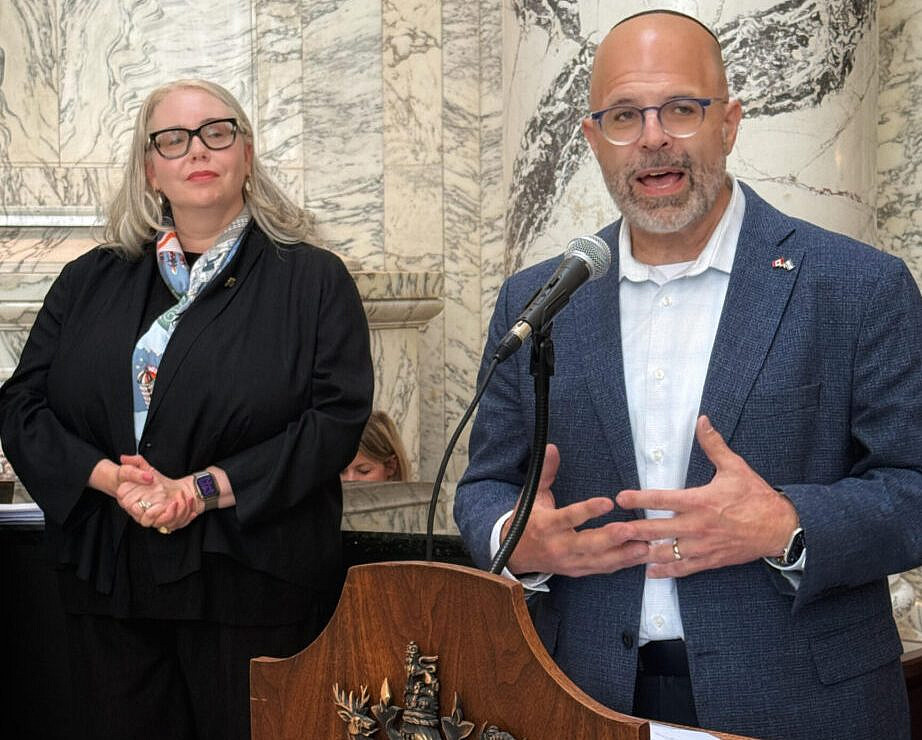
B.C. Solicitor General Nina Krieger and Rabbi Dan Moskovitz, marking Jewish Heritage Month for the first time at the B.C. Legislature, May 27, 2026. (Credit: Jaime Stein)
This past week, I stood in the Legislative Assembly of British Columbia for the first public celebration of Jewish Heritage Month ever held in our provincial capital.
That sentence matters because the key word is celebration.
For years, Jewish communal engagement with government has necessarily focused on antisemitism, Holocaust remembrance, security, and, since October 7, the fear and vulnerability Jews feel in Canada and around the world. Those conversations matter. The security guards outside our synagogues and schools are not decoration. The anxiety parents feel when their children go to campus or walk down the street wearing a Magen David is not paranoia. Jewish fear is real. Jewish vulnerability is real. Our indignation is righteous.
But fear cannot be the whole story of Jewish life.
Fear can protect a community, but it cannot nourish a soul. Security can guard a building, but it cannot make that building holy. Indignation can wake us up, but it cannot be the only thing that gets us to our feet.
That is why Jewish Heritage Month matters.
In 2018, the Parliament of Canada unanimously passed the Canadian Jewish Heritage Month Act, recognizing the contributions Jewish Canadians have made to this country’s social, economic, political, and cultural life. Yet until now, British Columbia had never formally celebrated it in the provincial capital.
We have gathered there many times in grief. For Yom HaShoah. For International Holocaust Remembrance Day. Since October 7, public officials have stood with us to mourn, condemn, and remember. All of that is necessary.
But it does not define us.
The historian and author Dara Horn insightfully titled her award winning book People Love Dead Jews. The title lands with a painful force because the world often seems more comfortable mourning Jewish deaths than celebrating Jewish life. Jews are invited to be symbols of tragedy more readily than partners in joy, culture, creativity, faith, and moral imagination.
So this past week, the Jews of British Columbia Canada insisted on celebration.
To our august provincial capital we brought Jewish music, Jewish food, Jewish leaders, Jewish pride, and Jewish joy into the heart of Canadian civic life. We gathered not only to say that Jews must be protected, but that Jews must be seen. Not only as a vulnerable minority, but as a living, breathing, contributing, creating, blessing people.
That idea is rooted deeply in this week’s Torah portion, Naso.
Naso is the longest portion in the Torah. It is filled with census lists, ritual instructions, anxiety, order, and structure. Then, in the middle of all that complexity, the Torah gives us one of Judaism’s most ancient and beloved blessings:
May God bless you and keep you.
May God’s face shine upon you and be gracious to you.
May God lift up God’s face toward you and grant you peace.
This blessing appears in the wilderness. The Israelites are not settled. They are not safe. They are not home. They are still figuring out how to travel together, how to organize themselves, and how to carry fear without allowing fear to become their identity.
That feels close to where Jews are right now in Canada and around the world, we are in the wilderness, navigating uncertainty.
The word Naso means “lift up.” At the beginning of the portion, when the Israelites are counted, the Hebrew does not simply say “count them.” It says, in effect, “lift up their heads.” Count them by raising them up. See them. Recognize them. Let each person know they matter.
That is what Jews have done in Canada. We have helped lift up this country, to say nothing of our greater impact on the advancement of human society.
The Jewish people are tiny. There are about fifteen million Jews in the world, fewer than four hundred thousand in Canada, barely one percent of this country. And yet, for more than 3,500 years, and throughout Canadian history, Jewish contributions have far out paced our percentage of the population.
The Hebrew Bible and the prophetic call for justice and human dignity. The revolutionary idea of a weekly day of rest, a sacred rhythm that helped inspire labour protections. A deep commitment to education, debate, charity, community responsibility, and tikkun olam, repairing the world.
Those are Jewish concepts, originating from ancient Jewish teachings, practiced now, but civilized societies as universal human values. They are the very things free nations are built to protect and defend.
Here in British Columbia and across Canada, Jewish life has helped shape the civic and cultural fabric of this country. David Oppenheimer, Vancouver’s second mayor, helped transform a frontier town into a modern city. Leonard Cohen brought Jewish spirituality, biblical imagination, brokenness, longing, and profound humanity into music and literature that touched millions around the world. Cornelia Hahn Oberlander, a founding member of my congregation, Temple Sholom, helped shape some of Canada’s most iconic public spaces and changed the way Canadians experience the relationship between nature and civic life.
But the Jewish contribution to Canada cannot be told only through famous names.
It is also the story of immigrants who arrived with almost nothing, fleeing pogroms, poverty, antisemitism, and closed doors in Europe. Many became peddlers, shopkeepers, tailors, factory workers, and garment workers. They worked long hours in hard conditions and brought with them a fierce commitment to labour rights, education, mutual aid, and human dignity.
Their children became us. Or our parents. Or our grandparents.
And not only through the lens of history. Here in Vancouver, at the height of the many modern refugee crises (Cambodia, Vietnam, the Balkans, Syria, Ukraine) My congregation and the broader Jewish community helped welcome hundreds, maybe thousands of families displaced and traumatized by those conflicts. Not because they were Jews, some were but most weren’t, but because all we human beings and our Torah demands, 36 times, more than any other commandment to “Love the stranger”. These open-hearted and open-minded Jews were not famous people trying to make history. They were members of the National Council of Jewish Women, they were volunteers at Jewish Family Services, they were members of congregations, many descendants of immigrants themselves. They saw their own story in those who are in some cultural/religious ways not like us, but who are exactly like us in so many ways and as Jews they could not stand idly by. So we said: we will help. We will receive them. We will make room. We will be family where family has been destroyed.
That is Jewish-Canadian heritage too. It is not an exaggeration to say that the whole of the Canadian refugee process (for better and for worse) has grown out of late blooming Canadian guilt for what it didn’t do for the Jews of Europe, when the official Canadian response to our cry for help was, “none is too many.”
Ordinary people doing extraordinary things because Jewish tradition taught them that when someone is hungry, you feed them. When someone is vulnerable, you protect them. When someone is alone, you draw them close. When the world breaks, you do what you can to repair it.
That is what Jews have brought to Canada.
And that is why the hatred of Jews is such a moral and intellectual failure.
Anyone who argues that the world needs fewer Jews, less Judaism, less Jewish visibility, less Jewish confidence, or less Jewish life is simply a bigot. They are intentionally blind to the blessings Jews have given the world. They are so consumed by hatred that they cannot recognize blessing when it is standing right in front of them.
To hate Jews is to despise a people who gave the world the Sabbath, and with it the radical idea that human beings are more than what they produce.
To hate Jews is to despise a people who taught that every human being is created b’tzelem Elohim, in the image of God.
To hate Jews is to despise a people who insisted that kings are accountable, that the poor cannot be forgotten, that the stranger must be protected, that memory must become responsibility, and that hope is a discipline.
We are not perfect. No people is. There is no such thing as a saint in Judaism. The closest we get is being a mensch, and some of us are still working on that, and some Jewish extremists have stopped even trying (shame!). But the vast majority of Jews I know inspire me. They should inspire the world.
For more than 3,000 years, the world has tried to rip these gifts from us, body and soul. Yet we are still standing. Still carrying them. Still holding them high.
So Canadian Jews, lift up your heads.
Hold your heads high with pride in who we are, what we do, and what we stand for.
Hold your heads high because Jewish life is a blessing TO Canada.
Hold your heads high because Judaism has something urgent and beautiful to teach a world that is angry, lonely, divided, and morally confused.
The answer to antisemitism is more Jewish life. More Shabbat tables. More Jewish learning. More children singing Hebrew songs. More teenagers going to camp and Israel. More tzedakah. More courage. More kindness. More Torah. More Jewish joy.
May God bless us and keep us.
May God’s face shine upon us.
May God lift up God’s face toward us and grant us peace.
A peace strong enough to hold our fear and our pride together.
A peace deep enough to let us lift up our heads, hold them high, and live as Jews with courage, gratitude, pride, and joy.
L’chaim. To life.
Based on a sermon delivered by Rabbi Dan Moskovitz, at Temple Sholom, Vancouver BC Canada May 29, 2026
Related Topics
Related Posts