Never Again Is Now: From Struggle to Promise
The Jewish people are a beacon of strength and resilience, a symbol of what is possible when eternal victimhood is rejected in favour of innovation and accomplishment. That is why it is so saddening to declare that antisemitism in Canada and around the world is on the rise — Jews currently are, in effect, victims. I thought we had beat the baseless hatred that has chased my people down for millennia. We established a free and democratic society, where Jews along with all groups have an equal opportunity to succeed and to thrive. The liberal values that uphold our society stand in proud defiance of the modern disaster that was the Holocaust; they are the embodiment of the covenant to never repeat this tragedy — the sentiment of “never again”. The sharp increase in antisemitic rhetoric and hate crimes raises concerns that this commitment may be falling flat, and questions whether the call of “never again” can actually follow through on its promise. In order to determine its role in the fight against antisemitism, its historical and present-day popularizations must be investigated and critiqued, allowing us to ascertain how it ought to be used moving forward.
The most appropriate way to establish the contextual meaning of “never again” is to look at its origin. Although it started as the slogan of those liberated from Buchenwald concentration camp and later platformed in a 1960 documentary of Nazi atrocities called “Mein Kampf”, it was not until 1971 that the phrase became tied to Jewish liberation in the public consciousness. That year, the infamous Betar youth activist and founder of the JDL terrorist group Meir Kahane published a book titled “Never Again! A Program for Survival”. His inspiration was his own organization’s slogan, derived from Yitzhak Lamdan’s 1926 poem “Masada”, where its influence on Betar’s anthem with the line “never shall Masada fall again!” instituted Kahane’s pledge that Jews shall violently fight against any perceived enemies in refusal of victimization.
The application of this phrase did hearken back to the Holocaust, but it did not entail the prevention of future ones more than it entailed a thirst for Jewish supremacy and control. The phrase ended up evolving to be much more moderate, while still highlighting the necessity of Jewish liberty and independence. It is now prominent in major Holocaust awareness and prevention efforts including the International Holocaust Remembrance Association’s (IHRA) working definition of antisemitism, the March of the Living, and the Yad Vashem Holocaust Remembrance Centre.
This history emphasizes that “never again” has always had intrinsic Jewish significance; it was created by Jews, built upon Jewish history, popularized by Jews, consistently claimed by Jews over decades, and fundamental to the Jewish state’s national identity. The phrase’s etymology is vital in establishing that it only has two practical meanings — the sum of its parts is either equal to or greater than the whole. Equal would be taking it verbatim, in which case it has no deeper meaning than the words that it’s composed of, and it’s not special to anyone or anything. But greater entails that its Jewish significance is itself the remarkability of the phrase, and therefore that the Jewish story holds the unambiguous right to claim this phrase within its narrative.
There are three broad categories in which “never again” is used in public messaging today. They will be referred to as the Gen-Zionist perspective, the anti-Zionist perspective, and the universal perspective. Each portrays one of the two meanings that were outlined, however they are all contingent on the phrase’s Jewish significance, indicating a profound connection between the two that cannot be emulated elsewhere.
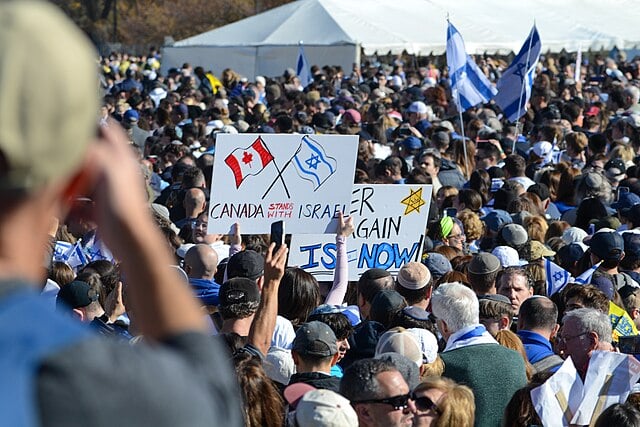
The Gen-Zionist perspective reflects the overwhelming contemporary use of “never again” by Zionist Jews and allies in the wake of October 7th, 2023. This title is inspired by Eylon Levy, the famed government spokesperson turned influencer who is on a mission to turn Gen Z into “Gen-Zionist”. The likes of Levy use their social media platforms in part to comment on instances of antisemitism both in the Diaspora and in the context of the war, doing so by frequently exclaiming that “never again is now”. As antisemitic attacks increased following the October 7th attacks, so too did the insistence from both ordinary civilians and Israeli governing bodies that the time to solidify the promise to never repeat the Holocaust is now. This campaign evokes urgency and unity in those that hold the Gen-Zionist perspective, highlighting the heart wrenching parallels between the massacres of October 7th and the ways in which the Nazis destroyed European Jewry — burning, prolonged torture, humiliation, dehumanization. The strong connection between these two events motivates those that it resonates with to advocate for change in the treatment of Jews.
This collective intergenerational trauma in descendants of Holocaust victims also calls back to the decisions of Jews who lived through the rise in antisemitism of 1930s Europe, and either disregarded the hatred as a phase, or escaped. This triggers a sense of togetherness for Jews which no one else can understand. This use of Holocaust memory is thus a proactive tool used by Jews to protect themselves from similar instances in the present and future, largely through educational movements that seek to create allyship between Zionist Jews and greater society. “Never again” is thus being used as an extension of its Jewish significance, making Holocaust awareness a perspective that is only given its true and complete justice by Jews.
The anti-Zionist category of “never again” usage simultaneously attacks and legitimizes the Jewish right to this phrase. The Venn diagram between expressions of antisemitism and anti-Zionism is almost a circle, and a significant portion of that is attributed to Holocaust inversion: the claim that Jews are doing to Palestinians what the Nazis had done to them. This includes flipping the connotation of “never again” to be an accusation against the actions of the Jewish state, but this becomes much more complex when anti-Zionist Jews partake in that. They assert that it is their Jewish heritage that permits them to use the phrase as denouncement of the Jewish right to self determination in their ancestral homeland, and to reject the so-called genocide that Israel is committing in the Palestinian territories. The falsities that groups akin to Independent Jewish Voices spread about Israel are reinforced when these Jews use their connection to the Holocaust to be the authoritative voice of the anti-Zionist perspective on the subject. Even these Jews acknowledge that its Jewishness is what makes the phrase special, yet support the side that, if they had their way, would do the exact opposite of “never again”. When the Jewish experience is twisted in this way, it shows that the phrase remains undeniably belonging to Jewish people.
American gun control advocacy has excruciatingly little in common with Holocaust awareness, yet for almost seven years the international Holocaust remembrance movement shares its rallying cry with a movement that is not and has not ever been relevant to any of its core concerns, and all by pure coincidence. Never Again MSD is a political action committee started by survivors of the Marjory Stoneman Douglas High School shooting in 2018 to influence legislation for stricter gun regulations. It began as a succinct social media post that concluded with the hashtag #neveragain with no affiliation to anything Holocaust related, and rapidly grew as an online and protest operation. This is exemplary of the verbatim meaning of the phrase used by the universalist perspective, which weakens its meaning over time as a result of detachment from its unique Jewish significance. When those who use it do not hold the view that this phrase has inherent Jewish significance, it perpetually spreads so thin that it becomes synonymous with “bad things should not happen”. In 2015, the European Union Foreign Policy Chief used the phrase when discussing the importance of protecting migrants after repeated boat sinkings, exclaiming that “We have said too many times “never again”. Now is time for the European Union as such to tackle these tragedies without delay”.
This distance from Jewish significance of the phrase can be true at the same time that the proudly Gen-Zionist side and the controversial anti-Zionist side use the Jewish significance, because the universalist is a stand-in for the average person, who is not especially educated on the conflict or the Holocaust. That average person makes up the majority of the world, and people with influence, especially political figures, gain more influence when their platform is resonant and generalizable to wider audiences. The deviation from honouring its innate Jewish context denies the foundational history which constructs Jewish identity as it stands today. This removal of the Jewishness in “never again” removes its power, its substance, and what it truly stands for.
“Never Again” is the thread woven through fundamentally unrelated or diametrically opposed stances, yet reinforces each of these movements’ messages to the world. This overall furthers the phrase from its unambiguous Jewish significance, despite the framing of the small gen-Zionist community and the minority of the minority that is Jewish anti-Zionists. This shift could fuel rising antisemitism, as the absence of the phrase’s Jewish significance leaves room for universalists to enable the inverted perspective perpetuated by anti-Zionists to fill that space. To prevent this shift, I propose that the phrase be preserved solely as a tool for Holocaust awareness. “Never again” should continue to serve the purpose it has served for decades: educating about what the Holocaust was and committing to its prevention.
The blatant antisemitism of today attempts to differentiate itself as anti-Israel sentiment. Thus, anti-Zionism is the rapidly emerging threat that must be tackled in its own right. This will fix the emerging and dominating far left antisemitism that meets and validates far-right classical antisemitism, exemplifying horseshoe theory. It will maintain a concentrated focus on reducing Holocaust denial, Holocaust revisionism, and Holocaust inversion. It will overshadow the universalist groups and discourage them from using those broad campaigns.
For the Jewish people in 2026, this essay is more than just an exploration into the evolution of a familiar slogan — it is crucial to understanding the modern manifestations of antisemitism, how to effectively combat it today, and the bystanders who have the power to either amplify or silence these movements. By anchoring “never again” in its rightful place as a beacon of Holocaust remembrance and Jewish resilience, we transform it from words into a living testament, a rejection of victimhood and a vibrant call to rise above adversity, to innovate, and to ensure that the Jewish light outshines the darkness of hatred.
Please reach out for an extended essay and academic sources!