
Boycotting Bamba in Brooklyn doesn’t help my people
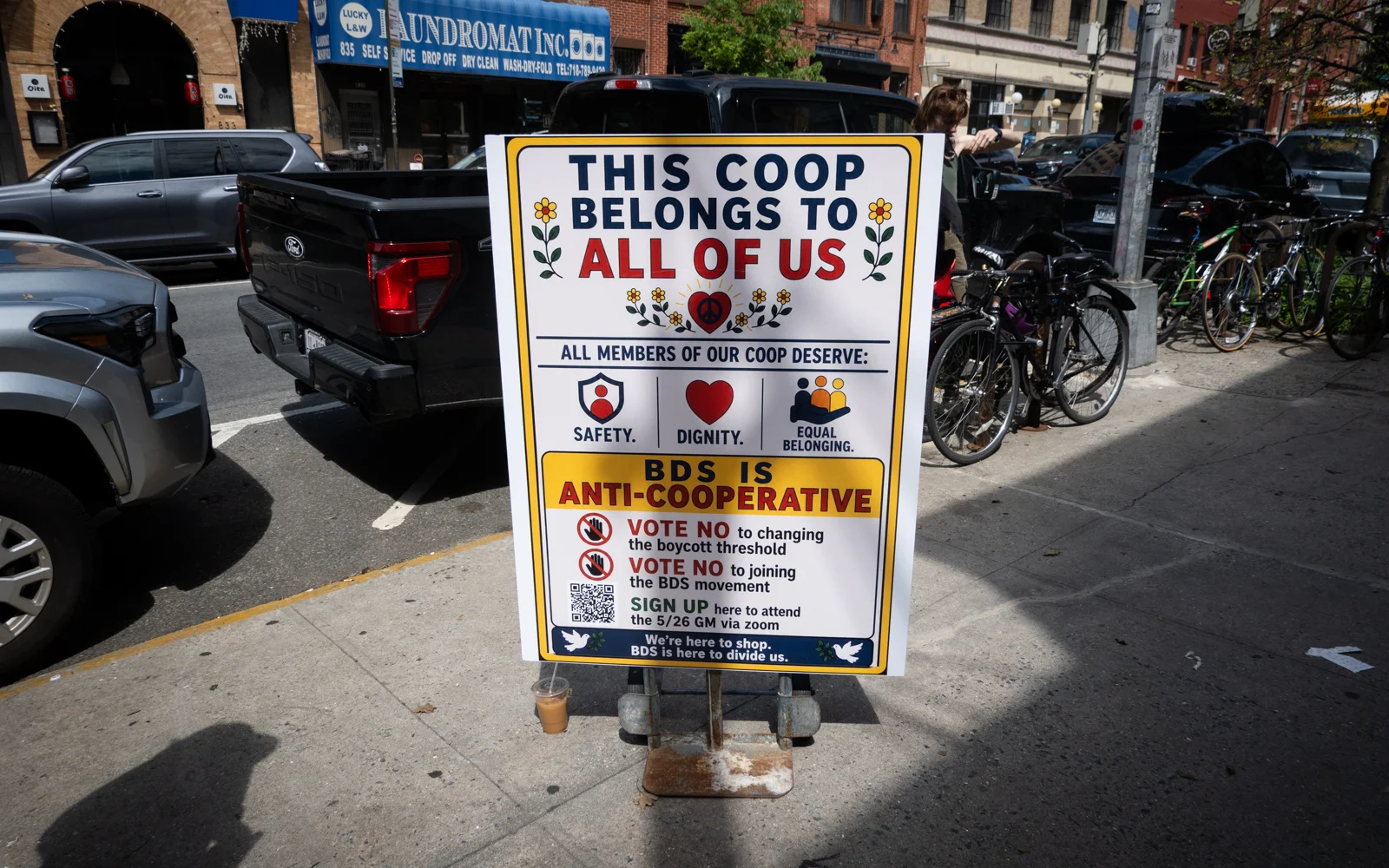
I was eight years old when my family was relocated from the Jewish Quarter of the Old City of Jerusalem to the Shuafat Refugee Camp outside the city, not by Israel, but by Jordan. That displacement set the course of my life: it is why I became a human rights activist and why I have spent 30 years telling truths that powerful institutions prefer to silence. The newest truth is that the members of the Park Slope Food Co-op, who voted this week to boycott Israeli products, did not help Palestinians. They never do.
On May 26, 6,772 members of a Brooklyn grocery cooperative voted 67 percent to 31% to remove Israeli-made products from their shelves: bell peppers, persimmons, olive oil, sesame goods, Dorot frozen herbs, and Osem Bamba. To reach even that vote, members first had to lower the required threshold from a 75% supermajority to a simple majority, proving that it was a sham vote.
Organizers determined that the meeting itself had to be held entirely online, citing security concerns. Let that detail land for a moment: a Brooklyn grocery cooperative could not hold a meeting in person to discuss removing hummus ingredients from its shelves. This does nothing to help Palestinians. Not a single Palestinian life will change for the better because of this vote.
I have watched this movement operate for two decades. Its record with Palestinian welfare speaks for itself. When international BDS pressure forced SodaStream to relocate its production facility out of the West Bank, approximately 500 Palestinian workers lost their jobs. These were not abstract casualties. They were men and women earning wages, feeding families, building lives through participation in a joint Israeli-Palestinian enterprise.
One worker, as NPR reported, had earned about $1,500 a month at the factory; afterward, he made a quarter of that selling produce from a street cart. The BDS movement called the factory closure a victory; it was anything but for Palestinian workers.
BDS does not build Palestinian hospitals. It does not fund Palestinian universities. It does not support the civil society organizations, the professional associations, or the municipal institutions that would need to exist in order for Palestinian self-governance to function. It offers symbols: the moral comfort of removing Bamba from a Brooklyn shelf while Palestinian workers grow poorer and Palestinian institutions grow weaker.
The actors who benefit from this are not ordinary Palestinians. They are the actors whose power depends on perpetuating Palestinian suffering, like Hamas, which Human Rights Watch documented committing grave crimes against Palestinians during its violent seizure of Gaza from the Palestinian Authority in June 2007, and again during its documented summary killing of Palestinians in October 2025.
Since seizing power, Hamas has governed as a theocratic dictatorship, stealing humanitarian aid and diverting construction materials into terror tunnels rather than investing in Palestinian livelihoods. Every act of international isolation that weakens the case for economic partnership strengthens Hamas’s claim that armed resistance is the only path. The BDS movement does not challenge that argument. It validates it.
I do not doubt that many of the members of the Park Slope Food Co-op who voted for this resolution believe they are helping Palestinians. That sincerity is, in its way, the most dangerous thing about them. Even Brad Lander, the former NYC Council member and Comptroller who has called for halting American military aid to Israel, opposed the boycott. When even the politicians most critical of Israel agree that a BDS resolution goes too far, the question worth asking is whom this resolution actually serves.
What helps my fellow Palestinians is economic development, civil society investment, education reform that teaches children science and history rather than martyrdom, and coexistence with Israel built on shared infrastructure and the mutual recognition that prosperity on one side requires stability on the other — not removing Bamba from the shelves of a Brooklyn grocery co-op while boycott activists destroy the Palestinian livelihoods they claim to champion.
There is a Palestinian future worth fighting for: one built by Palestinian entrepreneurs and professionals whose economic ties with Israeli neighbors make conflict too costly to sustain. That future cannot be built by a food cooperative deciding which olive oil is morally acceptable. It can only be built by people who stop performing “solidarity” from a safe distance and start asking what Palestinians actually need — and the answer has never been a boycott.