Replace ‘Tikkun Olam’ With שמירה על הבריאה: Guarding/caring for Creation
Replace “Tikkun Olam” With שמירה על הבריאה: A Jewish Language for Stewardship, Not Slogans
Why our God-given role is not to chase every crisis—but to guard creation before it breaks.
“Tikkun olam” used to feel like a compass.
Now it often feels like a bumper sticker—invoked for everything, claimed by everyone, and inevitably dragged into the political mud. The phrase has become so elastic that it can mean almost anything, which is another way of saying it means nothing in particular—except, too often, “my side’s list of urgent causes.”
Judaism deserves better than a word that sparks an eye-roll.
So here’s a proposal: let’s adopt שמירה על הבריאה (shmirah al ha-bri’ah)—guarding/caring for Creation—as the primary Jewish banner for our moral role in the world. Not as a new political program, but as a deeper frame. Not as a rejection of repair, but as a re-ordering: from reactive fixing to proactive stewardship.
“Tikkun Olam” didn’t start as a modern catch-all
One reason “tikkun olam” became so easy to politicize is that it has traveled through multiple meanings over time.
In the Mishnah, mipnei tikkun ha-olam means something like: “for the sake of social functioning,” legal adjustments designed to prevent breakdown and harm. It’s practical, narrow, and systems-minded.
Later, “tikkun” takes on broader spiritual overtones in liturgy and, in some streams, mystical weight. And in modern American Jewish life, “tikkun olam” became a powerful banner for wide-ranging social activism—often noble, sometimes vague, and frequently contested within the community.
That history matters, because it explains our current predicament: when a single phrase tries to hold law, liturgy, mysticism, and modern politics, it becomes a Rorschach test. Everyone sees what they want to see.
And then the arguments begin—not only about what to fix, but about whose fix counts, and who gets to define the Jewish moral agenda.
A better anchor: the Torah’s first job description for humanity
שמירה על הבריאה is different. It doesn’t begin as a campaign. It begins as a role.
In Genesis, the human being is placed in the garden “לעבדה ולשמרה (le’ovdah u’leshomrah)”—to work it and to guard it.
That phrase is astonishingly balanced. It does not say: exploit. It does not say: worship nature. It says: cultivate and protect.
That is stewardship.
And it scales. Because “garden” is not only a location; it’s a template. A world capable of flourishing must be tended, and anything tended can be harmed if the caretaker forgets what he is.
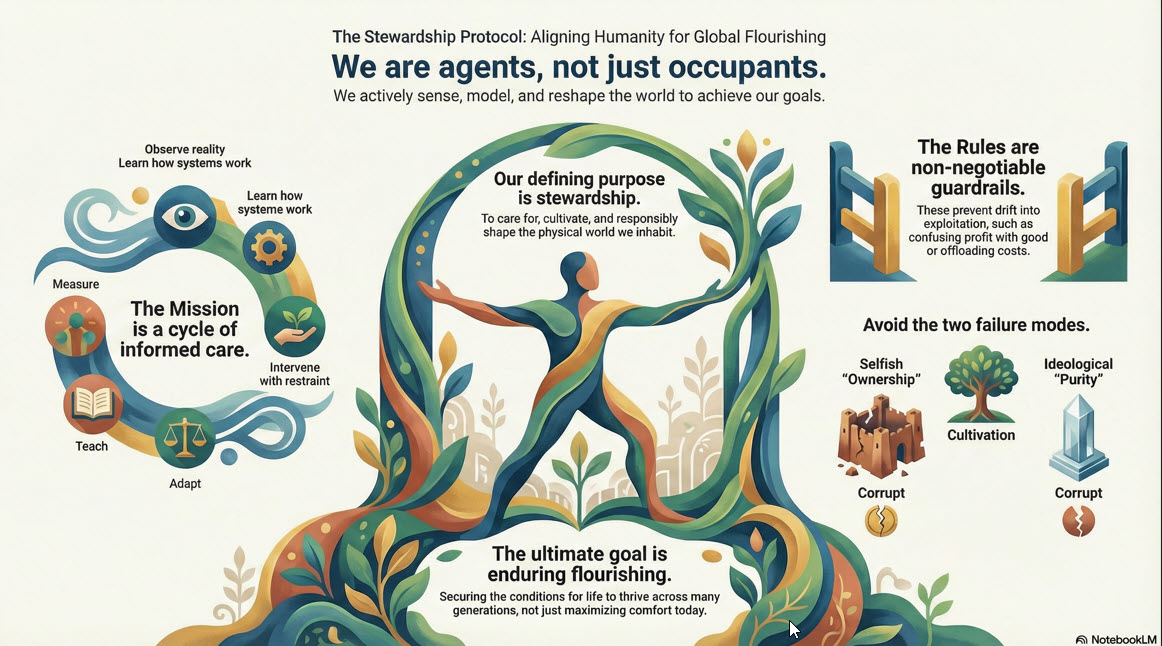
If humanity are “agents,” stewardship is the alignment problem
Now add a modern lens: humanity as agents—goal-driven beings with outsized power.
We don’t merely live in the world; we alter it. We build tools, accelerate forces, reshape ecosystems, move markets, flood information channels, and change what future generations inherit.
An agent with that level of leverage needs a top-level purpose—an organizing telos—otherwise it will optimize for short-term rewards, political wins, tribal applause, or profit proxies that “look like success” while quietly degrading the underlying system.
That’s what makes shmirah so clarifying. It states the purpose in a single sentence:
We are here to guard creation while we live in it, improve it, and pass it on.
Not “fix everything.” Not “win the argument.” Not “signal virtue.”
Guard what is real. Protect what is fragile. Sustain what allows life to flourish.
Why shmirah “supersedes” tikkun without erasing it
This is the key point: shmirah doesn’t abolish repair; it governs it.
Repair (tikkun) is what you do when something is already broken. Stewardship (shmirah) is what you do so it doesn’t break—or so it breaks less, later, and more repairably.
Tikkun is often reactive. Shmirah is inherently proactive.
Tikkun can become an endless chase after an infinite list of problems. Shmirah asks a different first question:
What are we doing—today—that makes tomorrow worse?
That question is not left-wing or right-wing. It’s adult.
Stewardship is bigger than “the environment,” but never smaller
Some readers will hear “creation” and think: climate, recycling, wilderness. Yes—those belong. But שמירה על הבריאה is not a narrow environmental slogan. “Creation” includes the physical conditions that make civilization possible:
- Land and water (soil health, aquifers, oceans, biodiversity)
- Air and energy (pollution, resilience, realistic transitions)
- Food systems (waste, sustainability, nutrition)
- Built infrastructure (durability, safety, repair culture)
- Public health (prevention, honest science, community trust)
And because humans are part of creation, shmirah includes the human ecological layer too:
- Social trust (truthfulness, restraint, refusal to scapegoat)
- Family and community stability (the “gardens” where humans grow)
- Education (training the next stewards, not just the next consumers)
- Technology and AI (tools that amplify agency must be governed by stewardship, not appetites)
If “tikkun olam” sometimes feels like a leap to the most headline-worthy moral emergency, shmirah starts closer to home and moves outward: guard the conditions of flourishing.
The anti-politicization move: shmirah demands measurable responsibility
One reason “tikkun olam” gets politicized is that it easily becomes identity performance: the right slogans, the right outrage, the right enemies.
Shmirah is harder to perform and easier to test.
Stewardship forces questions like:
- Did we reduce harm or merely announce concern?
- Did we preserve resilience or borrow against the future?
- Did we improve the system or just moralize it?
- Did we treat people as ends, not instruments?
- Did we leave the garden healthier—or simply declare ourselves righteous?
That is why shmirah elevates the discussion. It drags us out of the dopamine economy of constant crisis and into the slower, holier work of competence, restraint, and repairability.
What adopting שמירה על הבריאה could look like in Jewish life
If synagogues and Jewish institutions want this to be more than a nice phrase, it can become a real organizing principle:
- Language shift (first): Put “shmirah al ha-bri’ah” into sermons, mission statements, youth programs, and school curricula—not as politics, but as purpose.
- A stewardship checklist (not a platform):
- energy use and building stewardship
- food and waste practices
- purchasing ethics (durability over disposability)
- community care (the human garden)
- truth norms (anti-scapegoating, anti-rumor discipline)
- A “guardrails” ethic for activism: When we do pursue justice causes—and we should—we do so under stewardship constraints: no dehumanization, no performative cruelty, no scapegoating, no reward-hacking.
- Teach Genesis 2:15 as a civic-spiritual mandate: “To work and to guard” is not quaint. It is the baseline job description.
A final word to the tikkun-minded
This is not a sneer at doing good.
It’s a plea for a better Jewish operating system.
“Tikkun olam” is beloved for good reason. It carries moral urgency. It calls Jews outward. It refuses complacency. But when a phrase becomes both everything and a partisan marker, it fractures community and weakens moral seriousness.
Shmirah al ha-bri’ah keeps the urgency and adds something we desperately need: orientation, humility, and time horizon.
Repair what is broken—yes.
But first: guard what is entrusted to you.
Because the world is not a talking point.
It is a garden.
And we were placed here—le’ovdah u’leshomrah—to work it and to guard it.