
Middle East Analyst
Securing Democracy in the Post‑Labor Age
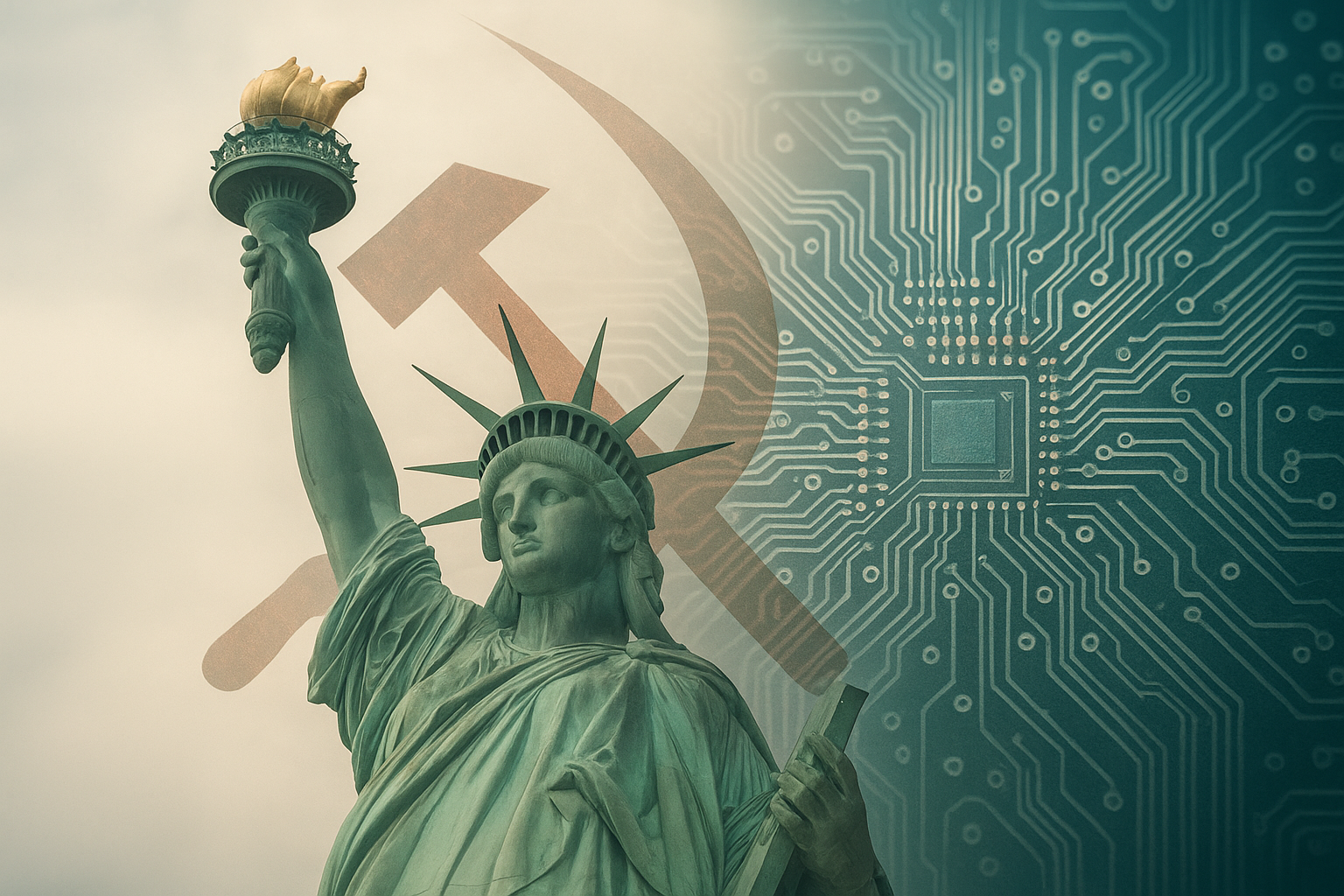
graphic by author/ChatGPT
Artificial intelligence, robotics, and automation are no longer experimental technologies. They are becoming the invisible infrastructure of daily life—powering logistics, healthcare diagnostics, financial decision‑making, manufacturing, and service platforms. This transformation is accelerating, not unfolding gradually. Democratic societies must now confront a defining paradox of the 21st century: how to sustain citizens’ income in an economy where traditional work is disappearing, while remaining globally competitive.
The End of “Workers” as the Basis of Politics
For more than two centuries, democratic politics has been organized around the worker. Labor created not just economic value, but political legitimacy. Parties, unions, and social movements all drew their authority from the centrality of human work.
But AI and robotics are dismantling that foundation. Radiologists, truck drivers, paralegals, factory workers, delivery drivers—entire categories of cognitive and physical labor are being absorbed by software and machines. The question is no longer whether technology will reshape employment, but how democratic societies will function when workers are no longer the organizing unit of political life.
The UBI Paradox
Universal Basic Income (UBI) is often proposed as the answer. And in a post‑labor economy, some form of income floor will be essential: without consumers, the AI‑robotics economy itself would stall.
But UBI contains an unavoidable contradiction:
- It must be high enough to sustain demand, yet modest enough to preserve competitiveness.
- Too generous, and industries migrate to lower‑cost jurisdictions.
- Too stingy, and domestic consumption collapses.
Compounding this is a structural imbalance: citizens are immobile, but capital is not. Corporations can relocate profits, data centers, and intellectual property to low‑tax environments, hollowing out the fiscal capacity needed to fund redistribution. Economists once described this kind of paradox as the Triffin Dilemma—when the very system that provides stability also undermines itself. In the AI age, the dilemma is clear: democracies depend on taxing profits to fund redistribution, yet those same profits are incentivized to flee.
What Democracies Must Do
- Build Sovereign Equity Funds. Taxation alone will not secure redistribution. Democratic governments must hold direct stakes in AI and robotics infrastructure—much like Norway’s sovereign wealth model—so that value creation remains tied to the citizenry rather than drifting offshore.
- Coordinate Internationally on Capital Mobility. Without global alignment, national tax reforms will fail. A collective tax floor or capital controls are necessary to prevent a race to the bottom.
- Design Democratic Governance for a Post‑Labor Economy. A technocratic “UBI Reserve Board” risks backlash if benefits tighten. Governance must combine technical benchmarks with democratic legitimacy. Citizens must see themselves as co‑owners of AI infrastructure, not passive recipients of algorithmic decrees.
- Treat Income Stability as National Security. A population stripped of economic security is vulnerable to radicalization, disinformation, and foreign influence. A hollowed‑out middle class is not just a social problem—it is a strategic liability.
- Fill the Meaning Vacuum. Income replaces wages, but it does not replace purpose. Democracies must invest in new forms of civic participation, education, and cultural life that confer status and belonging. If the “worker” is no longer the core democratic identity, the citizen must become the new one.
The Democratic Advantage—If We Use It
The greatest danger is not AI or robotics themselves but political paralysis. A failure to adapt will cede economic leadership to authoritarian competitors. Yet autocracies face their own existential challenge: their legitimacy rests on guaranteeing employment and growth, and a post‑labor economy undermines that claim. Democracies, by contrast, can redefine legitimacy around citizenship rather than work. That is their strategic advantage—if they act quickly enough to redefine what citizenship means in an era where labor is no longer the organizing principle of society.
This is not a matter of balance or technocratic tinkering. It is a national security imperative. Securing the economic floor of the citizenry is essential to democratic resilience, global competitiveness, and geopolitical stability.
Related Topics
Related Posts