
Managing Director, Horn Finance Initiative
Somaliland’s FinTech Shift to Integration Now
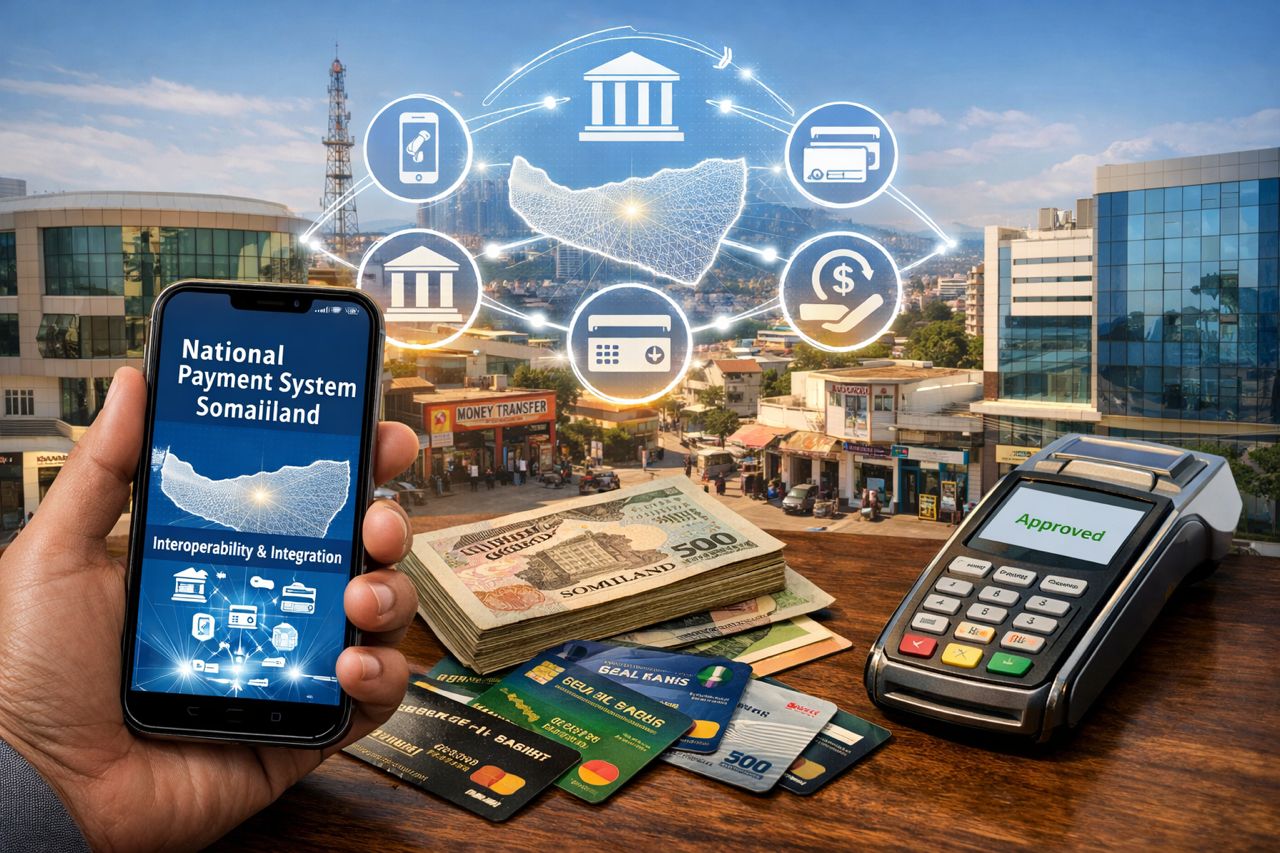
In much of the developing world, financial inclusion is framed as a problem of access, how to bring the unbanked into the system. Somaliland has already solved that problem. What it has not solved until now is integration. Over the past decade, widespread adoption of mobile money has enabled financial access at scale, (GSMA, 2023), even in the absence of deep banking penetration.
For over a decade, Somaliland has built one of Africa’s most dynamic mobile money ecosystems. Platforms such as Telesom’s ZAAD and Somtel’s eDahab have enabled a largely cashless urban economy, allowing millions to transact digitally in a country where traditional banking penetration remains limited. According to the GSMA, mobile money services in fragile and low-income contexts often substitute for formal banking systems rather than complement them (GSMA, 2022).
Yet underlying this success lies a structural weakness: fragmentation. Mobile wallets, banks, remittance providers, and government systems have evolved in parallel, but not together. As the World Bank has noted, fragmented financial ecosystems reduce efficiency, limit innovation, and constrain financial deepening in emerging markets (World Bank, 2021).
That reality is now beginning to change.
A Quiet but Strategic Shift
This week, the Bank of Somaliland launched a National Payment System (NPS), (Bank of Somaliland, 2026), a move that may prove to be one of the most consequential financial reforms in the country’s recent history. Supported by the Mojaloop Foundation, the system is designed to enable interoperability across financial service providers, including mobile money platforms and banks.
At first glance, this may appear to be a technical upgrade. In reality, it represents a structural transformation. National payment switches have been shown to significantly enhance financial system efficiency and inclusion by enabling real-time, low-cost transactions across providers.
For the first time, Somaliland is moving toward a unified financial architecture one in which different providers can communicate seamlessly, transactions can flow across platforms, and financial services can scale beyond closed ecosystems.
Why Interoperability Matters
The absence of interoperability has long been one of the most significant constraints on digital finance in emerging markets. The World Bank has consistently highlighted that lack of interoperability reduces competition, increases transaction costs, and limits financial innovation (World Bank, 2021).
In Somaliland, the implications have been even more pronounced. Mobile money platforms have operated as dominant but isolated networks. A user on one system could not easily transact with a user on another, while integration with banks remained minimal. Similar patterns have been observed across mobile money ecosystems in Sub-Saharan Africa, where provider-led silos limit market efficiency (GSMA, 2022).
This created what might be described as a “digitally advanced but structurally incomplete” financial system, highly efficient at facilitating payments, but limited in its ability to support broader financial services such as credit, savings, and investment.
The introduction of a National Payment System changes that equation.
By enabling interoperability, the new infrastructure lays the foundation for a more competitive and inclusive financial ecosystem. It allows fintech providers to build services on top of a shared platform, reduces transaction frictions, and enhances network effects across the economy (Mojaloop, 2024)
Beyond Payments: Unlocking Financial Depth
Perhaps the most important implication of this shift is not in payments, but in what comes next.
Until now, Somaliland’s financial system has been heavily transactional. Mobile money has excelled at enabling payments, but the transition to more sophisticated financial services particularly credit has been limited. According to the World Bank, access to digital payments does not automatically translate into access to credit without supporting data infrastructure (World Bank, 2022).
The missing ingredient has been data integration.
With a unified payment system, transaction data can begin to flow across institutions. This creates the possibility of building digital credit scoring models, expanding access to finance for small businesses, and developing new financial products tailored to local needs. Evidence from emerging markets shows that alternative data particularly mobile transaction data can significantly improve credit access for underserved populations (IFC, 2020).
In effect, interoperability transforms data from a fragmented asset into a system-wide resource.
Connecting Diaspora Capital
The National Payment System also has implications beyond domestic transactions. Somaliland receives substantial remittance inflows from its diaspora, largely through companies such as Dahabshiil. Remittances are a major source of income and economic stability in Somaliland and across the Horn of Africa (World Bank, 2023).
Yet these flows are not fully integrated into the local financial system. Remittances are often used for immediate consumption rather than being intermediated into savings or investment channels a common pattern in remittance-dependent economies.
A more connected payments infrastructure creates the opportunity to channel diaspora funds more effectively into savings, investment, and productive sectors. This could mark a shift from a consumption-driven remittance economy toward an investment-oriented financial system.
The Role of Mojaloop: Open Infrastructure for Emerging Markets
The involvement of the Mojaloop Foundation is particularly significant. Mojaloop is an open-source platform designed to enable interoperable digital payments, particularly in emerging markets where proprietary systems often dominate (Mojaloop, 2024).
Its adoption signals a strategic choice: to build a financial system based on open, scalable infrastructure rather than closed, siloed platforms. This approach aligns with global best practices, where open digital public infrastructure is increasingly seen as a foundation for inclusive financial systems (United Nations, 2022).
From Innovation to Integration
For years, Somaliland’s financial narrative has been one of innovation particularly the rapid rise of mobile money in a fragile and underbanked environment. The next phase is different.
It is about integration.
The launch of the National Payment System marks the beginning of this transition. However, experience from other markets suggests that infrastructure must be complemented by regulatory alignment, digital identity systems, and government integration to fully realize its benefits (Bank for International Settlements, 2020).
This is where institutions such as the Horn Finance Initiative (HFI) can play a catalytic role aligning policy, infrastructure, and innovation into a coherent system.
A Turning Point
Somaliland stands at an inflection point.
The foundations of a modern digital financial system are already in place: widespread mobile money usage, an active private sector, and strong diaspora engagement. With the introduction of a National Payment System, the country now has the missing piece the connective infrastructure needed to unify these elements.
If successfully implemented, Somaliland could offer a compelling model for other emerging economies: a system that moves directly from fragmentation to integration, leveraging digital infrastructure to drive inclusion, efficiency, and economic transformation.
In the end, the question is no longer whether Somaliland can innovate. It already has.
The question now is whether it can connect and in doing so, redefine its financial future.
Related Topics
Related Posts