Ukraine and Kurdistan: Ties Under Russia’s War
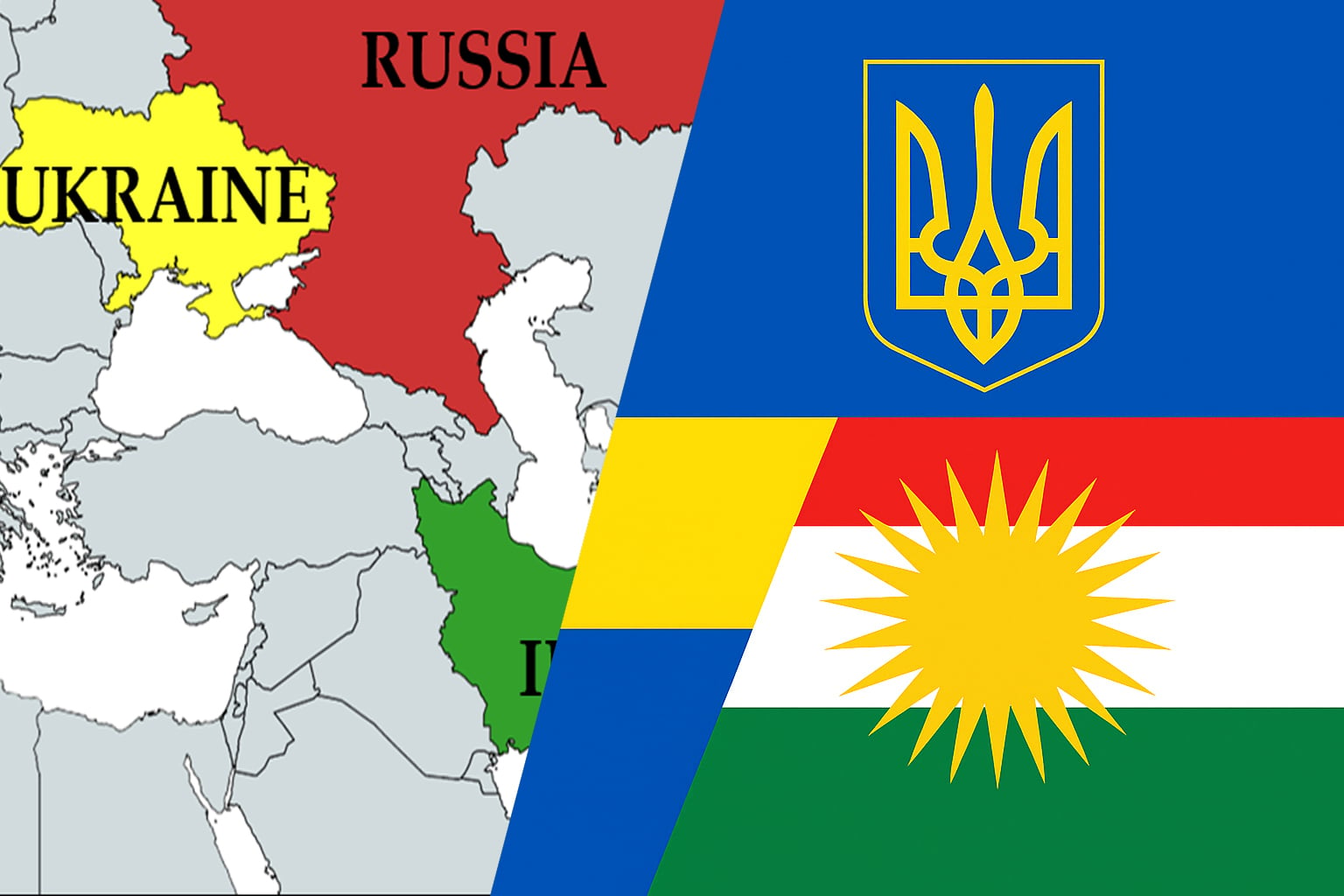
The Necessity of Relations between Occupied Kurdistan under Iran and Ukraine in Light of the Russia–Ukraine War
Ashtiako Pourkarim, Leader of the Kurdistan Independence Movement, “Kurdistan under Iranian Occupation”
The war launched by Russia against Ukraine in February 2022 not only transformed the political and security landscape of Europe but also extended its repercussions to the Middle East and surrounding regions. This war quickly transcended the scope of a regional crisis and turned into a global battleground where states and various forces either sided with Ukraine or aligned themselves with Russia. Among these actors, the Islamic Republic of Iran holds a special place. While grappling with its own internal crises, economic pressures, and social unrest, Iran firmly positioned itself as an ally of Russia, playing a decisive role in Russia’s combat capabilities by supplying Shahed-131 and Shahed-136 drones as well as other equipment. These drones were used in hundreds of strikes against Ukraine’s energy, transportation, and civilian infrastructure, directly targeting the daily lives of millions of Ukrainian citizens.
Iran’s involvement in the war was not limited to exports. International reports and official sources from the United States and Europe confirmed that Iranian personnel and trainers were present in occupied Crimea, directly engaged in operational guidance and training of Russian forces in the use of drones. Moreover, Iran transferred technology and components that enabled the local production of Russian-branded versions known as Geran-2 and Geran-3. This military-industrial collaboration allowed Russia to reduce its dependency on imports and dramatically expand its drone strike capacity. In effect, Iran became an active partner in Russia’s aggression—not merely a supplier of weapons.
However, hostility between Iran and Ukraine predates the war and is rooted in a tragic event etched into Ukraine’s collective memory. On January 8, 2020, Ukraine International Airlines flight PS752, en route from Tehran to Kyiv, was shot down by two missiles fired by Iran’s Revolutionary Guard air defense system just minutes after takeoff. All 176 passengers and crew, including Ukrainian nationals, were killed. This became one of the deadliest aviation disasters of the decade, sparking international outrage and demands for justice. Ukraine, alongside Canada, the United Kingdom, and Sweden, launched extensive legal proceedings and filed a joint case against Iran at the International Court of Justice. The ICAO Council also confirmed its jurisdiction to investigate. Although Tehran attempted to stall the process through denial, delays, and blame-shifting, the political message was clear: a deep mistrust between the two nations had been established, a mistrust that persists to this day. For Ukrainians, Iran was not only responsible for a human tragedy but also represented a state willing to recklessly endanger civilian lives.
When the Russia–Ukraine war erupted, this mistrust evolved into open hostility. Ukraine saw that the same country that had downed its passenger plane now stood with Russia, supplying deadly drones and becoming a de facto accomplice in aggression. In response, Kyiv downgraded diplomatic relations with Iran in September 2022 and revoked the accreditation of the Iranian ambassador. In May 2023, Ukraine’s parliament went further by imposing unprecedented sanctions on Iran for a period of fifty years. These sanctions encompassed a total ban on trade, investment, transit, flights, and technological cooperation, effectively designating Iran as Ukraine’s long-term strategic enemy. This was not a short-term measure but a recognition of Iran as a structural threat.
Iran’s diplomatic stance in international forums reinforced this perception. In key United Nations General Assembly votes condemning Russia’s aggression, Iran either abstained or openly opposed measures such as Russia’s suspension from the Human Rights Council. Though these votes were not legally binding, they sent an unmistakable signal: Tehran aligned itself with Moscow and defended the international legitimacy of Russia’s war. For Ukraine, such positions could only be interpreted as outright hostility.
Ukraine also broadened its counter-Iran strategy beyond the West by engaging regional actors. In 2025, Kyiv and Tel Aviv initiated a joint strategic dialogue focused on countering Iran. Within this framework, Ukraine’s foreign minister described Iran as an “existential threat to global security.” Ukraine’s alignment with Israel—already locked in confrontation with Iran—demonstrated that Ukraine views Iran not merely as a regional issue but as part of a global threat to peace and stability.
It is at this juncture that the Kurdish question gains relevance. The Kurdish nation in Iranian-occupied Kurdistan has endured decades of systematic repression. From the occupation of Kurdish lands to cultural and linguistic denial, from the arrest and execution of political activists to the suppression of parties and national movements and the deliberate underdevelopment of Kurdish regions, all have been instruments of the Islamic Republic’s policy to weaken and erase the Kurdish nation. Iran is the very regime that occupies Kurdistan, denies Kurdish national and political freedoms, and marginalizes their social and economic existence. For the Kurds, Iran is the enemy that has stripped them of their right to self-determination; for Ukraine, Iran is the actor whose suicide drones devastate its cities.
From the perspective of international relations theory, such conditions create fertile ground for convergence. The concept of a “common enemy” is recognized as one of the key drivers of alliances in world politics. Distinct nations—even if geographically or structurally different—tend to draw closer when confronted with the same threat. History offers many examples: the alliance of Eastern European states against the Soviet Union during the Cold War, or the convergence of the Baltic nations in the face of Russian aggression. Today, Ukraine and Kurdistan—one a sovereign state, the other a stateless nation under occupation—can find common cause around the challenge posed by Iran.
The potential areas of cooperation are diverse. Diplomatically, Kurdish political representatives can build connections with Ukrainian governmental and parliamentary institutions, amplifying the voice of Kurdistan within the framework of “shared security.” In the media sphere, both sides can jointly highlight the links between Tehran’s policies in Ukraine and its repression in Kurdistan, illustrating that Iran’s victims are found not only in the Middle East but also in the heart of Europe. In security and military terms, exchanging experiences in asymmetric warfare, counter-drone measures, and the development of low-cost defense systems could prove mutually beneficial. Even economically, Kurds could contribute to Ukraine’s reconstruction while leveraging the partnership to secure broader international support for the Kurdish cause.
Of course, obstacles and challenges abound. Iran and Russia will inevitably exert pressure to prevent any rapprochement between Ukraine and Kurdistan. Legal limitations stemming from Kurdistan’s statelessness, as well as the caution of certain European and Western states in engaging with non-state actors, are real barriers. Yet the experience of public diplomacy and networked cooperation has shown that even without formal recognition, avenues for communication, information exchange, and political convergence remain open.
The reality is that relations between Iran and Ukraine have moved far beyond a simple disagreement; their hostility has become structural and enduring. The downing of flight PS752, the deployment of Shahed drones, the presence of Iranian trainers in Crimea, Ukraine’s fifty-year sanctions, Tehran’s pro-Russia stances in international forums, and Kyiv’s strategic alignment with Israel all demonstrate that Iran is now perceived in Ukraine’s political consciousness as a long-term enemy. Meanwhile, the Kurdish nation has been suffering under the same regime for decades and urgently requires global support to break free from occupation and repression.
From this perspective, a strategic alliance between political forces in Iranian-occupied Kurdistan and Ukraine is not only logical and rational but also an ethical and historical necessity. Such an alliance could present a new model of cooperation between a stateless nation and a sovereign state—showing that the struggle for freedom, justice, and human dignity transcends national borders, and that victims of tyranny and aggression—even if separated by thousands of kilometers—can unite against a common enemy. For Ukraine, partnership with Kurdistan would strengthen the international front against Iran; for the Kurds, it would globalize their national question and provide them with a new ally in a struggle rooted in decades of oppression and occupation.