Why I Am Leaving Montreal at 70 · עוזב בגיל שבעים
The Erasure
Aliyah at Seventy — Post One of Three
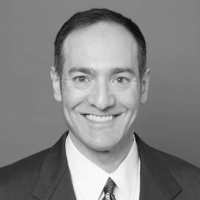
Menachem Elyah Paull
Nine months ago I asked an editor in Jerusalem to erase me.
She did it in two days.
Two days. I have waited longer than that for a plumber. I have waited longer than that for a rabbi to return a phone call. Ask a newspaper to make you vanish, however, and suddenly everybody is extremely efficient.
That is not normal for a writer. We spend our lives trying to be read. Then, one grey November evening, I sat alone in my apartment in Montreal and asked this publication to pull years of my work — de-index it, take my name off it, make me disappear. Within two days I was gone.
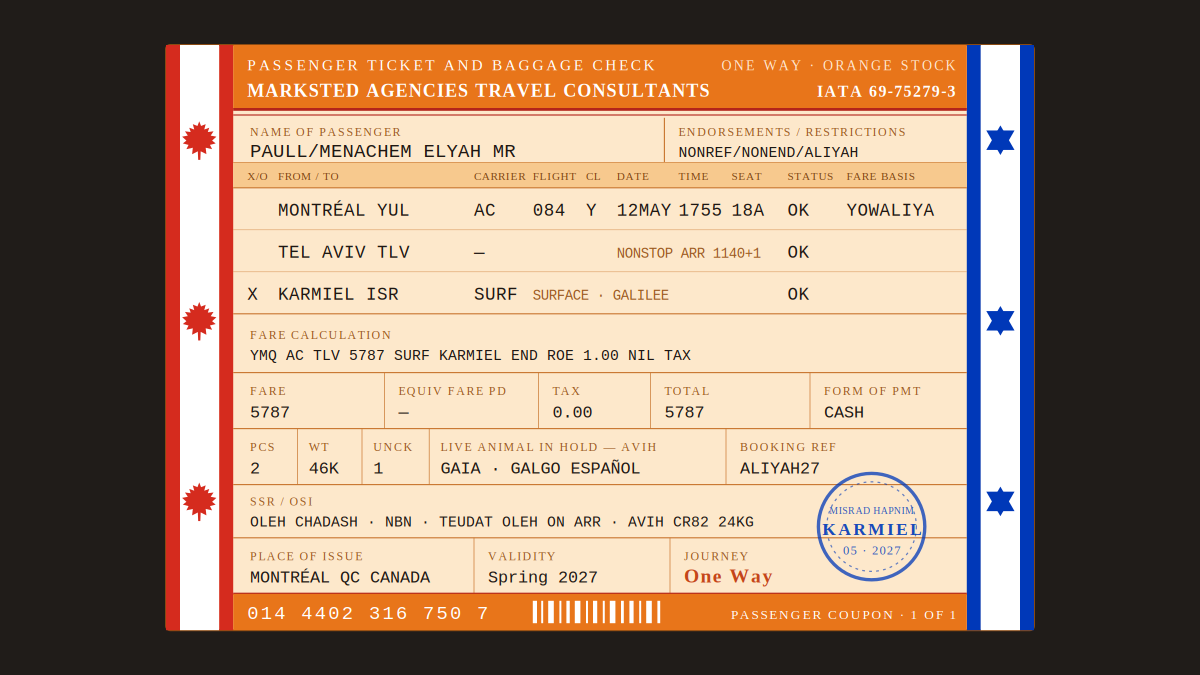
Today I am starting again, under a different name, to tell you why I am leaving Montreal after seventy years and making aliyah to Karmiel.
I am not leaving for the sunshine, the cheaper rent, or a late-blooming passion for chickpeas. I am leaving because I am Jewish, and I no longer trust this city as a place where I can be publicly Jewish without first doing the math.
There. I said it plainly. It only took me seventy years and one very patient editor.
Menachem Elyah Paull. I published for years as Mark E. Paull.
Mark is not dead. Montreal did not manage that. Menachem is the name I will carry to Israel, and at seventy I will answer to whichever one reaches me first — including “excuse me, you with the dog.”
And yes: a reasonable person will notice that a man who asked to be de-indexed is now publishing under a byline that names the old one. I have thought about it.
Disappearing was a decision I made in one evening, in fear, with the door locked. This one I am making in daylight, on purpose, with my name attached. Given the choice between being findable and accountable, or absent and assumed, I will take findable. The first version of me is not coming down again.
§
My mother was born in Montreal. My daughter was born in Montreal. My granddaughter was born in Montreal.
I was born in Ottawa.
My father had taken a job there for a year. I arrived here at four months old and have lived here ever since, and in seventy years not one person has ever asked me where I was born, because in this city four months old is close enough.
For seventy years, so was I.
There is a reason my parents were in Ottawa that year, and I will come to it in the third of these posts, because it turns out to be the reason for a great deal else besides.
Three generations of this family were born in Montreal. My granddaughter is the third. She is two years old, and she is staying.
I am the one leaving. I am also, it turns out, the one who never quite began here.
That fact sits underneath every spreadsheet I make. And I make a great many spreadsheets. We will come to that.
§
My grandmother was not born here either. She arrived. And what she did once she got here was run kosher hotels in the Laurentians — the mountain resort country an hour north of the city — through the thirties, the forties and into the fifties. The Mount Carmel was hers. There were others. There was a boarding house as well, because in that business you took whatever roof you could get your hands on and filled it.
She ran them because Jews were not welcome at the other ones.
This is the part readers outside Canada tend to assume happened somewhere else. It happened here. The resort towns north of Montreal had signs, property covenants and a beautifully polite vocabulary for telling a Jew where he could and could not sleep. Restricted clientele. Selected guests. A private atmosphere. You always knew which door was closed, because they had the courtesy to put it in writing.
My grandmother, Mina Kornfeld Geiger, solved the problem by feeding her own people. My mother, Rose, grew up in those dining rooms and later became one of the first women in Quebec to own a travel agency.
I ran that agency for thirty-four years. Thirty-five. Thirty-six, if I am telling the story to somebody I am trying to impress.
The agency represented the great Jewish resorts of the Catskills — the Concord Resort, Brown’s, Kutsher’s Country Club, the Pines, Granit, Brickman’s and Gibbers. For anyone under sixty: picture an all-inclusive resort, except that everybody is Jewish, nobody is relaxing, and the evening entertainment is a man in a tuxedo dismantling a politician in three sentences and then doing an impression of your uncle.
I spent perhaps twenty weekends a year in the Borscht Belt.
Yiddish. Chain smoke. Card games with stakes that were emotional rather than financial. Holocaust survivors at the next table ordering a second lunch, on the grounds that the first lunch had been a rehearsal. Jewish mothers who could diagnose terminal malnutrition from fifty feet, and from a hundred feet if you were not wearing a jacket.
It was loud, ridiculous and unapologetically Jewish.
It was a wonderful way to grow up.
§
In 1976 the Parti Québécois was elected here on a platform of Quebec independence, and English-speaking Jewish Montreal began packing.
For readers outside Canada: this was the moment when a large, prosperous, deeply rooted Jewish community looked at the political weather and concluded, more or less collectively, that it was time to go. Friends went. Businesses went. Whole families went. For a couple of years the highway west to Toronto was a Jewish parade of station wagons, moving vans and unsolicited advice.
I did not go.
I believed in René Lévesque. I saw something decent in what Quebec was reaching for, and I believed a Jew could stand inside it and remain entirely a Jew. I was not going to sit on a packed suitcase waiting to see how it turned out.
I stayed on purpose.
And I want to be clear that this was not innocence. Two years earlier I had been an elected officer of a Jewish youth order covering six states and six provinces. I had sat in rooms in Washington. I knew perfectly well what organized Jewish life looked like and what it was for.
I stayed anyway, and then I stayed another fifty years and raised my children here. Montreal was not somewhere I happened to live. It was mine. Staying was an argument, and the argument was this: a Jew does not have to leave in order to remain himself.
I can now admit that the people driving west may have understood something I did not.
I mistook the absence of a sign for belonging.
Montreal did not wake up one morning full of antisemites. It got colder by degrees. An excuse here. A qualification there. Another patient lecture about why Jews should not take things personally. The old signs came down, and the instruction simply got quieter: lower your voice, tuck in the symbol, explain Israel before you explain yourself.
The bargain I made with this city no longer holds. Pretending that it does would mean erasing myself again, and I have already outsourced that once.
§
I wrote something under my own name and put it where people could find it.
I knew when I pressed send that someone here would see it. That is not hindsight. That is what publishing is, and I have been doing it long enough to know the arithmetic.
Then someone did.
I don’t know who was first. I know it moved — the way things move now, instantly and to everybody, including a number of people who had never previously expressed the slightest interest in my work. Here. My streets.
What it said is not the point of this piece. That it was signed, and that it was Jewish, is.
I walk Gaia twice a day. Same hours. Same corners. Same people nodding at the same hour. Until that week, familiarity had felt like safety.
That evening I went out with the leash in my hand and read every face.
Who had seen it. Who had shared it. Who was looking at me half a second too long.
My ordinary dog walk had become a low-grade security assessment.
Gaia felt it before we reached the corner. I was holding the leash too tight and too high, and she could feel my arm through it. She stopped. She turned around and looked at me and waited.
That is what she does. Something is wrong, she stops walking, she looks at me, she waits for me to fix it.
I said her name and made my hand loosen and we kept going.
She stopped again at the next corner.
She had no opinion about the street. She had never had an opinion about the street. What she had was my hand, and my hand was telling her something was wrong, and I could not explain to her what it was.
That is the part I keep returning to. The only living thing on that street who knew something had changed could not be told what it was. And at that point, neither could I.
Seventy years in a city, and an ordinary walk with the dog now required a risk calculation.
Then I came back inside, locked the door, and emailed an editor in Jerusalem.
§
Nobody made me write it. Nobody made me sign it.
The signature was the exposure. Not the argument — the name. A name that has been in this city since I was a boy, on school registers and business licenses and a travel agency’s door for thirty-four years, and that had never once, until that week, felt like a piece of evidence.
Something changed that night, and it was not shame.
It was arithmetic.
If every honest sentence I write requires a personal security assessment, I am not free. If being visibly, publicly, loudly Jewish frightens me on my own street, then invisibility is not safety.
It is surrender, paid in installments.
די. Dai. Enough.
§
I am about to put some dates on the table. Before I do, I know what happens when a Jew starts listing dates.
Not every Muslim, every Palestinian, every Quebec nationalist, every person carrying a flag I do not carry is my enemy. I reject collective guilt. My people have been on the receiving end of it long enough to know exactly what it is, and I am not interested in picking up the instrument.
But I also reject the ritual in which a Jew is required to demonstrate his decency before he is permitted to say that he is frightened — and you have just watched me perform it, because I have not yet worked out how to stop.
And yes, criticizing Israel is not antisemitism. Israelis criticize Israel before breakfast. It is a national warm-up exercise, somewhere between the coffee and the stretching.
The dates.
On the night of 6 November 2023, Molotov cocktails were thrown at the front doors of Congregation Beth Tikvah in Dollard-des-Ormeaux, and at the back door of the Federation CJA building across the street. The Beth Tikvah site is not only a synagogue. It also houses Hebrew Foundation School. On 18 December 2024, thirteen months later, the same doors were firebombed again, shortly before three in the morning. A young man was later charged. The Canadian Jewish News reported both.
On 9 November 2023, in Côte-des-Neiges on the other side of the city, shots were fired at two Jewish schools — Yeshiva Gedola on Deacon Road, and Talmud Torah Elementary School a few streets away. Three days later, early in the morning on 12 November, Yeshiva Gedola was shot at a second time. Casings on the ground. Bullet marks on the façade. A man was arrested six months later and charged with discharging a firearm. Police said at the time that they were still investigating whether others took part.
Now let me tell you why I am not quoting those dates the way a wire service would.
I raised my family in Pierrefonds, four minutes from Dollard-des-Ormeaux. Both of my children went to Hebrew Foundation School — that school, in that building. My son from grade one onward. He was born in 1990, so he was still walking through those doors when the century turned. I have stood inside Yeshiva Gedola as well.
Those are not incidents in a report. That is my daughter’s school door. That is my son’s school door. My son is dead now, and the door he walked through at six years old has a police file.
So when the distinction is explained to me — that the anger is technically only about Zionism — I take limited comfort in it. So does everybody else checking his lock.
Some Montreal Jews will say I am exaggerating. Denial in this community has always had excellent catering. We can sustain a full argument, a smoked meat sandwich and a firm position on Israel, and still have room for dessert.
Argue away. I have the dates.
§
Quebec has a secularism law. A new teacher cannot wear a kippah in a classroom. The law also covers the hijab, the turban and the cross. Its defenders call this equality. This spring the Supreme Court of Canada spent four days hearing whether the law can stand — one of the longest hearings in the court’s history. The ruling has not come. I may be gone before it does, which tells you something about how long a Jew is expected to wait to find out where he stands.
I call it a very old demand, reissued in clean modern French: if the visible part of you makes the majority uncomfortable, remove it before entering public life.
Ordering everybody to disappear equally is not neutrality. It is merely tidier.
History has run the experiment on invisibility as a condition of acceptance — several times, in several countries — and I have read the results.
I am not impressed.
§
The email to Jerusalem was the moment I understood what I was actually doing.
I was not protecting myself. I was practicing. I was working out how small I could get, and how quickly, and whether it could be done without anyone noticing — and I was doing it well, because I have watched it done. My grandmother knew which name to put on the sign.
She had reasons. I have a laptop and a dog and a Canadian passport.
I did not write to the editor again in the morning.
It took nine months.
§
People say, “You’re going home.”
They mean it lovingly. I have started to wonder what they think I am leaving.
My daughter is here. My granddaughter is here. My parents are here — in the ground, in this city, and staying. My childhood is here. I can still tell you which shop stood on which corner in 1968, which is entirely useless information that I will be carrying across an ocean regardless.
My son is here. Five years, this July.
I am going to leave that sentence where it is for the moment. I will come back to it in the third of these posts, and when I do it will not say what you think it says.
That is home too.
That is the price.
So, no. I am not going home. I am leaving one home in order to build another, at seventy, which is a ridiculous age at which to begin anything except possibly a nap.
Leaving is not brave. It is necessary. And necessity can still break your heart.
§
I have spreadsheets. Twenty-four tabs at last count.
Karmiel rents. Groceries. Buses. Health coverage. Ulpan. Synagogues. Veterinary clinics. Exchange rates. Dog import regulations. And one tab, color-coded orange, whose purpose I no longer remember and which I am now afraid to delete.
Apparently aliyah is what happens when faith meets conditional formatting.
Moses crossed a desert with a staff, a brother who could speak in public, and the occasional direct instruction from God.
I have Microsoft Excel and a printer that only works when addressed respectfully.
And then there is Gaia, whose rabies antibody titre may have more influence over the date of my aliyah than the State of Israel does. After seventy years in Canada, my return to the Jewish people is currently pending the opinion of a laboratory regarding my dog’s blood.
Somewhere, a technician who has never heard of me is holding my future up to the light in a small glass vial.
You have to laugh. If you do not, the bureaucracy wins, and it is already ahead.
§
There is no fortune waiting for me. I am not buying an apartment above the Mediterranean. Nobody is meeting me at the airport with a set of keys and a warm expression.
I am going to Karmiel because I can afford it, because I want the Galilee, and because I might find there the thing I no longer have here.
A chevra.
People. Not followers. Not friends of friends online. Not people who agree with everything I say — God forbid. I am Jewish. Unanimity would make me suspicious.
A community. And a place where a mezuzah on a doorpost is not a position paper.
I may discover that I have romanticized Israel. I almost certainly have. Israeli bureaucracy may make Quebec look like a spa weekend. I may be trading Quebec passive aggression for Israeli active aggression, and be shouted at in Hebrew by a man who then insists on carrying my groceries up three flights of stairs while continuing to shout.
I will complain about the buses. The language. The price of cottage cheese. The fact that nobody understands me, including, for the first year or so, me.
Good.
That will mean I got there.
Not the brochure version of aliyah. Mine. The money. The mistakes. The dog. The paperwork. The leaving. The loneliness. The absurdity. Karmiel. Ulpan. Becoming an oleh at seventy. And finding out whether a country I have called home from five thousand miles away still feels like home once I have to buy groceries in it.
אני בדרך. Ani baderech. I am on my way.
§
Gaia knows something is happening.
She has been watching the boxes for a month. She has reasoned from the available evidence, the way she reasons from everything, and she has reached a conclusion.
The conclusion is the vet.
She is not wrong. That is where we go first.
She has simply not been told how far the appointment goes.