

Mathematics Teaching Professor, Author
150 Years of Heritage: Temple Sinai of Oakland, California
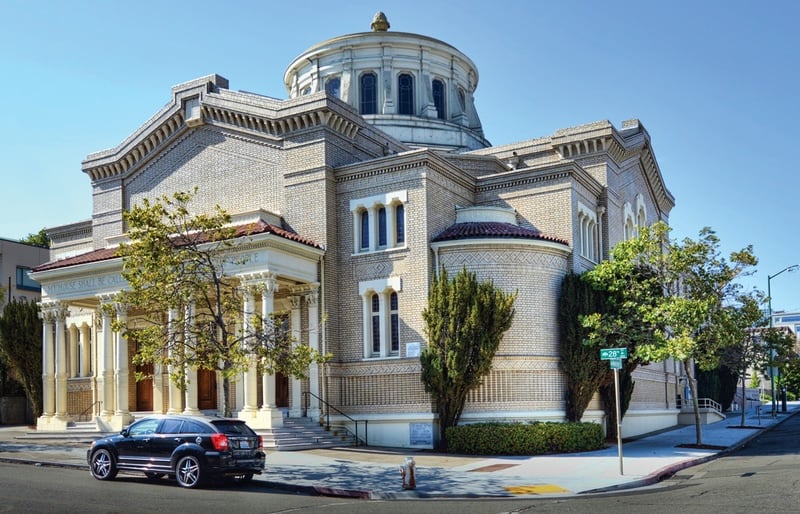
Temple Sinai of Oakland, California (Source: Temple Sinai of Oakland, California)
Temple Sinai, officially known as the First Hebrew Congregation of Oakland, is a Reform Jewish congregation and synagogue located at 2808 Summit Street, at 28th and Webster Streets, in Oakland, California. Founded in 1875, it is the oldest Jewish congregation in the East San Francisco Bay region and the oldest synagogue in Oakland. For nearly 150 years, Temple Sinai has been an important part of Oakland’s Jewish community, providing a place for worship, education, music, cultural life, social connection, and community service while continuing to evolve alongside the city it calls home.
I would like to thank the esteemed Terrie Goren, Executive Director of Temple Sinai, Oakland for her support and guidance.
Religious Events

Temple Sinai of Oakland, California, offers a welcoming Jewish community centered on worship, learning, tradition, and connection. The congregation welcomes members and guests to Friday evening Shabbat services with candle-lighting, song, prayer, teachings, sermons, guest speakers, and occasional special musical programs, followed by an Oneg Shabbat. Each Tuesday morning, members gather at 7:30 a.m. in the Albers Chapel for Minyan, beginning with a brief drash on the weekly Torah portion or another topic of Jewish interest before continuing with the traditional Shacharit prayers. Temple Sinai also provides opportunities to honor departed loved ones through its virtual Book of Remembrance and celebrates families welcoming new children through Hebrew naming ceremonies.
The congregation supports members through significant Jewish life-cycle experiences, including Confirmation, weddings, and times of loss. Confirmation helps students reflect on their Jewish identities as they transition from high school into young adulthood, emphasizing learning, personal reflection, and ownership of Jewish tradition. Temple Sinai clergy are available to officiate at Jewish weddings and to help congregants understand the traditions and rituals associated with the ceremony. During times of grief, the clergy and wider community provide pastoral support, while members are encouraged to discuss end-of-life wishes and funeral plans in advance with the clergy. Through these services and traditions, Temple Sinai accompanies its members throughout the many stages of Jewish life.
Music
Temple Sinai of Oakland has a vibrant music program that enriches worship with an eclectic range of Jewish musical traditions, including traditional, contemporary, folk, Chassidic, Middle Eastern, and classical Reform repertoire. Congregants and guests are encouraged to participate through communal singing, with music serving as a way to deepen spiritual connection, celebrate Jewish heritage, and express the kavanah, or intention, of prayer. The Temple’s Adult Choir, made up of approximately 25 to 35 people, welcomes anyone who enjoys Jewish music, singing, and community. No audition or Temple membership is required, and while music-reading skills are helpful, they are not necessary, making the choir an accessible way for people to become involved in Temple life and meet others.
Education
Temple Sinai of Oakland offers educational opportunities for all ages, emphasizing Jewish learning as a lifelong journey. Adult Education includes in-person and online classes on topics ranging from basic Judaism and Hebrew to Jewish history, philosophy, Torah, and Talmud. The Temple also supports those exploring conversion or choosing Judaism. For young families, the Family Center offers classes and community-building opportunities for children ages 0 to 2, while the David Pregerson Preschool provides a play-based Jewish education grounded in values of respect, community, curiosity, and inclusion.
Youth education continues through Kesher, Temple Sinai’s religious school program for children and teens. Elementary students participate in prayer, classroom learning, and activities such as music, art, and cooking, while the middle school program combines Jewish learning with social, emotional, and immersive experiences. Camp Kesher adds opportunities for children to explore nature, art, science, games, and other activities through a Jewish lens, with families gathering for Kabbalat Shabbat on Fridays.
Temple Sinai also guides students through important milestones and leadership opportunities. The Bet Mitzvah program combines religious school with individualized tutoring, study with clergy, and preparation for the ceremony. High school students can participate in the Madrichol leadership program, gaining experience while supporting younger students, and teens can take part in retreats and social programs that foster friendships, Jewish identity, and community. Together, these programs provide a continuum of Jewish education from early childhood through adulthood.
Culture
Temple Sinai of Oakland offers a wide range of adult groups and activities that encourage friendship, creativity, learning, and connection. Members can enjoy arts and crafts, board games, bocce, book groups, bridge, cooking, conversational Hebrew, gardening, hiking, mahjong, music, film discussions, Jewish genealogy, and Shabbat gatherings. Other groups organize Bay Area outings, travel discussions, and activities for grandparents. Members are also encouraged to suggest new groups, creating opportunities to build community around shared interests.
Temple Sinai also provides meaningful opportunities for service and support. The Brotherhood welcomes adult male-identifying members to participate in social activities and community mitzvot, while the Chevrah Kadisha helps care for individuals and families at the end of life according to Jewish tradition. The Caring Community supports people experiencing illness, loss, or other needs, while the Nechamah Committee offers comfort to those who are grieving and the Ritual Committee helps lead shiva minyanim. Together, these groups reflect Temple Sinai’s commitment to connection, caring, and community throughout all stages of life.
Community Service
Temple Sinai offers several opportunities for learning, dialogue, and community connection. Its Israel Education Committee provides educational programs and discussions led by academics and experts, exploring Israeli history, culture, law, politics, minority communities, women’s roles, and the relationship between religion and democracy. Sinai Coexist brings congregants together to learn, mourn, organize, and work toward a peaceful future in which Israelis, Palestinians, and others in the region can thrive. The Sinai BackFence provides an online community forum where members can exchange recommendations, share resources, and offer one another friendly support in everyday life.
Historical Backgrounds
Jews began arriving in California in the mid-19th century, with Jacob Frankfort, a German-born tailor, among the earliest documented Jewish settlers. Frankfort arrived in Los Angeles in 1841 as part of the Workman-Rowland wagon train. During the California Gold Rush, Jewish pioneers began settling in Oakland in the early 1850s. Among them was Samuel Hirschberg, who arrived in 1852 when Oakland had a population of only about 1,000 people. Many of these early Jewish settlers were young immigrants from Central Europe and Poland who established dry-goods stores, clothing shops, and other businesses that contributed to the developing community.
In 1862, Hirschberg and 14 other prominent Oakland residents founded a Jewish charitable institution and burial society, creating an organized foundation for the growing Jewish community. Three years later, in 1865, the community purchased land at the base of Mountain View Cemetery and established the “Home of Eternity” cemetery. These early institutions helped lay the foundation for the Jewish communal life that would continue to develop in Oakland for generations.
Which brings us to 1875.
In 1875, the United States had 37 states, and Ulysses S. Grant was serving as president during the Reconstruction era following the Civil War. That year, Congress passed the Civil Rights Act of 1875, landmark Reconstruction legislation that prohibited racial discrimination in public accommodations, including hotels, public transportation, and theaters, and sought to protect the right of African Americans to serve on juries.
At the same time, Oakland was a growing California city with expanding businesses and transportation connections to San Francisco. Ferry and transit services helped strengthen Oakland’s role in the developing Bay Area, while distinctive National Gold Bank Notes circulated among local businesses and residents, reflecting the city’s growing commercial activity.
It was in this year, 1875, the First Hebrew Congregation of Oakland, Temple Sinai was founded; marking it the oldest synagogue in Oakland. That year, 18 Jewish businessmen established the congregation, representing immigrants from Germany, Hungary, and Poland and reflecting the diverse origins of Oakland’s early Jewish community. In January 1876, the congregation met to elect officers and adopt its bylaws. Two years later, it built its first synagogue at 14th and Webster Streets, a building large enough to accommodate 500 worshippers. Although services followed Orthodox traditions, the congregation incorporated some reforms, including a sanctuary without a partition separating men and women. In 1881, Temple Sinai hired its first rabbi, Meyer Solomon Levy, who served the congregation for a decade before relocating to San Francisco.
In 1885, Temple Sinai’s first synagogue was destroyed by fire, but a member bravely rescued the Torah scrolls. The congregation soon built a new synagogue at 13th and Clay, with Rabbi Meyer Levy and the women of the congregation helping raise $3,700 through a Grand Fair. Rabbi Levy also championed Jewish education, successfully advocating for Jewish students to be excused from school during the High Holy Days.
During this period, the congregation included notable Oakland figures such as Gertrude Stein and Judah Magnes, while Rae Frank taught in its religious school. As Oakland’s Jewish population grew, the congregation moved to 12th and Castro in 1895 and gradually embraced Reform Judaism. In 1914, it dedicated a new building at 28th and Webster, officially taking the name Temple Sinai. The building featured a grand organ and an inscription from Isaiah: “My House shall be a House of Prayer for All Peoples.”
During the 20th century, Temple Sinai continued to evolve under a succession of influential rabbis. Rabbi Rudolph Coffee became known for addressing social issues, while Rabbi William Stern guided the congregation through the Depression and World War II, strengthening its community and interfaith involvement. Rabbi Samuel Broude later became active in civil rights, opposition to the Vietnam War, the arts, social action, and Jewish life, ultimately encouraging the congregation to remain in downtown Oakland. Rabbi Steven Chester continued this tradition after 1989, expanding Jewish education, music, preschool programs, and interfaith and community work.
In 2006, Temple Sinai launched a major expansion and modernization project that expanded classroom space and a new chapel that is used as for worship and community gathering. The clergy team currently leading the congregation includes Rabbi Jacqueline Mates-Muchin, the first Chinese American Rabbi and the first female Senior Rabbi, Cantor Ilene Keys, who is now the longest serving member of Temple Sinai’s clergy at 31 years, and Rabbi Andi Berlin, who started her career at Temple Sinai and has returned for a year as the congregation searches for a long term Assistant Rabbi.
Today, Temple Sinai stands as a testament to nearly 150 years of Jewish life in Oakland. From its beginnings as the First Hebrew Congregation of Oakland in 1875, the congregation has grown and evolved while remaining rooted in worship, education, music, community, and social responsibility. With a diverse community of nearly 1,000 member families, Temple Sinai remains a vibrant participant in the changing life of downtown Oakland and a center of its members’ lives. Its commitment to Jewish learning, cultural expression, community service, and care for others continues to connect generations, honoring the congregation’s rich history while creating new opportunities for Jewish life and community in the future.
Contact Information:
Temple Sinai, 2808 Summit Street, Oakland CA 94609
Phone: 510-451-3263
Email: templesinai@oaklandsinai.org
Website: https://www.oaklandsinai.org/