

Mathematics Teaching Professor, Author
170 Years of Jewish Life: The Story of Temple B’nai Abraham, Livingston, NJ
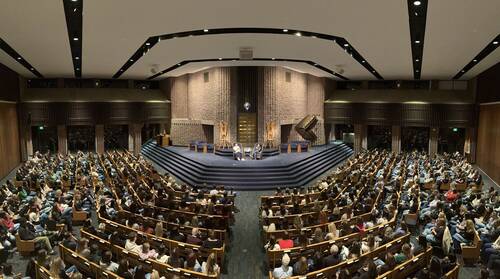
Rachel Goldberg-Polin speaks to a packed sanctuary of over 1,400 guests. (Source: Temple B'nai Abraham, Livingston, NJ)
For more than 170 years, Temple B’nai Abraham has been a cornerstone of Jewish life in New Jersey. An independent synagogue for more than 80 years, it has been guided by the community it serves, adapting to the changing needs of its members while preserving a strong foundation of tradition, connection, and service.
Today, Temple B’nai Abraham continues this legacy through vibrant worship, lifelong learning, and community engagement. Its clergy team, including Cantor Emily Simkin and Assistant Rabbi Becky Jaye, leads the congregation with warmth, vision, and a commitment to creating meaningful Jewish experiences for all.
I would like to thank the esteemed Rabbi Max Edwards and Marisa Ollins for their support of this article.
Synagogue
Temple B’nai Abraham in Livingston, New Jersey, is a welcoming and vibrant synagogue dedicated to meaningful worship, lifelong learning, and community connection.
The remarkable Ross Sanctuary is designed to inspire, featuring expansive clear-glass windows and an architectural skylight that fills the space with soft, natural light. This thoughtful design allows worshippers to feel connected to the beauty of the outside world while participating in services. The bimah is fully ADA accessible, and the sanctuary is equipped with a state of the art digital sound system and hearing assistance technology to ensure an inclusive worship experience.
For more intimate gatherings, the Gittlin Chapel offers the same architectural warmth and radiance as the Ross Sanctuary. It provides an ideal setting for smaller ceremonies, traditional ketubah signings, private bedeken ceremonies, and other meaningful occasions.
Temple B’nai Abraham also offers live streaming for Shabbat services held onsite, as well as many other services and community events. Recognizing that members of its kehillah k’doshah, sacred community, may not always be able to attend in person, the clergy is committed to making worship and congregational life accessible through modern technology, allowing members to remain connected wherever they are.
Torah Scrolls
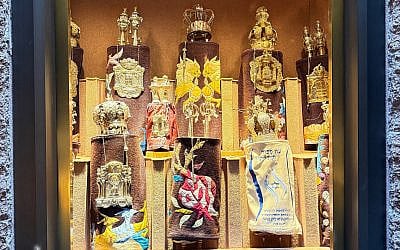
Temple B’nai Abraham is home to 13 Torah scrolls, reflecting the congregation’s rich spiritual heritage. The Torah mantles were created by renowned textile artist Ina Golub, who designed a total of 26 mantles for the congregation, 13 colorful mantles used throughout the year and an additional set of 13 white mantles for the High Holy Days.
Among the congregation’s Torah scrolls are two that survived the Holocaust, serving as powerful reminders of Jewish resilience and continuity. One of these is part of the Czech Memorial Scrolls collection, preserving the legacy of Jewish communities devastated during the Holocaust.
Religious Events
Temple B’nai Abraham welcomes the community each Friday evening for Shabbat services at 6:30 p.m., held in person and streamed through the LiveControl platform. Services feature a blend of congregational singing and cantorial music and are followed by an Oneg Shabbat reception.
The synagogue also celebrates the full cycle of Jewish holidays with meaningful worship services and special observances throughout the year.
Culture
Temple B’nai Abraham offers a variety of groups and programs that foster connection, service, learning, and engagement across all generations.
Sisterhood, The Women’s Connection, brings congregants together through friendship, service, education, and philanthropy. Members support the synagogue and community through programs, volunteer opportunities, Oneg Shabbat receptions, the Judaica Shop, chuppah rentals, scholarships, youth initiatives, and social action projects.
Men’s Club promotes friendship, service, and community involvement through cultural, educational, social, and volunteer activities. Open to all male congregants, the group provides opportunities to connect, participate in synagogue life, and support Jewish community initiatives.
Social Action Committee (SAC) provides opportunities for congregants of all ages to practice Tikkun Olam (repairing the world) through hands-on mitzvot, volunteer projects, and partnerships with synagogue groups.
The Pulse strengthens the Temple B’nai Abraham community by creating engaging, inclusive experiences that encourage connection, celebration, and involvement while supporting the congregation’s continued growth.
Prime Time welcomes adults age 55 and older, as well as all interested participants, for opportunities to socialize, learn, and explore together through a variety of programs and activities.
Learn
Temple B’nai Abraham offers lifelong learning opportunities for children, teens, and adults through engaging educational programs that nurture Jewish identity, knowledge, and community connection.
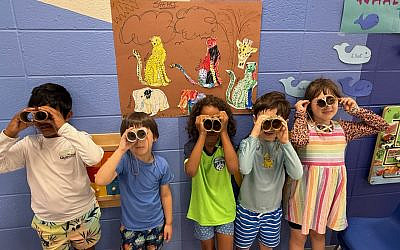
JStart Preschool provides exceptional early education for children from birth through age 5. Through innovative, age appropriate learning experiences, caring educators support each child’s unique development while fostering confidence, curiosity, and a love of learning.
Jewish Learning Program (JLP) engages students in grades K to 6 through Shoreshim, where children explore Jewish roots and values through Torah, Jewish history, Israel, art, music, prayer, modern Hebrew, holidays, and hands-on project-based learning.
Mechinah prepares 7th graders for Jewish adulthood and B’nai Mitzvah, emphasizing that this milestone is the beginning of a lifelong Jewish journey. Completion of the Mechinah year is required for students celebrating their B’nai Mitzvah at Temple B’nai Abraham.
Hebrew Pods (Mercaz Ivrit) provide grades 2 to 7 with small-group, individualized Hebrew instruction focused on reading skills, prayer, and preparation for B’nai Mitzvah.
Makom Teen Program welcomes students in grades 8 to 12 with meaningful experiences, community building, and engaging programs throughout the year, including an annual trip.
Temple B’nai Abraham Book Club brings adults together for thoughtful discussions and exploration of a different book each month.
Historical Background
In the early 1700s, the area that would become the United States consisted of Native American lands and British colonies along the East Coast. Most people lived in rural communities where daily life centered on farming, trade, and cooperation.
During this time, New Jersey became home to early Jewish settlers, including merchants such as Aaron Lozada of Bound Brook, who helped establish some of the colony’s first Jewish communities. Jewish families also settled in areas such as Monmouth County, contributing to the diversity and growth of colonial New Jersey.
Between 1700 and 1850, Jewish life in New Jersey developed from small, scattered settlements into more organized communities. By the mid 19th century, increased immigration from Germany and Central Europe brought significant growth and strengthened Jewish communal life throughout the state.
Which brings us to 1853.
In 1853, Franklin Pierce became the 14th President of the United States, leading a nation of 31 states facing growing tensions between the North and South over the expansion of slavery. Despite these divisions, the country continued to expand and develop.
New Jersey was undergoing a major transformation, shifting from a primarily rural farming state into an emerging industrial center. Canals, horse-drawn carriages, and the arrival of steam railroads reshaped transportation and connected communities across the state.
Newark had grown into a thriving manufacturing city with a population of nearly 48,000, fueled by industry, brewing, and waves of new immigrants. During this period of rapid change, Newark’s Jewish community numbered about 200 working-class families, many from Germany and Bohemia. Beginning as peddlers, many built successful businesses and helped establish the foundation of a growing Jewish community.
It was in that year, 1853, in Newark, that a small group of Jewish émigrés from Poland decided to form their own congregation. They first gathered in the home of Abraham Newman, laying the foundation for the congregation that would become Temple B’nai Abraham.
In 1855, the Jewish community acquired land for a cemetery and was incorporated under New Jersey law as “Congregation of the Sons of Abraham, B’nai Abraham,” honoring benefactor Abraham Newman and recognizing the tradition of Abraham as the first Jew. The congregation purchased its first building, a former Newark Baptist Church, in 1861.
After several moves over the next three decades, the cornerstone for a new 900-seat synagogue at High Street and 13th Avenue was laid in 1897. In 1924, the congregation raised the remarkable sum of $1,250,000 to build its final Newark home, a magnificent structure at Clinton and Shanley Avenues.
In 1939, Rabbi Dr. Joachim Prinz, who had escaped Nazi Germany in 1937, became the senior rabbi of Temple B’nai Abraham when the congregation was located in Newark, New Jersey. A powerful voice for civil rights and social justice, Dr. Prinz became a prominent leader in American Jewish life and used his experiences to advocate for equality and human dignity.
A close friend and ally of Dr. Martin Luther King Jr., Rabbi Prinz spoke immediately before King at the 1963 March on Washington, representing the American Jewish Congress as its president. His leadership helped guide Temple B’nai Abraham into a new era of community engagement and social responsibility.
Recognizing the movement of Newark’s Jewish community to western Essex County in the 1960s, Temple B’nai Abraham built a new home in Livingston, New Jersey, and relocated there in 1973, beginning a new chapter in the congregation’s history.
From its beginnings in Newark in 1853 to its current home in Livingston, Temple B’nai Abraham has remained a center of Jewish life, faith, and community. Through generations of change, the congregation has continued to honor its history while embracing new opportunities for worship, learning, service, and connection.
Contact Information:
Temple B’nai Abraham, P.O. Box 46, Livingston, NJ 07039
Phone: 973-994-2290
Email: tbainfo@tbanj.org
Website: https://www.tbanj.org/
Instagram: @templebnaiabraham