3 Movements of the Soul in the Storm of Existence
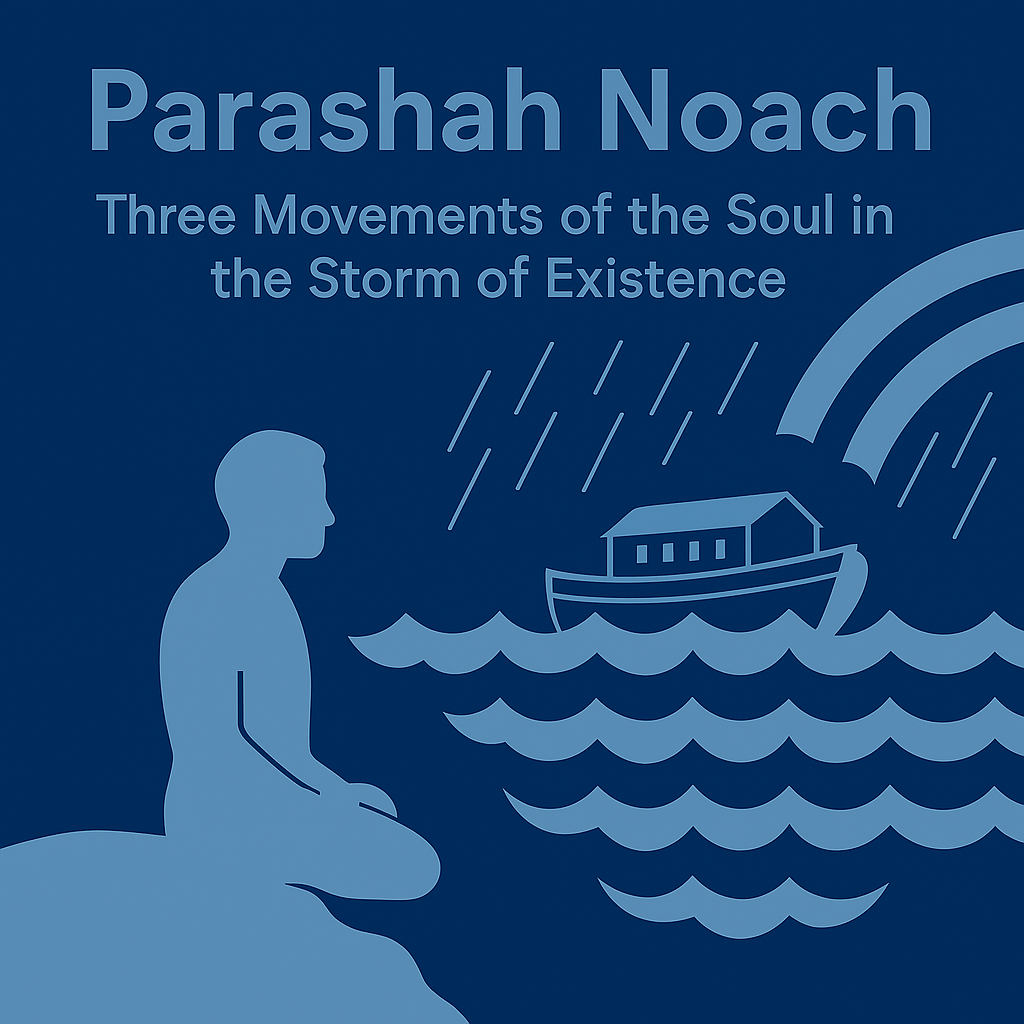
Parashat Noach – From the Teivah to the Brit: Three Movements of the Soul in the Storm of Existence
The earth was filled with ḥamas. Violence, yes, but more than that: corruption that dissolves the very meaning of what had been created. It was not only that human beings killed one another; it was that the whole world had been emptied of word, stripped of what had founded it. In the midst of this total collapse, Noach appears as tzaddik bedorotav — righteous in his generation. Not perfect at all, but different: he refused to be swept away by the current of violence that everyone had normalised.
First Movement: Teivah — Refuge in the Word
God commands: “עֲשֵׂה לְךָ תֵּבָה” — Make yourself an ark. The word תֵּבָה (teivah) appears only twice in the whole Torah: here, and in the basket of papyrus that would save Moshe. Not by chance.
Teivah means both ark and word. What Noach builds is not mere physical shelter: it is space sealed by obedience, a dwelling made of word materialised, a place where life can remain when everything outside disintegrates.
The faithful soul does the same. While the world shouts, destroys, fills itself with ḥamas, it encloses itself — not out of fear, but out of lucidity — in the word that preserves. Noach does not preach to his contemporaries, does not organise public resistance, does not protest: he builds. Every plank of gopher wood, every layer of pitch, every exact measure is an act of silent resistance. An act of faith in what is not yet seen.
The teivah establishes a radical truth: what does not enter into word is lost. There is no neutrality possible between refuge and flood, between inhabiting the word and dissolving into chaos. The first fidelity is not heroic: it is intimate, patient, obedient. It is to accept the measures received and to build according to them, even if the whole world considers the task absurd.
Second Movement: Zachor — Sustenance in Memory
The flood covers everything. The waters rise for forty days, prevail for one hundred and fifty. Noach is not spared from passing through judgement: he is spared within it. He is confined, surrounded by death, floating over a world reduced to primordial chaos. The teivah keeps him, but offers him no visible exit. There is no land in sight, no date of arrival, no sensory certainty.
The turning point comes when the text says: “וַיִּזְכֹּר אֱלֹהִים אֶת־נֹחַ” — And God remembered Noach.
זָכַר (zachor) is not psychological memory, not that God had forgotten and suddenly recalled. Zachor is to bring something from the past into the present with performative force, to make present what had been promised. When God remembers, things change: the wind blows — רוּחַ (ruaḥ), the very word for the Spirit that hovered over the waters in Bereshit — and the waters begin to subside. The land reappears not by natural evaporation, but because it is remembered back into existence.
The faithful soul discovers something crucial here: it is not enough to seek refuge in word. That was the first movement, necessary but insufficient. Now it must learn that existence itself is sustained because it is remembered from above. Waiting without visible proof, persevering in the teivah when nothing seems to change, becomes a pure act of trust. Trust that one does not sustain oneself, but is sustained by divine memory that does not cease.
Noach sends out the raven, then the dove. Once, twice, three times. The olive leaf in its beak: the world exists again. But that world did not emerge through the effort of the one who waited, but because the active zachor of God brought it back from the abyss.
Third Movement: Brit — Stability in the Covenant
God commands: “צֵא מִן־הַתֵּבָה” — Come out of the ark. Just as Noach did not enter by his own decision, he does not leave by initiative. The word that sheltered now liberates. And the first thing Noach does upon leaving is to build an altar and offer sacrifice. The רֵיחַ נִיחֹחַ (reach nichoach) — the pleasing aroma — rises, and God utters something unexpected:
“I will never again curse the ground because of man, though yetzer lev ha’adam ra mine’urav — the inclination of the human heart is evil from youth.”
Radical paradox: God promises never to destroy again precisely because He recognises that humanity will remain fragile and prone to evil. The promise does not depend on human reform, does not wait for humanity to become righteous. It depends entirely on divine decision. The zachor — the memory of Noach floating, sustained — becomes brit: commitment that limits divine justice itself.
God establishes covenant with Noach, with his sons, with all living creatures, with the earth itself. Sign: the bow in the clouds. Each time it rains and the rainbow appears, God Himself will remember His covenant. It is memory that obligates God, self-limitation inscribed in the sky.
Fragility under the Covenant
The story does not end with the bow. Noach plants a vineyard, drinks, becomes drunk, lies uncovered. His sons react in opposite ways: some cover, another mocks. Blessing and curse are born from that moment. The tzaddik of the flood becomes a vulnerable man. The covenant does not erase fragility: it only gives a framework so that history does not collapse back into chaos.
Soon after, humanity raises Babel: a tower as anti–teivah. A construction not sealed by received word, but raised to make a name for itself and avoid dispersion. God confuses tongues, scatters peoples. But He does not destroy. Because the brit is already in force: even human error unfolds within a framework of continuity.
Teivah → Zachor → Brit
-
Refuge in word: salvation begins by inhabiting the word that preserves. It is not enough to know it exists; one must build according to its measures, enter when commanded, remain until told to leave.
-
Sustenance in memory: life subsists because it is remembered from above. The faithful soul does not sustain itself by its own strength nor by accumulated merit, but because God actively brings it into the present.
-
Stability in covenant: existence finds permanent framework in the covenant that self-limits divine judgement. The rainbow does not signal virtue achieved, but grace sustained.
How I Understand Parashat Noach in Relation to Human Life
The story of Noach reveals how the human soul responds to collapse. Each reader may recognise themselves in one of these three movements:
-
Judgement: What am I seeing collapse in my world? What does that downfall tell me about what I have ignored or allowed?
-
Silent fidelity: What inner structure am I building in the midst of chaos? Am I nourishing my centre or yielding to the environment?
-
Transformation with memory: What wound, loss, or trial has made me more human? What lesson can I no longer forget, and to which I must remain faithful?
To live like Noach today is to resist without shouting, to build without being understood, to love without external proofs. It is to act from a covenant that does not depend on success, but on fidelity. It is to seal the ark from within, each day, knowing that this silent gesture may be the only thing that saves the future.
The covenant is not only with God outside. It is sealed also in the purest within you, and from there, if honest, it sustains the world.