

30 Years After Rabin’s Assassination – What’s the lesson learned?
On November 4th, 1995, I was one of the 100,000 people in Kings of Israel Square in Tel Aviv, who were inspired by Yitzhak Rabin’s last speech before he walked down the stairs to meet Yigal Amir’s three shots that changed everything. At the time, I was a Tel Aviv representative on the Peace Now movement’s national leadership forum, and in the days before social media, our role was to try to ensure that if the rally was organized, the people would come. We knew about Rabin’s hesitation and fear that they wouldn’t. But they did. And they kept on coming. There was tremendous excitement and energy in the air. Youth movement kids bunny-hopped around the square, peace signs were everywhere.
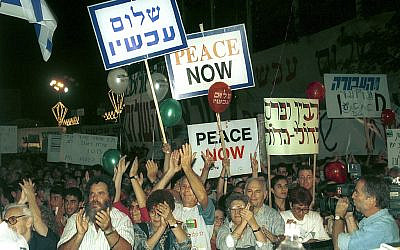
That “Yes to Peace, No to Violence” demonstration was the answer to the right-wing rally a month earlier at Zion Square in Jerusalem, where the crowd, egged on by opposition leader Benyamin Netanyahu’s Mussolini-like incitement-filled speech delivered from a balcony overlooking the square, shouted “Death to Rabin!” and held pictures of him in a keffiyeh, or as a Nazi. At the time, no one used the term fascistic to describe what was happening. Unlike today, with the ongoing attempt to undermine the independence of the courts and freedom of media and educational expression, accompanied by now Prime Minister Netanyahu’s dream of Israel becoming a “Super-Sparta” and an autarchic society cut off from the rest of the world, relying totally on its own resources.
“The people truly desire peace and oppose violence”
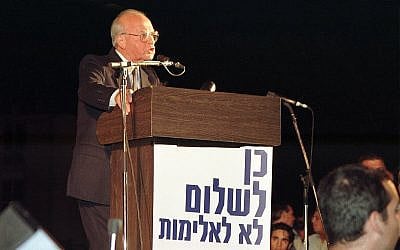
Standing there, listening to his speech, we were all impressed and inspired when he said, “I was a military man for 27 years. I fought so long as there was no chance for peace. I believe that there is now a chance for peace, a great chance. We must take advantage of it for the sake of those standing here, and for those who are not here — and they are many. I have always believed that the majority of the people want peace and are ready to take risks for peace. In coming here today, you demonstrate, together with many others who did not come, that the people truly desire peace and oppose violence…”
We also smiled when he talked about “This government which I am privileged to head, together with my friend, Shimon Peres…” knowing the ongoing rivalry between them. I remember saying to a Peace Now colleague that his delivery was much smoother than usual, which was frequently quite awkward. Rabin was clearly relieved after all the abuse he had suffered from right-wing elements to see so many people come out to express solidarity and support for his policy and effort.
Two moving acts of memory
Today, 30 years later, there were two very moving acts in memory of that fateful day. At Heichal Hatarbut in Tel Aviv, home of the Israeli Philharmonic Orchestra, filmmaker Amos Gitai presented the first ever performance in Israel of his powerful show “Yitzhak Rabin: Chronicle of an Assassination”, a moving pageant with videos, poetry, music and testimonies from Rabin’s wife Leah, the last interview with Rabin himself, quotes from Julius Caesar, images of Netanyahu’s incitement and much more.
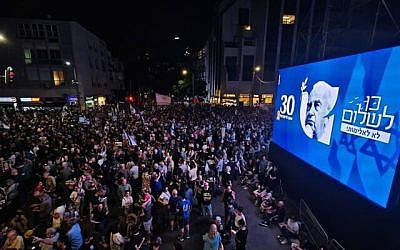
This was followed by a 30th anniversary rally with the participation of over 80,000 people near Rabin Square (the post-assassination name for Kings of Israel Square), adjacent to the area of the original “Yes to Peace, No to Violence” rally in 1995 and the spot where the assassin’s three bullets were fired. This was the first memorial rally for Rabin after a five-year break due to COVID and the war. After a year of demonstrations for democracy against the attempt to undermine the independence of the courts, and two years of demonstrations for the return of the hostages and eventually the end of the war, this was the first demonstration in which the call for peace was front and center. The headline in Ha’aretz the next day was “The Peace Camp has been liberated from the paralysis that struck it by the murder and by October 7th. We have awakened.”
So what lesson do I take away from this? First of all, as Amos Gitai says, “we have to act against forgetfulness.” We must preserve the memory of what happened, and who was responsible. We also have to act against the attempt to depoliticize the memory of the significance of what Rabin was trying to do and why he was assassinated. Yigal Amir wanted to kill the peace process by killing Rabin, who the right was afraid had the authority to carry out the negotiations and to make the necessary compromises for peace with the Palestinians. Avrum Burg, the former Speaker of the Knesset and head of The Jewish Agency for Israel, is among the many who say that Amir succeeded.
We can’t do it alone and need the international community to help
The major lesson I take away from comparing the reality 30 years ago and today is that, at the time of the “Yes to Peace, No to Violence” rally, it was possible to believe that Israelis and Palestinians could be the primary drivers for a peace agreement between the two nations. The 1993 Oslo Agreement, led by Yitzhak Rabin and Yasser Arafat, and signed on the White House lawn by Shimon Peres and Mahmoud Abbas, was a totally Israeli-Palestinian led initiative, backed by strong civil society elements in both societies, particularly Peace Now on the Israeli side.
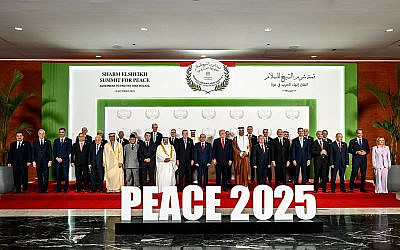
Today it is not possible to imagine a peace process initiated and led by the Israeli and Palestinian leaderships. International involvement is absolutely essential. The first steps towards this realization are the French-Saudi Initiative to end the war and build a road to peace based on a two-state solution, which led to the New York Declaration, the momentum to recognize a Palestinian state alongside the State of Israel, the Trump-imposed end to the 2 year war, the 20 Point Plan and the Sharm El- Sheikh Declaration.
We need a change of leadership, on both sides
One of the challenges on the Israeli side is the fact that the presumed leader of an alternative government, former Prime Minister Naftali Bennet, did not participate in the 30th anniversary rally at Rabin Square. If one could meld The Democrats Party former IDF Deputy Chief of Staff head Yair Golan with former Foreign Minister Tzippy Livni’s speech, together with former Prime Minister Yair Lapid’s speaking abilities and the moral authority of former hostage from Kibbutz Nir Oz Gadi Moses, the last speaker at the rally, into one alternative leader, we might have a new generation Rabin. Maybe AI could help with this.
But seriously, we need a change in both the Israeli and Palestinian leadership, along with the consistent “encouragement” and active involvement of the international community, to be able to take advantage of the current historic moment to initiate a new peace process, in the spirit of Yitzhak Rabin’s legacy.