
From Kibbutz to the global stage
3I/ATLAS – If the Earth Is About to Burn, Will NASA Still Keep Its Data Locked?
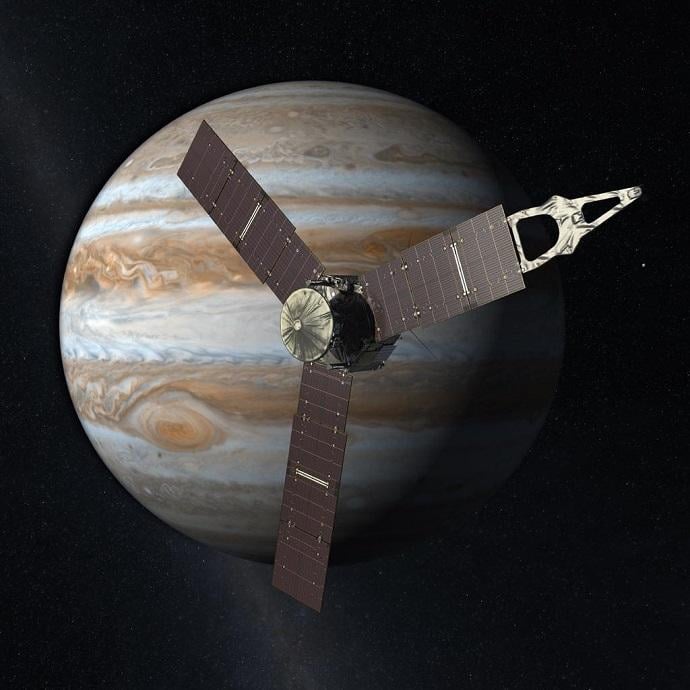
Image Source: A NASA simulation of the Juno spacecraft in orbit around Jupiter — could this probe be humanity’s first to meet an interstellar visitor? Credit: NASA,
3I/ATLAS – If the Earth Is About to Burn, Will NASA Still Keep Its Data Locked in Drawers?
The mysterious visitor that tests the limits of science, silence, and imagination.
The Daily Mail, Economic Times, and India’s WION network—joined by the New York Post and Harvard astrophysicist Prof. Avi Loeb—are reporting today on several troubling findings regarding the interstellar object 3I/ATLAS.
The first: new images from a Spanish observatory show 3I/ATLAS with no visible tail.
The second: a strange change in color.
The third: a deviation from its predicted path and an unexpected increase in speed—evidence of a non-gravitational force.
And the fourth: a lack of material that should have evaporated near the Sun and provided thrust to the object.
According to estimates, more than 13 percent of its mass—about 4.4 Billion tons—has vanished.
If confirmed, this could indicate an external power source, unless forthcoming observations prove a natural cometary cause.
So the question arises:
What kind of engine could propel a body moving through space with a mass of 33 billion tons, rich in carbon monoxide (CO), poorer in carbon dioxide (CO₂), and containing about 5 percent water?
Could these materials serve as fuel, and what scale of engine would be required to increase its speed by another 20–30 kilometers per second?
This question is relevant not only to 3I/ATLAS, but also to my previous Times of Israel article of October 29, where I suggested that comets and interstellar bodies might one day serve as bridges for research and transport between our Solar System and the wider Milky Way.
Recently, scientists at the Massachusetts Institute of Technology (MIT) reported a remarkable success with one of the devices aboard NASA’s Perseverance rover on Mars: the MOXIE experiment, designed to produce oxygen from Mars’s atmosphere—composed of 96 percent carbon dioxide.
The device draws in atmospheric gas, compresses and heats it to 800 °C using the rover’s nuclear generator, and channels it through metallic catalysts that split carbon dioxide into carbon monoxide and oxygen atoms.
These atoms combine into O₂—molecular oxygen—which is measured and released back into the Martian air.
In a paper published in Science Advances, the researchers reported that during the rover’s first year on Mars, MOXIE operated seven times under different conditions—day, night, and seasonal changes—for sessions of one to one-and-a-half hours each.
In all cases, it worked flawlessly, producing about six grams of oxygen per hour.
A small amount, yes—but proof that the technology works.
Near the Sun, where extreme heat is abundant, similar methods could, in principle, extract oxygen from CO₂ without added energy input.
That means a comet or an interstellar body might generate its own power using internal compounds—CO, CO₂, and H₂O—as natural propellants.
Scientists might also hypothesize that the large quantities of CO observed around 3I/ATLAS are linked to processes that release oxygen from CO₂—naturally or otherwise.
Another possibility is to exploit the water detected on the object, splitting it into hydrogen and oxygen: hydrogen as fuel, oxygen as oxidizer.
Water collected in space is already recycled for drinking, cooling, and fuel production.
If comets indeed carry abundant water, they could become the universal energy resource of the future.
For now, patience is required.
We must wait for new data from telescopes on Earth and in space—and for clear answers about what is happening there, and what it means for us here.
Reader’s Note
One of my readers, a 50-year-old from Kfar Saba, Israel, wrote to me:
“There’s nothing to do—if you skip your morning pills, you start doing crazy things.”
I replied:
“We have to stay optimistic. Even if this turns out to be an artificial object with technological influence—let’s treat it as a thought experiment.
Why would something seven billion years old travel all this way to threaten us, when it likely possesses technologies far beyond our imagination?
Perhaps, more reasonably, curiosity itself is part of evolution—of the universe, just as it is of humanity. Shabbat Shalom.”
Meanwhile, NASA remains silent.
No budget approval to release the images and data.
And the world? It could still burn.
Let’s hope—and pray—it won’t.
Image Caption:
An artistic visualization of a possible encounter with 3I/ATLAS.
In a recent paper, Prof. Avi Loeb and his British collaborators Adam Hibberd and Adam Carroll proposed using NASA’s Juno spacecraft to study 3I/ATLAS when it passes near Jupiter on March 16, 2026.
Juno has been orbiting Jupiter since 2016 and is scheduled for decommissioning late this year—either to burn up in the Jovian atmosphere, or, if NASA accepts their proposal, to collide with 3I/ATLAS, transmitting images and data from the mysterious visitor.
Image Source:
A NASA simulation of the Juno spacecraft in orbit around Jupiter — could this probe be humanity’s first to meet an interstellar visitor?
Credit: NASA,
A NASA simulation of the Juno spacecraft in orbit around Jupiter — could this probe be humanity’s first to meet an interstellar visitor?
Credit: NASA,
Related Topics