
’80s Cool, 2030 Whiz, Spandex Optional: Meet Israel’s ‘Megaforce’ Rolling Fleet
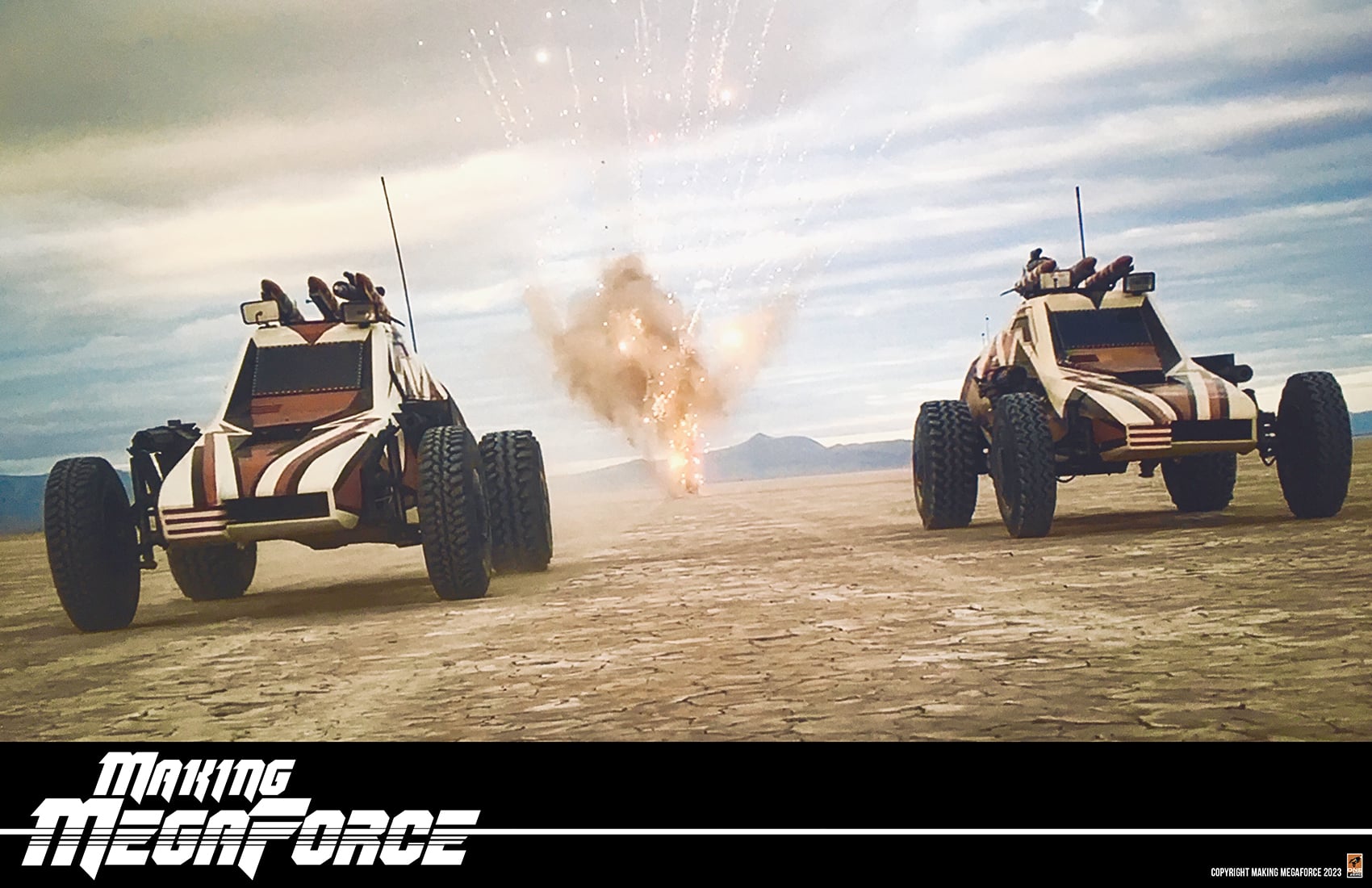
Perhaps drawing inspiration from the high-octane aesthetics of 1980s cult cinema, future-tech concepts in specialized vehicle engineering are emerging that seem to bridge the gap between silver-screen fantasy and military-oriented all-terrain design realities for the theater of war.
This vision in motion for a state-of-the-art dune buggy fleet–reminiscent of the iconic, ultra-cool, rapid-deployment vehicles featured in the 1982 “cult” film Megaforce–and celebrated recently by Making Megaforce–emphasizes a futuristic tech approach to design mobility.
By prioritizing extreme agility, low-profile silhouettes, and advanced maneuvering systems, these platforms aim to redefine how vehicles navigate challenging, no guts, no glory, high-stakes environments, bringing the need for speed and pizzazz of cinematic retro into the realm of 6th/7th generation fully autonomous and AI-integrated dune buggy innovation.
But it’s going to take critical minerals and brains.
The Arabian Shield, located predominately in neighboring Saudi Arabia, is currently the most vital Middle Eastern region for future critical minerals needed for advanced vehicle tech. It holds substantial reserves of copper, tantalum, niobium, and rare earth elements necessary for prospective Israeli “Megaforce” buggies as all-terrain, high-tech exports.
Riyadh has deliberately prioritized its strategic, technological, and economic partnership with Israel’s ally in the United States over Israel itself regarding critical minerals, pursued by U.S. tech interests in competition with China for AI-dominance.
And Riyadh is prioritizing U.S. tech, investment, and expertise to transform its mining sector under Vision 2030, rather than sourcing Israeli technology. .
For Israel to get a handle on the U.S. pursuit for what the Arabian Shield has to richly offer in the form of rare earth elements, though a strategic partner, it must focus harder on leveraging its technological expertise, research and development to rival ruthless Western competition.
It appears Washington D.C. has front-loaded sensitive technology cooperation and security assurances–including critical minerals–without requiring Saudi commitment to normalize relations with Israel.
The Brain Game
It’s the “brain game” that puts Israel in the driver’s seat. But Israel’s dealing with the same U.S. interests making “a ton” off the rigid-minded Iran war in Alphabet (Google), Meta, Microsoft, NVIDIA. Amazon (Hyperscalers), naming the exceptional U.S. competitors.
In addition, Israel is also dealing with U.S. tech interests in: MP Materials, US Strategic Metals, Cisco, Bechtel, Albemarle, Qualcomm and xAI (Elon Musk’s self-branded world domination endeavor) to name other companies providing challenge to Israel’s AI goals.
U.S. tech giants are investing billions to build AI data centers in Saudi Arabia, facilitating access to raw materials and energy, with sustainability, growing financial instability, and ethical alignment all concerns.
This U.S.-Saudi partnership has deepened, as far as fair-weather friends go, into a perceived “new golden era,” that combines for the moment Saudi capital and energy with U.S. technical expertise, directly affecting Israel’s ambition to be the mother AI hub in the Middle East.
But with Israel’s high-tech, combat-ready buggy exports in the realm of possibility, ongoing fiscal concerns and international policy mistakes by the Trump administration could trigger a further depreciation of the U.S. dollar and higher inflation, eroding the purchasing power of U.S. tech giants made to feel smaller and even paler.
In a stronger fiscal position, Israel’s defense strategy must have a balance between strong national security and strong economic growth because the two are mutually dependent.
But some less-capitalized, struggling to scale, Israeli wartime innovation startups face existential threat, and as a result of their lack of means and talent, face a slow death in a high-risk, high reward position on the side of the hunt where multi-national “buzzards” (particularly from the U.S.) feast on “road kill” firms.
Japan, South Korea, Taiwan, and Australia Buying Buggies
Japan, South Korea, Taiwan, and Australia are nations now looking beyond the U.S. for technologies that provide a qualitative edge in protecting their homeland personnel and combating threats.
Israel could put itself in the lucrative position to offer unique, rugged, combat-ready solutions for reconnaissance and special “Megaforce-type” rolling operations as a burgeoning export business of “dune buggy” style ultralights. These countries mentioned would eat this up like jam on matzah. There’s a demand for rapid deployment and high mobility tactical vehicles.
The export business between U.S tech defense companies and Japan, South Korea, Taiwan, and Australia regarding “military-type dune buggies” giving edge to defense and warfare is foolishly underdeveloped and a great post-war opportunity for Israel with eyes wide open.
How could U.S. tech miss this money-making opportunity? I don’t know. I guess they’re not eating their organic leafy greens.
Its starts with 2030 vision: 6th./7th. Gen. “Megaforce” Dune Buggy Fleet (2030-2035+).
- Fully Autonomous & AI integrated: Israeli buggies into the year 2030 fast approaching will be designed to navigate complex dune terrain (hopefully minus radioactive nuclear fallout) without driver input, using Israeli-generated AI for optimal pathfinding and high-efficiency, “fuel- free” (renewable, ambient energy) management.
- Modern “Sun Power” Integration: Israeli buggies that fully power themselves through advanced foldable solar collectors and/or energy-harvesting paint matching driver’s “eco-elastane” spandex “activeAIwear.”
- Smart Materials: Adoption of adaptable materials that can instantly adjust stiffness or shape based on speed and terrain.
- Hydrogen Fuel Cell Tech: Slated exploration of hydrogen fuel for long-range. quick-refueling off-road “Megaforce-type” jaunts.
Exporting combat-ready dune buggies (such as future year-to-year models of the Carmour Mantis and REGO Patrol X ) to Japan, Taiwan, South Korea, and Australia would represent a significant expansion of Israel’s growing defense exports. As a part of a post-war strategy, this would leverage the “battle-tested” reputation of Israeli technology, should it not be stressed by a CENTCOM “paths of glory” enterprise to keep war with Iran running hot.
Israel’s potential economic benefits include:
1.) Direct Revenue and GDP Growth
- Rising Export Growth: Direct Revenue and GDP Growth: Israeli defense exports have jumped higher significantly, driven by demand for Israeli vehicles and APCs. Adding “Megaforce-type,” high-tech ATVs to rolling stock, especially premium markets like Japan, South Korea, Taiwan, and Australia, could ramp revenue by leaps and bounds.
- High-Margin Deal Slip: Savvy Israeli defense firm CEOs, including those taking cues from Megaforce by developing futuristic, specialized ATVs inspired by the ’80s flick, could in theory secure substantial East Asia/Oceania contracts.
- GDP Contribution: The defense sector export expansion is a vital contribution to Israel’s economic future, with high-tech often acting as a “Masada” for economic growth during wartime crisis.
2.) Investment and Partnerships (Foreign Strategy)
- “Battle-Tested” Marketing: Israeli vehicles in high-intensity conflicts (Gaza/Lebanon) are in high demand. Sales to the 4 listed Asia-Pacific nations would validate Israeli tech for new markets, competing with U.S.interests, and attracting foreign direct investment.
- Deepening Alliances: Combat-ready dune buggy exports to Japan, South Korea, Taiwan, and Australia strengthen Asian-Pacific defense ties, providing great potential based on mutual success to collaborative research and development projects, leading to reduced future development costs for Israeli firms.
But a problem exists with the 4 economic alliances. The coordinated military actions by the U.S. and Israel, led by Prime Minister Netanyahu’s obsession with upheaval of the Iranian state, has resulted in significant energy supply disruptions and crisis-level elevated energy prices for Asian-Pacific nations.
Netanyahu’s attitude that it’s not Israel’s major concern is his call. For this has indeed caused tension in import-export relationships as countries struggle with energy shortages, inflation, and a re-evaluation of their energy security alliance with Israel.
3.) Employment and Manufacturing Surge
- High-Tech Jobs: Increased production demands for stuff like AI surveillance, remote weapons stations on high-tech buggies could send defense sector hiring to new heights.
- Tech Ecosystem: Production could benefit the broader technology and manufacturing ecosystem, including aggressive sub-contractors and ambitious Israeli tech startups..
4.) Shekel Strength & Market Might
- Strengthening the Shekel: Large-scale buggy exports help maintain the stability and value of the shekel.
- Investor Confidence: Buggy sales could help boost investor confidence in the Israeli economy, mitigating risks of credit downgrades during post-war recovery.
Israel’s long-term post-war economic resilience could invigorate by diversifying into East Asia/Oceania with “battlefield buggy” exports, taking the pressure off European export restrictions, which in turn drives sales.