


88 Years After Kristallnacht, a Holocaust Survivor Dies of Antisemitic Terror
As Jews commemorate Kristallnacht, synagogues are burning, Jewish businesses are being targeted, and a Holocaust survivor has died following an antisemitic terrorist attack in Australia. The promise of Never Again is being tested.
Eighty-eight years ago, on November 9 and 10, 1938, the streets of Germany and Austria were engulfed in violence against the Jewish people.
Synagogues were set ablaze. Jewish businesses were smashed and looted. Homes were ransacked, families terrorised, and approximately 30,000 Jewish men arrested and sent to concentration camps.
The shattered glass covering the streets gave the pogrom its infamous name: Kristallnacht, the Night of Broken Glass.
It marked a devastating escalation in Nazi persecution, demonstrating what happens when antisemitism becomes normalised, tolerated and ultimately translated into violence.
The world knows what followed.
For generations, we have promised Never Again. We have built Holocaust museums, erected memorials and educated our children about the consequences of hatred.
Yet tonight, on the 88th anniversary of Kristallnacht, Jews across the Western world are again confronting burning synagogues, threatened businesses and deadly antisemitic violence.
Have we truly learned anything from history?
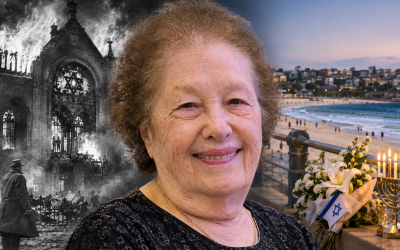
Perhaps no story captures the painful significance of this anniversary more powerfully than that of Eva Geller.
Eva survived the Holocaust as a child, escaping Nazi persecution in Romania before rebuilding her life in Australia.
On December 14, 2025, she attended a Hanukkah celebration at Sydney’s Bondi Beach, where two gunmen opened fire on Jewish families gathered to celebrate the festival of lights.
Fifteen innocent people were murdered and dozens wounded in an antisemitic terrorist attack that shocked Australia and the world.
Eva, then 89, was among those shot.
She was not the only Holocaust survivor whose life was touched by the Bondi massacre. That survivors of Nazi persecution should again confront antisemitic violence, this time on Australian soil, is a devastating reminder of how far we remain from fulfilling the promise of Never Again.
Despite serious injuries and repeated hospitalisations, Eva demonstrated extraordinary determination, managing to walk again after doctors reportedly told her she would never do so.
But on November 5, 2026, just days before the anniversary of Kristallnacht, Eva Geller died at 90, becoming the 16th victim of the Bondi massacre.
Consider the heartbreaking symbolism.
A Jewish woman who survived Nazi persecution, found refuge and built a life in Australia, was shot nearly nine decades later while celebrating her Jewish faith.
She escaped the antisemitism of Hitler’s Europe, only to become a victim of antisemitic terrorism in modern Australia.
What does Never Again mean when even Holocaust survivors cannot live out their final years free from antisemitic violence?
 For Australian Jews, the warning signs have been impossible to ignore.
In December 2024, Melbourne’s Adass Israel Synagogue was firebombed while worshippers were inside. The attack was subsequently classified as terrorism.
In July 2025, another Melbourne synagogue, in East Melbourne, was deliberately set alight while approximately 20 worshippers were inside.
That same evening, protesters violently targeted the Israeli-owned Miznon restaurant in Melbourne’s city centre.
Sydney has witnessed antisemitic graffiti and arson attacks, including the October 2024 firebombing of Lewis’ Continental Kitchen, a kosher delicatessen in Bondi, and the January 2025 firebombing of a childcare centre in Maroubra. Australian intelligence subsequently linked the attack on Lewis’ and Melbourne’s Adass Israel Synagogue to Iran’s Islamic Revolutionary Guard Corps.
And then came Bondi.
Australia, a country that prides itself on multiculturalism and religious freedom, has witnessed synagogues burning and Jewish families murdered while celebrating Hanukkah.
And Australia is far from alone.
In March 2026, a synagogue in Rotterdam was firebombed. An incendiary explosion damaged a synagogue in Liège, Belgium. Jewish institutions in Germany have faced vandalism and attempted arson, while synagogues in Canada have been targeted by gunfire.
In Manchester, an attack at Heaton Park Hebrew Congregation on Yom Kippur in October 2025 left two people dead.
Different countries. Different circumstances. Yet the same disturbing reality: Jewish communities are confronting intimidation and violence in societies that promised to protect them.
Perhaps the most disturbing symbolism surrounding this anniversary comes from Philadelphia, the American city synonymous with liberty and freedom.
On November 8, the eve of Kristallnacht, pro-Palestinian activists planned a “Boycott Ride” targeting six Jewish-owned or Israeli-associated restaurants and businesses. What they did not count on was the large contingent of pro-Israel protestors to drown out their noise.
Promotional material declared: “No business for Zionists!” and “These Zionist Establishments must go! Not in our city!”
The planned demonstration drew condemnation from Philadelphia Mayor Cherelle Parker, Pennsylvania officials and Jewish community organisations.
The fact the event was planned on such an anniversary demonstrates clearly this is antisemitism masqueraded as antizionism.
Consider the significance.
On the eve of commemorating a Nazi pogrom remembered for the destruction of Jewish-owned businesses, activists are identifying Jewish-associated establishments and declaring that they do not belong in their city.
A planned boycott in a democracy is not equivalent to the state-orchestrated violence of Nazi Germany. But the historical echoes in the language of exclusion are deeply disturbing.
The organisers may describe their actions as antizionism rather than antisemitism.
Yet when Jewish business owners are targeted because of their identity or presumed connection to Israel, that distinction becomes increasingly difficult to sustain.
A Jewish restaurateur in Philadelphia is not the Israeli government. A Jewish-owned café is not a military installation.
Jewish families should not have to justify their right to operate businesses because others object to Israel.
Antisemitism has always adapted its language to the political circumstances of the day.
Throughout history, Jews have been accused of disloyalty, economic manipulation and collective responsibility for events beyond their control.
Today, hostility towards Jews is sometimes expressed through the language of antizionism.
Criticism of Israeli government policy is not inherently antisemitic if the same standards are applied to other countries. But when synagogues are firebombed, Jewish businesses intimidated, and Jewish communities collectively blamed for events in the Middle East, the boundary has clearly been crossed.
No political slogan can transform the intimidation of Jewish civilians into legitimate protest.
Why should a synagogue in Melbourne burn because of events in Gaza?
Why should Jewish businesses in Philadelphia be singled out?
Why should a Holocaust survivor celebrating Hanukkah at Bondi Beach become the victim of a terrorist massacre?
These questions deserve answers, not excuses.
Kristallnacht teaches us that antisemitism does not begin with burning buildings.
It begins when hatred is excused, discrimination becomes acceptable, Jewish neighbours are treated as outsiders, and bystanders convince themselves that someone else’s persecution is not their concern.
Our world in 2026 is not Nazi Germany in 1938. The Holocaust remains historically unique in its scale and systematic destruction.
But history need not repeat itself exactly for its warnings to matter.
Tonight, as we remember the broken glass of November 1938, we must also remember Eva Geller.
A woman who survived the Holocaust, rebuilt her life and lived to see her 90th birthday, only to die following an antisemitic terrorist attack in the country she called home.
Her story should never have ended this way.
Never Again was never meant to be merely a promise to remember the dead. It was meant to be a commitment to protect the living.
Eighty-eight years after Kristallnacht, that commitment is being tested once more.
The question is whether the world will finally act before the glass shatters again.