


Mathematics Teaching Professor, Author
88 Years After Kristallnacht: Why Are Jews Still Being Targeted?
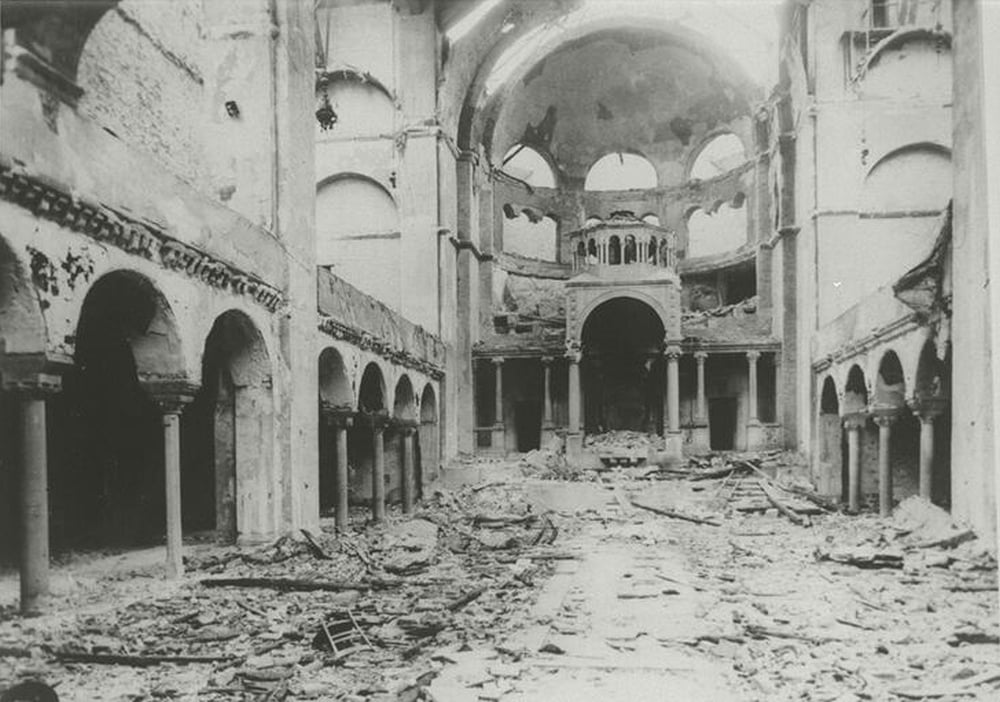
Partially destroyed Fasanenstrasse Synagogue in Berlin (Source: Public Domain)
The targeting of Jewish-owned businesses in Philadelphia, on the eve of the 88th anniversary of Kristallnacht, raises disturbing questions about the persistence of antisemitism and the lessons of history.
The planned bicycle boycott of Jewish-owned businesses in Philadelphia is a troubling reminder that antisemitism remains part of contemporary society. Its timing is particularly significant: the demonstration is scheduled for November 8, 2026, immediately before the 88th anniversary of Kristallnacht, the Nazi-organized pogrom of November 9-10, 1938.
The comparison between these events must be measured carefully. While a planned bicycle demonstration is not equivalent to the organized violence, destruction, and mass arrests of Kristallnacht, the deliberate identification and targeting of businesses because their owners are Jewish raises serious concerns about discrimination, intimidation, and the exclusion of Jews from ordinary community life. The question history compels us to ask is where such hostility leads if it is tolerated, normalized, and left unchecked, and whether, 88 years after Kristallnacht, we are once again witnessing the early warning signs of a society willing to turn against its Jewish citizens.
Thus the question is not simply what motivates the organizers. It is also what their actions communicate to the Jewish community and to the broader public.
Philadelphia: Jewish Businesses Become Targets
According to reporting about the planned demonstration, the organizing group, Philly Bike On Your Left, has promoted a bicycle ride through Philadelphia’s Rittenhouse Square neighborhood, identifying six restaurants and businesses described as Jewish-owned.
Promotional material reportedly uses language such as: “Ride around Rittenhouse with us as we show these Zionist business owners that we see them for the disgusting humans they are.” Another message calls for these establishments to be removed from the city.
The language is significant. Rather than addressing individuals based on specific conduct, the campaign identifies businesses through the perceived identity and affiliations of their owners.
Pennsylvania Governor Josh Shapiro’s office condemned the planned demonstration, describing it as an attempt to intimidate Jewish businesses and drive them out of local communities.
Pennsylvania Attorney General Dave Sunday similarly stated that targeting Jewish Pennsylvanians for matters they have no ability to control because of their faith is unacceptable.
Philadelphia Mayor Cherelle Parker also condemned singling out businesses because their owners are Jewish.
These statements reflect a fundamental principle of American civic life: people should not be subjected to discrimination, intimidation, or economic exclusion because of their religious identity.
A restaurant owner should not have to defend their right to operate a business because they are Jewish. Employees should not have to wonder whether their workplace will become a target because of the religious identity of its owners. Customers should not be confronted with campaigns designed to stigmatize businesses through collective religious association.
The proposed demonstration is particularly troubling because its organizers have publicly identified individual Jewish owned establishments and rehashed old antisemitic tropes to describe their owners. And again, this was scheduled the day before the 88th anniversary of Kristallnacht,
Kristallnacht: The Night the Glass Shattered
Kristallnacht, translated as the Night of Broken Glass, occurred on November 9th and 10th, 1938, throughout Nazi Germany, Austria, and the Sudetenland.
The pogrom was organized by the Nazi leadership and carried out by members of the SA, SS, Hitler Youth, and participating civilians. Jewish homes, synagogues, schools, hospitals, and businesses were attacked.
The destruction was extensive. More than 1,400 synagogues and Jewish prayer rooms were damaged or destroyed, while more than 7,000 Jewish businesses were damaged or looted. Jewish homes, cemeteries, and community institutions were also vandalized. Approximately 30,000 Jewish men were arrested and sent to concentration camps. At least 91 deaths were initially reported, although later historical research established a substantially higher death toll when subsequent deaths and suicides are included.
The streets were covered with broken glass from Jewish storefronts, giving the pogrom its infamous name.
I find it important to pause and recognize that Kristallnacht did not emerge from nowhere. It followed years of increasingly aggressive antisemitic propaganda, discriminatory legislation, economic exclusion, and the systematic isolation of Jewish citizens.
Parallels today
The parallels here that can be seen in the United States are self-evident, the public targeting of Jewish individuals and businesses as seen in this bike protest, the normalization of antisemitic rhetoric as witnessed by Micheal Che’s ‘genocide joke’ viewed last week by millions on SNL, the growing tendency to hold Jews collectively responsible for matters beyond their control, as viewed on adds that tell us the money going to Israel is why the price of eggs are too high, and a political party that targets Jews, the rise of the Democratic Socialists of America (DSA) whose established anti-Zionism as an organizational requirement and identified equating anti-Zionism with antisemitism as potential grounds for expulsion.
All this blends together to further intensify concerns that hostility toward Jewish identity is becoming normalized and that targeting Jews is being given an unacceptable degree of political legitimacy.
As for a brief historical reminder, in 1933, Adolf Hitler became Chancellor of Germany. His government quickly began dismantling the rights of German Jews. The 1935 Nuremberg Laws stripped Jews of citizenship rights and prohibited marriages between Jews and non-Jewish Germans. Jewish professionals were excluded from public employment, Jewish children faced increasing discrimination in education, and Jewish businesses became targets of economic pressure.
By November 1938, German Jews had already experienced years of escalating persecution. Kristallnacht marked a dramatic escalation from discrimination and exclusion to widespread physical violence.
It was a precursor to the Holocaust, during which six million European Jews were murdered.
The message of the planned Philadelphia bike protest should give us pause, when Jewish-owned businesses are publicly identified, singled out, and targeted for exclusion, it sends a message that Jews are not welcome simply as members of their community. It raises the disturbing question of whether Jewish Americans are being held to a different standard and made to feel that their identity alone is grounds for hostility.
The lesson of Kristallnacht is that society must never tolerate the normalization of antisemitism or allow the exclusion and persecution of Jews to become acceptable again. We must never forget how quickly discrimination can escalate when hatred is ignored, excused, or allowed to take root.