Geopolitical Analyst: Bridging Somaliland & Israel to the world
9/11 – A Personal Remembrance: The Day the Screen Became Real
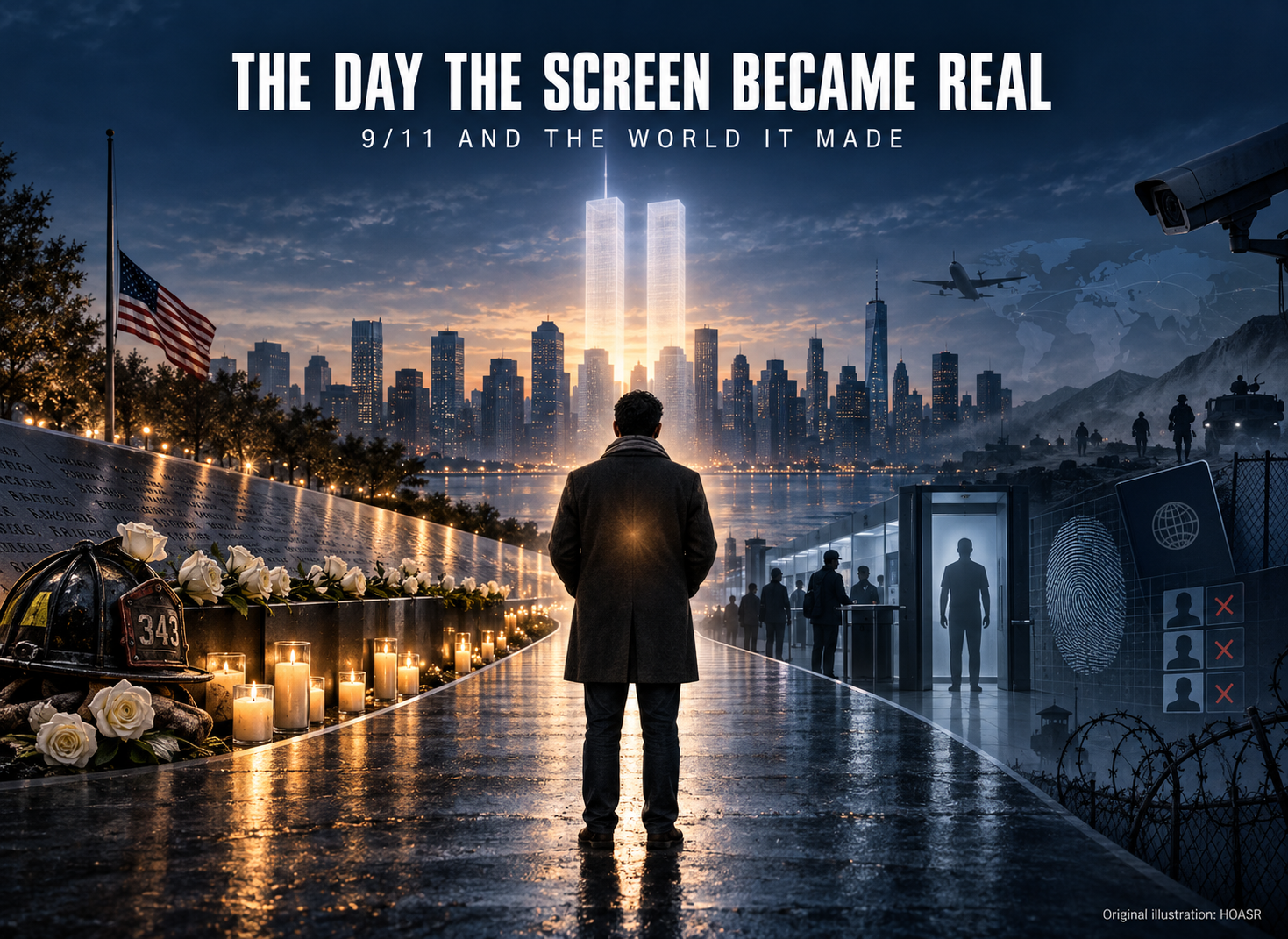
A remembrance of those killed on September 11, 2001—and a reflection on how the attacks transformed security, civil liberties, Muslim life and global geopolitics.
A Muslim immigrant remembers September 11 and the world it made
A personal remembrance of the lives taken on 9/11, the suspicion endured by innocent Muslims afterward, and the enduring lesson that security must never be pursued at the expense of human dignity.
I did not first experience September 11 as history. I saw it as a few silent images on a television screen in a restaurant in downtown Toronto.
I was having lunch with two friends. Above us, a giant television was muted. Hockey images had been playing, the familiar background noise of Canadian public life even without sound. Then my eyes caught the Twin Towers, dark smoke pouring from them, fire where there should have been glass and sky.
I knew those buildings. During my four years at university in the United States, I had visited New York several times and had been around the World Trade Center. The skyline was not abstract to me. It belonged to places I had walked and memories I had carried back to Canada.
For a few seconds, I drifted away from the conversation. I stared at the screen and thought: this cannot be real. Perhaps it was a trailer for an upcoming Hollywood film. Perhaps it was an advertisement for a video game. The pictures were too terrible and too cinematic for the mind to accept immediately as ordinary news.
Nobody around me seemed to understand what we were seeing. The television remained silent. Lunch continued. I looked away and returned to my friends.
Only hours later, after work and after I reached home, did I learn that those glimpses were real. Hijacked passenger aircraft had been turned into weapons. Nearly three thousand people were killed in New York, at the Pentagon and aboard Flight 93. It was the deadliest terrorist attack in United States history. The people trapped in the towers, the passengers and crews in the aircraft, the workers at the Pentagon, and the police officers, firefighters and emergency personnel who ran toward danger became part of a grief much larger than any one country.
The first duty is remembrance
Before 9/11 became a doctrine, a war, an intelligence reorganization or an argument about civil liberties, it was a morning of individual human beings losing their lives. They had names, families, unfinished conversations and ordinary plans for the evening. Many people below the impact zones escaped, often with the help of first responders; many at and above them could not. The official 9/11 Commission later described emergency workers improvising amid failed communications and almost unimaginable conditions.
That human scale matters. It is too easy, after twenty-five years, to remember only the falling buildings and forget the lives inside them. It is also too easy to convert the dead into permanent justification for whatever governments later chose to do. Honour requires something harder: grief for the victims, gratitude for courage, justice for the perpetrators, and an honest accounting of the decisions made in the victims’ names.
I write this with another anniversary approaching in our collective memory: the victims murdered in Israel on October 7, 2023, the people taken hostage, and families whose lives were permanently divided into a before and an after. I do not equate every conflict or every government response. I connect the victims through a simple moral principle. Terrorism deliberately attacks human beings in order to terrorize a wider society. Our compassion must begin with those attacked, and it must not end at the border of our own religion, ethnicity or political camp.
America had the right to defend itself
America was enraged, and understandably so. An armed attack had occurred on its homeland. A government that could not protect its people, identify those responsible and prevent another attack would have failed its most basic duty. Al-Qaeda had planned the operation from abroad, and the Taliban regime in Afghanistan sheltered its leadership. Self-defence was not an invented grievance.
But a terrorist organization presents a different test from a state army crossing a recognized border. Where does a country strike? Who is responsible: the planners, the financiers, the hosts, the sympathizers, or everyone who shares a nationality or faith? What quality of evidence is enough to kill, detain or invade? How long does an emergency authorization last?
These are not questions for peaceful days only. They matter most when leaders are angry, citizens are frightened and restraint looks like weakness. The President of the United States and every official acting under the Commander-in-Chief were being tested not only in strength but in judgment. Revenge can feel like strategy. It is not. Emotion can clarify the need to act, but it can also erase the distinctions on which justice depends.
The 9/11 Commission eventually found failures of imagination, policy, capability and management. The hijackers exploited airport and cockpit systems designed for an older kind of hijacking. Agencies failed to connect information already in government hands. The lesson should have been that better intelligence, competent coordination and precisely targeted lawful action were essential. Too often, however, the lesson absorbed by political culture was broader: expand power first and debate its limits later.
When a neighbour became a suspect
For Muslims in North America and Europe, the change was not confined to foreign policy. It entered airports, workplaces, schools, friendships and introductions. A Muslim name could suddenly feel like evidence that required explanation.
I watched people shorten or alter names that had been given to them at birth. Samatar became Sam. Mohamed became Mo. Ali became Al. Nassir became Nas and any other name could also be made to sound less obviously Muslim. These were small acts of self-protection, but they disclosed a large fear: that a person might be judged before he spoke, not by his conduct but by what his name caused another person to imagine.
Meeting new people became less natural. Curiosity about one’s background could carry a new edge. At an airport, an additional question or search might be defensible in a particular case; repeated suspicion attached to a category of people became something else. Liberal, peaceful Muslims found themselves informally placed on trial for crimes they abhorred as deeply as their Christian, Jewish, Hindu, Sikh or secular neighbours did.
The data confirms that this was not merely my private sensitivity. FBI figures compiled by Pew show reported anti-Muslim hate crimes in the United States rising from 28 in 2000 to 481 in 2001. In a survey late that year, 52 percent of Muslims said their community had experienced anti-Muslim discrimination after the attacks, even as 75 percent also said Americans had been respectful and tolerant. Both experiences were real: hostility from some, solidarity from others.
Canada was not insulated by the border. Statistics Canada found that twelve participating police services recorded 232 hate crimes in the two months after the attacks, more than three times the 67 recorded in the comparable period a year earlier. Police linked many incidents to 9/11; Muslims, Jewish people, Americans and Arabs or West Asians were among those targeted. That finding is important because fear rarely remains neatly aimed. Once collective blame is released, it searches for anyone who looks close enough to the enemy in the public imagination.
Sikhs were attacked by people who mistook turbans for proof of Muslim identity. Arabs who were Christian were treated as Muslim. Muslims whose families had lived in the West for generations were asked where their loyalties lay. The categories were crude because prejudice is crude.
Why should Christians be held responsible for Jim Jones, David Koresh or a serial murderer who invokes his own twisted beliefs? They should not. By the same moral logic, why should nearly two billion Muslims answer collectively for mass murderers who appropriate Islam while violating its prohibition against the murder of innocents? A criminal is responsible for his crime. An organization is responsible for the violence it plans and executes. A faith community is not a conspiracy simply because a terrorist steals its vocabulary.
The security state enters daily life
The post-9/11 transformation was also institutional. The United States created the Transportation Security Administration, hardened cockpit doors, expanded watchlisting and reorganized intelligence and homeland security. Canada enacted its Anti-terrorism Act in December 2001, changing the Criminal Code and other laws. European governments strengthened counterterrorism laws, border controls, data retention and intelligence cooperation. Some reforms closed genuine vulnerabilities and have undoubtedly made mass-casualty plots harder to execute.
Air travel became safer in important respects, but it also became a ritual of suspicion. Shoes came off. Liquids were limited. Bodies and bags became data points. Names were checked against secret lists that could be difficult to challenge. Financial transfers, telephone records and travel patterns entered a vastly expanded system of preventive security.
What had once sounded like George Orwell’s warning in Nineteen Eighty-Four began to feel like administrative normality: cameras, databases, biometric identifiers, automated risk scores and agencies sharing information across borders. “Big Brother is watching you” was no longer only a literary sentence. It described a new anxiety about how much the state could know, how long it could retain that knowledge, and whether an innocent person could ever correct a mistaken suspicion.
Constitutional rights did not literally disappear, and North America was not formally placed under martial law. Courts, journalists, civil-liberties organizations and legislatures continued to contest executive power. Yet the emotional experience for many people was of rights becoming conditional. Detention without ordinary criminal trial at Guantanamo Bay, coercive interrogation, secret prisons, extraordinary rendition, broad surveillance and targeted killing made the boundary between emergency and permanence dangerously uncertain.
The language of the era intensified the atmosphere: sleeper cells, blacklists, no-fly lists, pre-emption, preventive detention and an “axis of evil.” Saddam Hussein, al-Qaeda and the Taliban were often compressed in public conversation into a single cloud of threat, even though Iraq was not responsible for 9/11. The invasion of Iraq demonstrated the cost of allowing fear, disputed intelligence and strategic ambition to run together. Removing a dictator did not erase the obligation to establish a truthful case for war or to plan for the society left after the regime collapsed.
A geopolitical earthquake
The world order I had known across America, Canada and Europe changed that day. NATO invoked collective defence for the first time. The United States went to war in Afghanistan and later Iraq. Counterterrorism partnerships reshaped relations with Pakistan, the Gulf states, Central Asia and governments across Africa. Drone warfare and special operations extended the battlefield into countries where no conventional war had been declared. Intelligence cooperation deepened even between uneasy partners.
The effects travelled far beyond Western capitals. Civilians in Afghanistan, Iraq, Pakistan, Yemen, Somalia and elsewhere lived beneath wars, raids, checkpoints, displacement and the possibility of being misidentified. Soldiers and their families carried physical and psychological wounds. Vast public resources were spent. Brown University’s Costs of War project has documented not only direct deaths and expenditure but the longer consequences for health, displacement, governance and political trust.
There were positive consequences too, and honesty requires acknowledging them. Governments learned to share intelligence more rapidly. Aviation security adapted to suicide hijacking. Terrorist financing became harder. Police and emergency services improved joint planning. Many plots were disrupted. Muslim civic organizations, interfaith coalitions and ordinary neighbours also answered suspicion with public service, education and solidarity. A generation of Muslims became more visible in journalism, law, medicine, scholarship and elected office rather than retreating permanently from public life.
But tactical improvement did not equal strategic victory. Al-Qaeda lost leaders and territory, yet its model mutated. The Islamic State exploited broken states and digital recruitment. Lone actors and small cells required fewer instructions. Encrypted communication, commercial drones, cryptocurrency, artificial intelligence and online propaganda changed the operating environment. Far-right terrorism, antisemitic violence, anti-Muslim hatred, narco-terrorism and politically motivated mass violence showed that the capacity to terrorize is not owned by one religion or ideology.
Are we safer twenty five years later?
My answer is uncomfortable: we are better protected in some ways, but we have not defeated terrorism.
Intelligence is faster. Databases are larger. Airport and border systems are more sophisticated. Security professionals are generally less likely than in the first emotional years after 9/11 to confuse adrenaline with analysis. The best counterterrorism work is patient, evidence-based and often invisible. It identifies networks without declaring entire communities suspect. It prevents violence without giving extremists the civilizational war they want.
Yet terrorism survives because it is a method, not a single army. It adapts to pressure. It feeds on failed governance, humiliation, sectarianism, occupation, conspiracy theories, racism and political entrepreneurs who find advantage in fear. Like the war on drugs, the war on terrorism cannot be won by announcing an enemy category and applying force without end. Military power can destroy a training camp or remove a commander. It cannot by itself create legitimate government, social trust or an idea of belonging strong enough to defeat recruitment.
The deeper measure of safety is therefore not whether every danger disappears. No free society can promise that. It is whether we can reduce danger without becoming governed by it. A society that protects its citizens while preserving due process, equal citizenship and freedom of belief is stronger than one that answers terror by distributing fear among innocents.
What remembrance asks of us
When I return in memory to that Toronto restaurant, I think of the silence. The television had no sound, but the images carried a message that would soon fill every room in the world. At first, my mind protected itself by calling the scene fiction. Later, governments and societies sometimes protected themselves by turning complicated reality into another kind of fiction: a world divided cleanly into “us” and “them.”
There is an us. It is not the West against Islam, Christians against Muslims, Jews against Arabs, or one civilization against another. It is every person who believes that civilians are not instruments, that faith does not excuse murder, and that justice must be guided by evidence rather than inherited blame.
And there is a them: those who deliberately murder innocents and those who turn the resulting grief into permission to hate other innocents. Terrorists want societies to overreact. They want neighbours to distrust one another, governments to abandon their own principles, and every atrocity to recruit for the next one. We should refuse them that victory.
On this anniversary, I remember Ground Zero. I remember the Pentagon and Flight 93. I remember emergency workers who entered buildings others were desperate to leave. I remember Muslims who grieved as citizens and human beings, then discovered that some neighbours saw only their names. I remember the victims of October 7 and of terrorist attacks in cities and villages across continents, including the countless victims whose names never became internationally known.
Twenty-five years later, the screen is still real. The methods change, the technology advances and the slogans are repackaged. Our task is not merely to watch more closely. It is to see more clearly: the victim as a human being, the perpetrator as an accountable individual, the innocent as innocent, and security as a public trust that must defend both life and liberty.
That is how remembrance becomes more than sorrow. It becomes judgment. It becomes restraint. And, if we are wise enough, it becomes a form of protection.
Selected Sources
- National Commission on Terrorist Attacks Upon the United States, 9/11 Commission Report executive summary
- Pew Research Center, 25 Years After 9/11, a Portrait of Muslim Americans, September 3, 2026
- Statistics Canada, Hate crimes increased for a short period after September 11
- Parliament of Canada, Bill C-36 Anti-terrorism Act legislative history
- Transportation Security Administration, TSA timeline
- Brown University Watson School, Costs of War project
United States Department of Justice, The Department of Justice Ten Years After 9/11
Related Topics
Related Posts