
90 Seconds to Fight Antisemitism: Inside the Digital Resistance
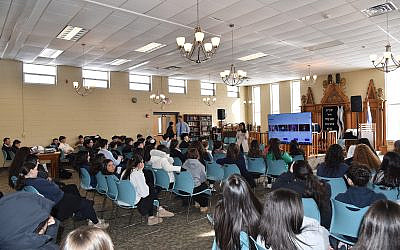
Standing in the halls of Westchester Hebrew High School, my alma mater, I watched something remarkable unfold. High school students, some barely old enough to vote, were learning to wield what might be the most powerful weapon in the fight against modern antisemitism: coordinated digital activism.
The scene was far from what you might expect. No protests, no picket signs, no chanting. Just determination, and a free app called Emissary that’s quietly revolutionizing how Jews fight back against the oldest hatred.
“When one person responds, it’s commendable. But when we all respond, it’s powerful.”
— Sara Nisarov, Emissary Field Organizer
A Movement Born From Crisis
That simple truth became the rallying cry for a movement born in crisis.
Emissary, a 501(c)(3) nonprofit based in Minnesota, was created in the immediate aftermath of October 7th—when antisemitism surged globally and disinformation flooded social media, casting Jews and Israel in the darkest possible light.
What we witnessed wasn’t random outrage.
It was organized.
The Battlefield Has Moved
Antisemitism today spreads like a virus—fast, adaptive, and global.
The battle for public opinion no longer takes place in newspapers or on nightly news. It lives on Instagram, TikTok, X, and Facebook—where lies travel at algorithmic speed and truth is forced to play catch-up.
By the time facts appear, narratives are already set.
Many Jewish organizations, despite their dedication, were not built for this digital battlefield. They weren’t designed to move at the speed of hate.
Good intentions are no longer enough.
New times require new tools.
What Is Emissary?
Emissary is a free mobile and web-based technology platform designed to unite Jewish and non-Jewish communities in the fight against antisemitism.
It operates through three core functions:
Today — professionally vetted, daily content users can immediately share to counter false narratives and promote understanding.
Connect — a digital organizing hub that allows synagogues, schools, nonprofits, campus groups, influencers, and individuals to mobilize through coordinated campaigns and real-time action.
Ask Emissary — an AI-powered assistant providing clear, credible answers about antisemitism, Judaism, and Jewish history.
The organization was founded by David Kristal and David Burton and is led by Ken Greer—community leaders who understood a simple reality: digital hate requires digital sophistication.
But Emissary’s evolution reflects something even bigger.
Last year, Minds and Hearts—the organization I co-founded with Daniel Rosen in Westchester, New York—merged with Emissary. Our grassroots organizing model and campaign methodology became the backbone of what is now Connect.
The result is a unified platform—combining institutional reach with community mobilization—so individuals and organizations no longer fight alone.
Power in Numbers
Emissary is built on a basic insight: most people want to help, but feel overwhelmed.
They don’t have hours.
They don’t know what to say.
And they’re afraid of getting it wrong.
That’s where missions come in.
A mission might be pressuring a brand after an antisemitic incident.
It might be amplifying the story of a fallen Israeli so his name trends.
It might be sharing verified information before disinformation takes hold.
Each mission takes seconds.
But when hundreds—or thousands—act at once, impact compounds.
Algorithms notice.
Visibility shifts.
Truth breaks through.
Ninety seconds can matter.
Voices From the Front Lines
The students I met at Westchester Hebrew High understand what they’re up against.
Reese Cohen said it plainly: “We’re only 0.2% of the world. We have to look out for each other—because there’s a lot of hate toward us.”
For students like Emily Strobel and Rachel Urman, who stepped up as Emissary champions, the platform fills a void.
“I think it’s amazing to spread light when there’s so much darkness in the world,” Emily told me.
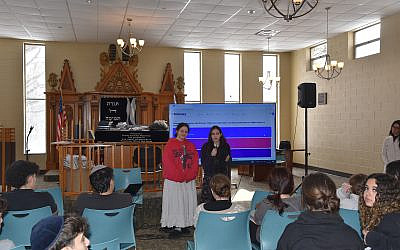
Students Finding Their Voice
Rachel Ehrman, a student champion, said what many are thinking:
“I wanted to learn more about the antisemitism that’s going on so I can speak against it. People joke about it—but this isn’t something to joke about.”
For others, the stakes are deeply personal.
Emily shared that her cousin, Rabbi Leibel Lazaroff, was a victim in the recent Bondi shooting. “It just shows that anything can happen,” she said.
David Akilov from Queens described something many young Jews feel but rarely articulate: “It matters that there’s an organization putting our stories out there—our side of the truth.”
Adle Weiss spoke about the isolation social media can create. “You see so much antisemitism online. It can make you feel really alone. Having something that connects us—and helps us fight back—matters.”
From Helpless to Empowered
Lisa Kahn Kriegel, Dean of Student Life at Westchester Hebrew High School, sees the shift clearly.
“It gives students who often feel helpless a real way to make a difference—just by spending a few minutes on their phone.”
That change—from paralysis to agency—is Emissary’s quiet strength.
Students aren’t waiting until they’re older.
They aren’t waiting for permission.
They’re acting now, on the very platforms where the battle is being fought.
A Broader Mission
Emissary is not only about responding to hate. It’s about reshaping the narrative.
As Sara Nisarov explained to students, the goal is dual: “To combat antisemitism—but also to increase pro-Semitism. To build unity, understanding, and pride in who we are.”
That distinction matters.
When thousands of users consistently share verified content, positive Jewish stories, and factual corrections, the digital environment begins to shift—not emotionally, but measurably.
The Connect feature transforms passive readers into organizers. Synagogues, schools, campus groups, organizations, influencers, and individuals can mobilize in real time.
Advocacy stops being symbolic.
It becomes operational.
Why This Moment Matters
Standing in that high school shul, I thought about how we got here.
After October 7th, like so many Jews, the ground shifted. The merger of Minds and Hearts with Emissary wasn’t about branding—it was about survival. Fragmentation was no longer viable.
We needed shared tools.
Shared infrastructure.
Shared urgency.
Leadership in this moment isn’t about visibility. It’s about usefulness.
It’s about giving a 15-year-old a way to act.
Giving a grieving family a way to be honored.
Ensuring no Jewish student feels alone online again.
What Comes Next
The students at Westchester Hebrew High represent something larger than themselves.
They understand what older generations had to learn the hard way: social media isn’t going away. The internet isn’t going away. And the battle for minds and hearts will be won—or lost—online.
Every petition signed.
Every post shared.
Every lie stopped before it spreads.
These are small acts. But they accumulate. They influence algorithms. They reach people who may never enter a synagogue—but may pause when they see hundreds of thoughtful voices pushing back against hate.
We are 0.2% of the world’s population. We have always been outnumbered.
But we have also always adapted.
Every generation finds new ways to tell our story, defend our existence, and educate those willing to listen. This generation’s insight is simple:
You don’t need a platform.
You don’t need expertise.
You don’t need permission.
You need 90 seconds, a smartphone, and the willingness to show up.
Antisemitism has gone viral.
But so has Jewish pride.
So has Jewish solidarity.
So has Jewish truth.
And now, finally, we have the tool to help it spread.
To learn more about Emissary, visit the Apple App Store or Google Play and search for Emissary4All.