


I write what I see
A Bad Day for Levinsky, A Worse Day for Charles Dance
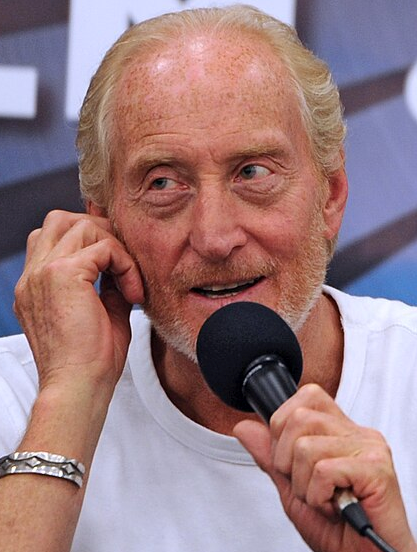
Charles Dance, actor of kings and tyrants, stepping into Britain’s oldest role: vilifying Jews. Photo: Alan Chang, CC BY-SA 2.0 (via Wikimedia Commons).
Charles Dance, famed for playing tyrants, now performs his most revealing role: demanding Britain apologize for the Balfour Declaration. Of all the crimes of empire, he singles out the one promise that gave Jews a chance at survival. Bengal famine? Ireland’s starvation? Africa’s scars? Silent. Only when Jews claw back a sliver of history does Dance posture about injustice. He said the Balfour Declaration should be “unpicked”—as if Jewish sovereignty itself were a stain to be scrubbed from history. The implication is clear enough, Israel’s very creation is to be treated as illegitimate, the Jews as trespassers on their own land.
England, after all, wrote the playbook. The first country in Europe to expel its Jews (1290), it stayed Jew-free for centuries but not imagination-free: blood libels of Norwich and Lincoln, Chaucer’s slander, Shylock spat upon at the Globe. Hatred thrived even without Jews to hate.
When Jews returned, they remained outsiders. Disraeli, paraded as proof of tolerance, was baptized at twelve and spent his career insisting he was no longer Jewish. He rose to prime minister, yes—but only as a showcase stripped of Jewishness. And the monarchy? The Succession to the Crown Act of 2013 finally repealed the ban on marrying Catholics, but the core law still stands: the monarch must be Protestant, a member of the Church of England, and its Defender of the Faith. Jews, Muslims, Hindus—everyone outside Anglicanism—are constitutionally excluded from the highest symbol of belonging.
A Jewish prime minister? In theory, yes. In practice? Only when the sky turns purple and the Thames runs dry. That’s the joke everyone in Britain understands.
So let’s call it what it is, England still enshrines structural exclusion at the highest level of state; effectively it’s apartheid but dressed in coronation robes. And yet this same country presumes to lecture Israel about democracy, identity, and who may govern in the only Jewish state on earth.
And before the predictable chorus pipes up—“but in Israel an Arab can’t . . .”—just stop with your nonsense. Arabs in Israel sit in the Knesset; they sit on the Supreme Court, sending even Jewish prime ministers to prison. An Arab party once held the balance of power in forming a government. Will an Arab ever be prime minister of Israel? Maybe, maybe not. At least one has run for office, though he later fled to Qatar after being accused of aiding Hezbollah. That is how delicate the balance becomes in a country surrounded by enemies. Israel wrestles with survival daily, while Britain clings to its prejudice.
So why should Israel surrender its Jewish identity? One Jewish state in a world of crosses, crescents, and crowns—and that alone is branded “apartheid.” Every nation guards its symbols, its language, its faith. In Israel you find Hebrew, Arabic, and English on every street post and as I mentioned above, Arabs in its parliament and Supreme Court. Compare that to Jordan, Qatar, Saudi Arabia, or England. A Jew as prime minister there? Never. The world swallows twenty-two Arab states, dozens more Muslim and Christian nations, yet chokes on one Jewish state. They dare to call it apartheid. Worse, they have gutted Zionism itself—the word that once meant Jewish survival, rebirth, and return—and turned it inside out, spitting it back as if it were a curse. To them, Jewish life in its own land is a crime instead of a miracle that should be celebrated.
Their contempt also bleeds into culture; early British cinema smeared Jews with disgusting titles like The Robber and the Jew (1908) and A Bad Day for Levinsky (1909). The Levinsky movie reduced a Jew to a slapstick thief, a greedy fool chasing a slot machine through the streets after “cheating” it of a coin. My own name turned into a caricature: Levinsky as swindler, Levinsky as parasite. England mocked us on screen long before Charles Dance ever appeared.
And the prejudice never stopped. Today it runs through English media, where Israel is cast as villain in every headline, every “investigation,” every glossy documentary. Hamas press releases are treated as scripture, UN reports as gospel, while Israeli numbers and Jewish memory are dismissed as lies. The tropes are medieval, but the stage is modern. And now Charles Dance steps forward as if to prove the point—recycling the oldest English script, painting Jews as a mistake, Israel as a crime, and what do you know, the Balfour Declaration as sin.
It runs deeper. T.S. Eliot called Jews “spiritually undesirable.” H.G. Wells urged that Jewish “difference” be erased. Roald Dahl confessed, “I have become anti-Semitic.” Even Beatrix Potter, creator of Peter Rabbit, warned of Jews’ “love of profit.” These were the voices of the English mainstream, serving centuries of contempt as art. England’s national treasures, dripping with contempt had polished hatred into art. Is it a wonder that my father’s friend from medical school once confessed that the only reason he had befriended him was because he was not a typical Jew . . . Imagine that “compliment,” it demands the Jew apologize for even existing!
The empire’s record is darker still:
-
India: 3 million dead in Bengal famine (1943).
-
Ireland: a million dead in the Great Famine while Britain exported food.
-
Kenya: torture camps in the 1950s.
-
South Africa: the first concentration camps (1899–1902).
-
Caribbean: slavery, with slaveowners compensated while the enslaved got nothing.
-
Australia: Aboriginal massacres and the Stolen Generations.
-
Middle East: borders carved to suit empire, monarchies propped up, Palestinians butchered in Jordan’s Black September (1970).
-
And still today, Britain clings to fourteen overseas territories while presuming to lecture Israel about occupation.
England never truly confronted its past. The Council of Oxford (1222) forced Jews to wear badges, banned synagogues, restricted Jewish life, and laid the road to expulsion in 1290. Eight centuries later, the Church of England muttered an apology—but only in words. No reparations, no place in schoolbooks, no truth passed to its children. The Aliens Act of 1905 singled out Jewish immigrants fleeing pogroms, branding them “undesirables,” and in the 1930s, Oswald Mosley’s Blackshirts marched under police protection, their chants echoing medieval blood libels. In 1947, as Britain cracked down on Jews in Palestine, mobs in Manchester, Liverpool, and Glasgow smashed synagogues and looted Jewish shops. From Oxford’s councils to Whitehall’s decrees to streets filled with broken glass, the pattern is unbroken.
Once again, Britain slammed the gates shut on Jews fleeing annihilation. The 1939 White Paper barred Holocaust refugees from Palestine. The Struma drifted until nearly 800 drowned. The Patria exploded in Haifa because Britain meant to deport its passengers to Mauritius. The Exodus, crammed with 4,500 survivors, was dragged back to Germany by the Royal Navy. Those who slipped through were caged in Cyprus. Refugees branded “illegal” in their own land. Jews with pistols were hanged as “terrorists.” Arabs with knives were praised as “resistance.” Britain perfected the inversion of survival as crime, and murder as valor.
And who did Britain empower as the voice of Palestine? Haj Amin al-Husseini, the Grand Mufti of Jerusalem who was pardoned, promoted, and funded even after he incited pogroms. Later he sat with Hitler in Berlin, broadcasting Nazi propaganda in Arabic and urging Muslims to kill Jews wherever they found them. While Jews were barred from their homeland, Britain legitimized a Nazi collaborator.
And still the monarchy bowed elsewhere. How absurd that the Queen, head of the Church of England, toured every Arab capital yet never once set foot in Israel—the Jewish homeland her own empire had promised. And these days, William and Kate holiday with Jordan’s royals while Queen Rania poses as a moral voice on Palestine. Yet her own kingdom is built on land carved from Mandatory Palestine, its majority population Palestinian, and when they demanded a voice in 1970, King Hussein’s army slaughtered them in Black September. That is the hypocrisy Britain embraces—taking lectures from monarchs who massacred Palestinians while condemning the one state that gave them refuge.
So forgive me if I laugh when Charles Dance, heir to this tradition, postures as moral critic. He has unmasked himself as a court jester who wags his finger at the one people his country tried so hard to bury. And now, as Britain recognizes a Palestinian state even while Hamas clings to Israeli hostages and reloads its rockets, the pattern repeats—reward the killers, scold the survivors.
If once it was a bad day for Levinsky, today is a worse day for Dance—unmasked as a fraud, a relic of an empire that painted conquest as virtue and still paints Jewish survival as sin. The difference is that today, we have Israel and we’re sovereign; we’re no longer your stage props or your punchlines. And we’ll never bow to an empire of famine and chains that still dares to lecture us.
Related Topics
Related Posts

