


A Brandy in One Hand, a Cigar in the Other, the World Was Changed Forever
“I was sent to these Arabs as a stranger… but charged by duty to lead them… I was a participant in a fraud.” T.E. Lawrence aka Lawrence of Arabia
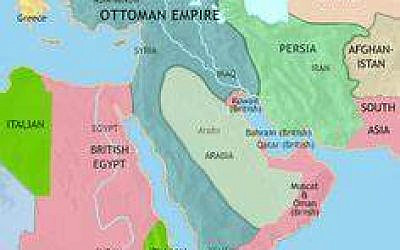
The Middle East underwent a profound transformation leading up to and during the First World War. Before 1917, much of the region was governed by the Ottoman Empire, which had maintained control over the Levant, Mesopotamia, and parts of the Arabian Peninsula for centuries.
Prior to the territorial shifts that occurred toward the end of the war, the political landscape looked significantly different:
- Ottoman Imperial Provinces: Instead of modern nation-states like Iraq, Syria, or Lebanon, the region was divided into vilayets (provinces) and sanjaks (districts) administered from Constantinople. For example, what is now Iraq was divided into the three vilayets of Basra, Baghdad, and Mosul.
- British and French Influence: While the Ottomans held the interior and northern regions, the British Empire controlled Egypt (as a protectorate) and held various treaties with coastal sheikhdoms along the Persian Gulf and the Aden Protectorate.
- The Persian Empire: To the east, the Qajar Dynasty ruled Persia (modern-day Iran), serving as a significant non-Ottoman power in the region.
- The Hejaz: In the Arabian Peninsula, the Sharifate of Mecca governed the Hejaz region along the Red Sea coast under Ottoman suzerainty, while the interior Nejd was under the burgeoning influence of the House of Saud.
The map of the region began to change drastically in 1917 as Allied forces advanced through Jerusalem and Baghdad, eventually leading to the Mandate system established by the League of Nations.
The Sykes-Picot Agreement was a secret 1916 convention between Great Britain and France, with the assent of the Russian Empire and Italy, to define their mutually agreed-upon spheres of influence and control in an eventual partition of the Ottoman Empire.
The agreement was named after its lead negotiators: Mark Sykes (representing Britain) and François Georges-Picot (representing France).
The Terms of the Agreement
The deal essentially drew a line across the Middle East—often called the “Line in the Sand”—running roughly from Acre on the Mediterranean coast to Kirkuk in the east.
- The Blue Zone (France): Direct control over the Syrian coast and much of modern-day Lebanon, with a sphere of influence over the Syrian interior.
- The Red Zone (Britain): Direct control over southern Mesopotamia (modern Iraq), including Baghdad and Basra, and the ports of Haifa and Acre.
- The Brown Zone (International): Palestine was slated for international administration due to the holy sites in Jerusalem.
- The Arab State: The regions between the French and British zones were intended to become an independent Arab state or confederation of states, but divided into British and French “spheres of influence.”
Was it concluded over a glass of brandy?
While the image of two imperial diplomats carving up the world over spirits is a popular trope for colonial-era deal-making, there isn’t a specific historical record confirming a single “brandy-soaked” moment where the deal was struck.
However, the story persists for a few reasons:
- The Informal Setting: Sykes and Picot did meet frequently in various settings, including private clubs and offices, where refreshments like brandy would have been common for men of their social standing in early 20th-century London and Paris.
- The “Line in the Sand” Quote: Mark Sykes famously told the British Cabinet, “I should like to draw a line from the ‘e’ in Acre to the last ‘k’ in Kirkuk.” This casual approach to complex ethnic and religious borders gave the impression of a whim-driven afternoon conversation rather than deep strategic planning.
- Symbolism: Whether brandy was involved or not, historians use the image to illustrate the lack of local consultation. The agreement was made by two men who had never lived in the region, completely ignoring the “McMahon-Hussein Correspondence,” which had promised the Arabs independence in exchange for revolting against the Ottomans.
Impact and Legacy
The agreement remained secret until the Bolsheviks discovered it in the Russian archives after the 1917 Revolution and published the text, causing a massive diplomatic scandal and deeply damaging the trust between Western powers and Arab leaders. Today, Sykes-Picot is often cited as the root of many modern geopolitical tensions in the Middle East, as it created “artificial” borders that did not account for sectarian or ethnic realities.
The Shift from Secret Deal to International Law
While Sykes-Picot was a secret map of intentions, the San Remo Conference was the formal meeting of the Allied Supreme Council (Britain, France, Italy, and Japan) to finalize how the former Ottoman territories would be governed.
The transition from the Sykes-Picot Agreement to the San Remo Conference of 1920 is where the “lines in the sand” became official international law, fundamentally shaping the modern Middle East.
Key Outcomes of San Remo
The conference established the Mandate System, which was overseen by the League of Nations. This system was technically intended to provide “administrative advice and assistance” until the territories could stand alone, but in practice, it functioned as colonial rule.
- French Mandates: France was granted the Mandate for Syria and Lebanon. To secure this, they had to militarily oust the newly declared Arab Kingdom of Syria in July 1920.
- British Mandates: Britain was granted the Mandate for Palestine and Mesopotamia (Iraq).
- The Balfour Declaration: Crucially, the San Remo Resolution incorporated the terms of the 1917 Balfour Declaration, committing the mandatory power in Palestine to the establishment of a “national home for the Jewish people.”
Major Changes to the Original “Brandy” Map
Several things changed between the Sykes-Picot draft (1916) and the San Remo reality (1920):
- The Mosul Question: Originally, the oil-rich region of Mosul was in the French “Blue Zone.” However, Britain negotiated to bring it into the British Mandate of Iraq in exchange for giving France a share in the Turkish Petroleum Company.
- The Collapse of the International Zone: The idea of an “International Zone” for Palestine was abandoned in favor of a direct British Mandate.
- The Birth of Transjordan: Shortly after San Remo, the British carved out the territory east of the Jordan River, creating the Emirate of Transjordan (modern-day Jordan) to satisfy a promise to the Hashemite family.
The Legacy of 1920
San Remo is often seen by historians as the moment the “Great Powers” finalized the borders that define the region today. These boundaries often ignored existing tribal, linguistic, and religious lines, leading to decades of internal friction within the newly created states.
The San Remo Conference of April 1920 is often described as the “Magna Carta” of the Zionist movement because it transformed a British policy statement into a binding instrument of international law.
While the Balfour Declaration of 1917 had expressed British intent to support a Jewish national home, it was a unilateral statement made during the war. San Remo provided the legal foundation for that intent to become a reality.
1. International Legal Recognition
Before San Remo, the Balfour Declaration was essentially a letter from the British Foreign Secretary to a private citizen (Lord Rothschild). At San Remo, the “Big Four” Allied powers (Britain, France, Italy, and Japan) formally adopted the Balfour Declaration as part of the post-war settlement. This shifted the concept of a Jewish homeland from a British promise to a collective international obligation.
2. The Mandate for Palestine
The conference assigned the Mandate for Palestine to Great Britain. Unlike a standard colony, a Mandate was a trust created by the League of Nations. The specific terms of this Mandate—drafted and agreed upon at San Remo—explicitly charged Britain with:
- Securing the establishment of the Jewish national home.
- Safeguarding the civil and religious rights of all inhabitants, regardless of race or religion.
3. Inclusion in the Treaty of Sèvres
The decisions made at San Remo were written into the Treaty of Sèvres (1920), the peace treaty between the Allies and the Ottoman Empire. This meant the Ottomans formally ceded sovereignty over Palestine, and the international community recognized the “historical connection of the Jewish people with Palestine” as the grounds for reconstituting their national home there.
4. Setting the Borders
The conference began the process of defining the geographical boundaries of what would become the British Mandate. While the exact borders were refined over the following years (such as the 1923 border with French-controlled Syria and Lebanon), the core territory identified at San Remo became the legal entity within which the infrastructure for a future state—such as the Jewish Agency and the Hebrew University—was built.
5. Shift in Governance
San Remo marked the end of the British military administration (OETA – Occupied Enemy Territory Administration) and the beginning of a civil administration. This led to the appointment of Sir Herbert Samuel as the first High Commissioner for Palestine in July 1920, signaling the start of a formal government tasked with facilitating Jewish immigration and land settlement.
Summary of Impact
Without the San Remo Conference, the Balfour Declaration might have remained a historical footnote or a lapsed wartime promise. By incorporating it into the international legal framework of the League of Nations, San Remo provided the legal title for the Jewish national home, which served as the foundation for the eventual Declaration of Independence in 1948.
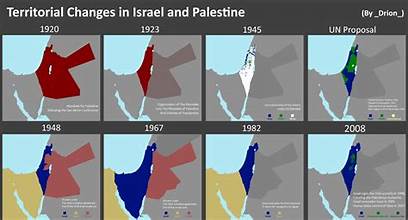
Maps courtesy of brilliantmaps.com