NAnews - Nikk.Agency Israel News
A Chabad Rabbi Joins Ukraine’s Military Chaplaincy as War Reshapes Jewish Life
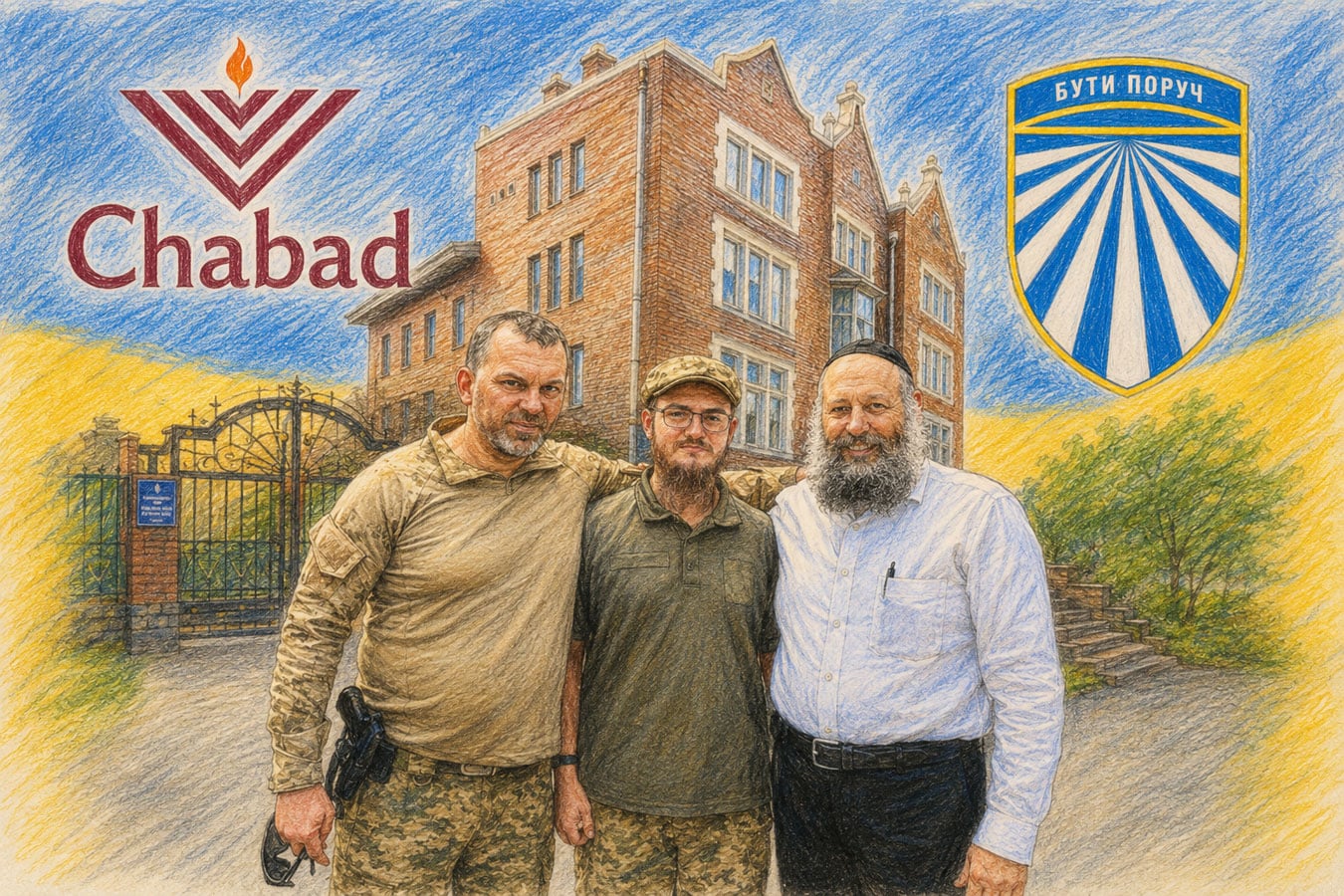
A Chabad Rabbi Joins Ukraine’s Military Chaplaincy — and a Quiet Jewish Story Comes Into View. Illustration made with AI
On July 17, 2026, Rabbi Levi Yitzchak Stambler, the chief rabbi of Kamianske, announced that Rabbi Nochum-Simcha Leitans had completed several months of military training and had been appointed as an assistant to a military chaplain in the Armed Forces of Ukraine.
The announcement was brief, but the story behind it is much larger.
Leitans is not a public figure who suddenly appeared in uniform. For years, he has been part of the religious and educational life of the Chabad community in Kamianske. He was responsible for the yeshiva and advanced Torah-study programs, taught Jewish law and tradition, and helped prepare boys for bar mitzvah. Now, the same man who accompanied young Jews as they put on tefillin and approached the Torah will accompany Ukrainian servicemen living through war.
Stambler wished Leitans and his fellow soldiers protection, strength and a swift peace. The public announcement did not identify his military unit, his future place of service, the chaplain whom he will assist or the date of the formal military order.
The photograph accompanying the announcement shows Leitans with Lieutenant Colonel Davyd Hruba, a member of the Kamianske Jewish community whom Stambler identified as the head of a professional training school. No further information about the school’s military affiliation was disclosed.
That absence of detail is understandable during wartime. Yet even without the name of a brigade or unit, the appointment tells us something important about Jewish life in Ukraine: it is no longer confined to synagogues, schools and humanitarian centers. It is also present inside the country’s military institutions.
From Dniprodzerzhynsk to a Chabad Center Modeled on 770
Kamianske is a major industrial city in Ukraine’s Dnipropetrovsk region, situated on the Dnipro River not far from the city of Dnipro. Until 2016, it was known as Dniprodzerzhynsk, a Soviet-era name that was replaced during Ukraine’s decommunization process.
Its Jewish community belongs to the international Chabad-Lubavitch movement. Rabbi Levi Yitzchak Stambler has led the community since 2001 together with his wife, Dina Stambler.
The community includes the Beit Reuven Synagogue, the Beit Baruch charitable center, a Jewish school, a yeshiva and educational and social programs for children, families and elderly residents. The modern community building, opened in 2008, was designed to resemble the famous Chabad headquarters at 770 Eastern Parkway in Brooklyn, where the office and synagogue of the Lubavitcher Rebbe, Rabbi Menachem Mendel Schneerson, were located.
This architectural connection is more than decorative. It reflects the way Chabad communities function throughout the Jewish world: a local synagogue is also a school, a welfare center, a meeting place and often an emergency network.
After Russia launched its full-scale invasion, the Kamianske community continued distributing food, assisting evacuations, helping people find safer accommodation, providing psychological support and delivering humanitarian aid. Shabbat packages and assistance to elderly and vulnerable community members continued even during the war.
Leitans emerged from this environment. His move into military chaplaincy is therefore not a break with his previous life. It is an extension of the same principle: remaining physically and spiritually present wherever people need support.
A Chaplain and a Chaplain’s Assistant Are Not the Same Position
The phrase “assistant military chaplain” may sound like a junior version of the same religious office. Under the Ukrainian system, however, the two positions have different legal and military statuses.
A military chaplain must be a Ukrainian citizen and a recognized clergy member of a registered religious organization. The chaplain receives a special religious mandate, undergoes military preparation, signs a contract and serves in an officer position.
The chaplain is responsible for the spiritual and pastoral care of the unit. This may include prayers and religious ceremonies, private conversations with servicemen, assistance to the wounded and bereaved families, ethical and religious advice to commanders, and humanitarian or charitable work.
The assistant, by contrast, is an enlisted or junior military position rather than an officer’s post. The assistant helps organize religious gatherings, prepares locations for services, handles practical and administrative tasks, supports communication with commanders and soldiers, and assists in work with the wounded and military families.
In simple terms, the chaplain leads and carries formal responsibility for the spiritual service. The assistant makes that service possible in daily military life.
There is also an unresolved detail in Leitans’s case. In October 2025, the leadership of Ukraine’s Military Chaplaincy Service stated that, under the existing doctrine, an assistant chaplain should not be a member of the clergy.
Leitans, however, is publicly described as a rabbi.
This does not necessarily mean that the appointment contradicts regulations. In Jewish communities, the title “rabbi” may refer to education, communal authority or a religious function, while Ukrainian law may apply a more specific legal definition to an officially registered clergy member. The documents clarifying Leitans’s exact religious and military status have not been made public.
For that reason, the accurate description is the one used by the Kamianske community itself: Rabbi Nochum-Simcha Leitans was appointed as an assistant to a military chaplain. There is currently no public basis for describing him as a commissioned military chaplain or chaplaincy officer.
How Many Jewish Representatives Serve in Ukraine’s Chaplaincy System?
Ukraine does not publish a full public register of military chaplains divided by religion and denomination.
In October 2025, the authorized structure of the Military Chaplaincy Service reportedly included approximately 1,700 positions: about 70 leadership posts, roughly 800 military chaplain positions and approximately 800 assistant chaplain positions.
Many of those posts were still vacant. Overall staffing was estimated at around 45 percent, with about 43 percent of chaplain posts and approximately 40 percent of assistant positions filled. The exact number of representatives of Judaism was not disclosed.
This is where terminology becomes especially important. Public reporting often places several different categories under the general word “chaplain”: commissioned officers, religious representatives formally authorized to work with the military, assistant chaplains and volunteers.
The clearest publicly documented status belongs to Rabbi Yaakov Pinchas Syniakov, also known as Ihor Syniakov. In 2025, he became a junior lieutenant and headed the chaplaincy service of the 7th Rapid Response Corps of Ukraine’s Air Assault Forces. An official military publication later described him as the only Jewish military chaplain serving in the Armed Forces of Ukraine at that time.
David Milman occupies a different position in this history. In April 2023, he became the first rabbi formally authorized to cooperate with the Ukrainian military in providing religious, spiritual and humanitarian support. Milman has helped Jewish soldiers observe Shabbat and holidays, obtain kosher food, tefillin and religious literature, and has worked with wounded servicemen and bereaved families.
The apparent contradiction between Syniakov being called the only Jewish military chaplain and Milman being called the first officially authorized rabbi may be explained by their different formal statuses: Syniakov is publicly documented as a serving officer in the chaplaincy structure, while Milman was authorized as a religious representative cooperating with the Armed Forces.
Leitans now joins this developing system as a publicly known Orthodox Jewish assistant chaplain.
Another known assistant, Kostya Yudin, comes from a Messianic Jewish community. Messianic communities combine Jewish traditions with belief in Jesus and are not recognized as a branch of Judaism by Orthodox Jewish authorities. This distinction matters when trying to calculate how many representatives of Judaism — rather than organizations using Jewish religious language — serve in the chaplaincy system.
Why This Story Should Matter in Israel
At NAnews — Israel News, we follow the points where Israeli, Jewish and Ukrainian realities meet. The appointment of a rabbi from Kamianske may seem like a small personnel announcement, but it reveals a broader development: Jewish institutions in Ukraine are becoming part of the country’s wartime resilience.
For Israeli readers, there is another familiar element. Chabad is a global network whose communities often become emergency infrastructure long before governments or international organizations arrive. In Kamianske, the same community that maintains a synagogue modeled on Brooklyn’s 770, educates Jewish children and supports elderly residents is now sending one of its rabbis into the military chaplaincy system.
This is not only a story about a rabbi joining the army.
It is a story about a Jewish community refusing to separate spiritual responsibility from civic responsibility. It is about Torah study moving from the walls of a yeshiva into the uncertain reality of military service. And it is about Ukrainian Jews defining their place in a country fighting for its survival.
Nochum-Simcha Leitans will not command troops, and he has not been publicly identified as an officer. His role will be quieter: helping a chaplain, organizing religious and humanitarian support, listening to soldiers and remaining beside them.
In wartime, that quiet presence can matter more than any title.
Related Topics
Related Posts