
Director of the Center for Law and Antisemitism, Striks Faculty of Law
A Chimerical Test for Antisemitism
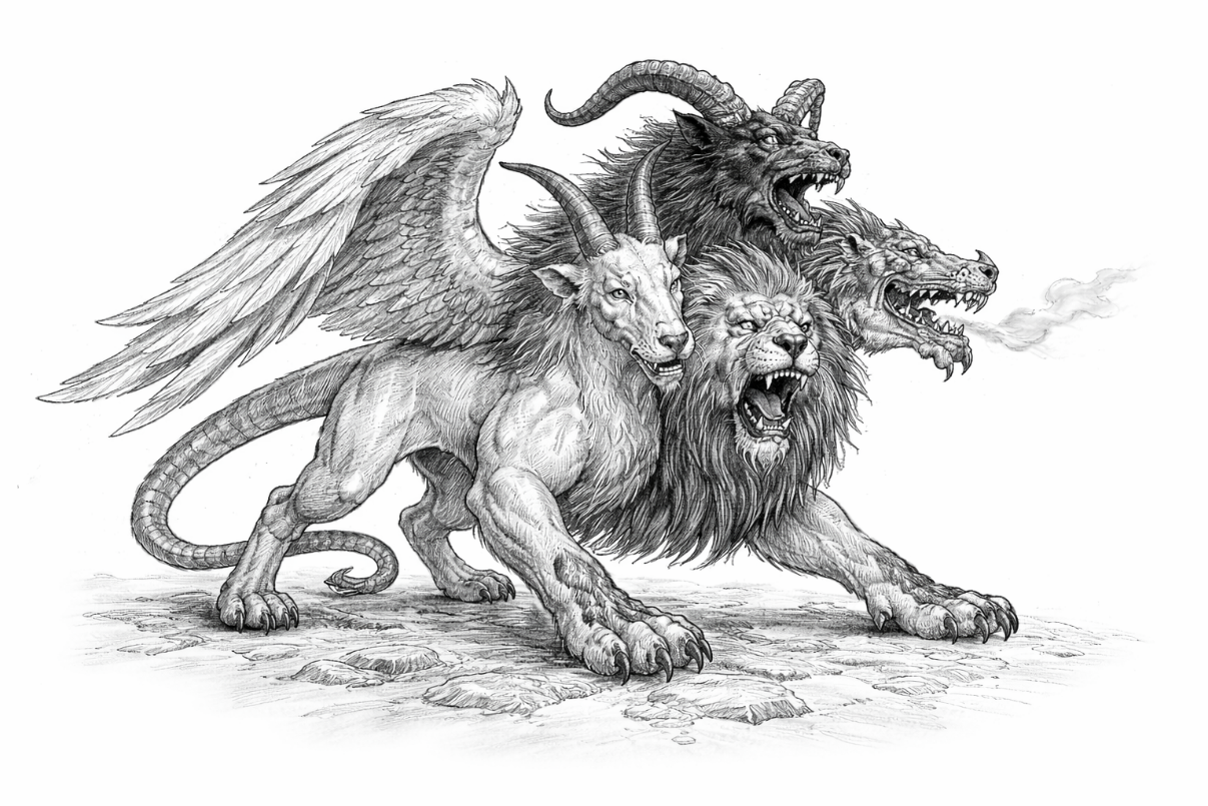
A chimera - the mythological creature behind Gavin Langmuir’s concept of “chimerical assertions.” Image created with ChatGPT.
For years, scholars, educators, Jewish organizations and public institutions have tried to explain the difference between legitimate criticism of Israel and antisemitism. And yet the confusion persists. Sometimes it is genuine. Sometimes it is politically convenient.
So perhaps it is worth trying again – this time with the help of a major historian who is not often invoked in public debates today: Gavin I. Langmuir.
Langmuir, one of the most important historians of medieval antisemitism, argued that antisemitism is not simply another form of xenophobia. Hatred of outsiders can be based on fear, competition, cultural difference, religious hostility, ignorance or crude generalization. It can be ugly and dangerous. But antisemitism, in Langmuir’s analysis, becomes something more distinctive when it attributes to Jews imaginary, impossible or monstrous qualities that are not grounded in empirical reality.
He called these “chimerical assertions.” The chimera is a mythological creature composed of parts of different animals. In Langmuir’s usage, a chimerical assertion is a claim that attributes to an outgroup, with certainty, characteristics that have never actually been observed. These are not merely exaggerations or hostile stereotypes. They are fantasies: Jews as ritual murderers, well-poisoners, desecrators of the host, secret rulers of the world, or demonic enemies of humanity.
Langmuir used this framework primarily to explain the transformation of Christian anti-Judaism in the Middle Ages. In the Augustinian tradition, Jews were seen as spiritually blind, mistaken and humiliated, but they were also to be preserved as witnesses to Christian truth. They had failed to recognize Christ, but their failure was understood as blindness rather than fully conscious demonic rebellion. This outlook led many Christians to view Jews primarily with contempt and condescension rather than as demonic enemies.
From the twelfth century onward, however, this image began to change. As Christian scholars encountered the Talmud and rabbinic literature, some came to believe that Jews were not merely blind to Christian truth, but had knowingly rejected it. If Jews had knowingly rejected Christ, and if they had knowingly participated in the crucifixion of the Son of God, then, in the Christian imagination, only a satanic force could explain such a crime.
From this world emerged the blood libel, accusations of host desecration, charges of well poisoning and other fantasies that presented Jews not as a mistaken religious minority, but as demonic enemies of Christian society. From this moment, Jews were not only despised; they were also feared. In other words, Jews were transformed from real human beings into chimerical figures: imagined carriers of cosmic evil. And once you fear someone, once you believe they are satanic, you are far more likely to harm them. This was also the period in which pogroms and expulsions against Jews in medieval Europe expanded dramatically.
Langmuir was writing about medieval Christian Europe, but his distinction can also illuminate other settings. In parts of the Arab and Muslim world, Jews in premodern periods often lived as a legally subordinate minority: tolerated, restricted, humiliated, and at times attacked, but not usually imagined as an all-powerful demonic force threatening the world.
From the nineteenth century onward, and especially in the twentieth century, that changed in parts of the region. European antisemitic ideas entered Arab and Muslim political discourse; blood libels appeared; the *Protocols of the Elders of Zion* circulated; and myths of global Jewish or Zionist power became more common, especially as modern nationalism, imperial pressures and the conflict over Zionism intensified. Here too, the shift was from contempt, subordination or hostility toward chimerical demonization: Jews and Zionists could now be imagined as a hidden power, a global conspiracy, or a force manipulating history from behind the scenes.
This is precisely why Langmuir is useful for understanding the debate about Israel today. The central point should be stated clearly: not every criticism of Israel is antisemitic. One can criticize the Israeli government, the prime minister, ministers, settlements, the conduct of a war, military decisions, legislation, diplomacy, or policies toward Palestinians. Such criticism may be harsh, one-sided, unfair, mistaken or deeply troubling. But as long as it addresses real policies, real actions and real political responsibility, it remains within the realm of political criticism.
One way the line is crossed is when Israel, Israelis or Zionists are no longer treated as real political actors, but as chimerical figures: demonic, satanic, contaminating, hidden, global, unbearable, or dangerous to humanity itself.
Three recent examples illustrate the point. The first is the statement reported this week from Turkish Foreign Minister Hakan Fidan’s interview with CNN Türk. According to reports published on July 2–3, 2026, Fidan said that Israel is not only Turkey’s problem, but a problem for the whole world, and that Israeli authorities had become “a burden that humanity can no longer bear.” There is a vast difference between saying “Israeli policy is dangerous” and saying that Israel is a burden humanity can no longer bear. The first is a political claim. The second transforms Israel into a metaphysical weight upon the human species. Israel is no longer a state whose actions may be criticized; it becomes a problem for humanity as such.
The second example came in late May 2026, in an ordinary public encounter in Cambria, California. A hotel worker harassed an Israeli couple during check-in, asking whether they were “baby killers” and whether they had served in the IDF. In a social media caption, he wrote that he had never “stared into the soul of the devil” as he did that night. This case is especially revealing because the demonization moves from the level of the state to the level of individual human beings. Random Israelis in a hotel lobby become “baby killers” and embodiments of the devil. They are no longer guests, individuals, civilians, tourists or human beings with their own views and biographies. They become representatives of absolute evil.
The third example came earlier, on April 9, 2026, when Pakistan’s Defense Minister Khawaja Asif wrote on X that Israel was “evil” and “a curse for humanity,” and referred to it as a “cancerous state.” The post was later deleted. Again, this is not simply criticism of a military action or government policy. The language is pathological and metaphysical. Israel is not described as a state acting wrongly, but as a disease in the body of humanity — a cancer, a curse, an evil. That is the language of purification and removal, not political disagreement.
Taken together, these examples show why the distinction matters. Political criticism remains attached to the world of actions and responsibility: governments make decisions, armies conduct operations, and citizens, courts and observers can ask whether those decisions were lawful, moral, proportionate or wise. Demonization works differently. It detaches the discussion from conduct and attaches it to essence. Israel is no longer accused of doing something wrong; it is described as being something evil — a cancer, a curse, a satanic presence, a burden on humanity. Once the language shifts from what a state does to what it supposedly is, we are much closer to Langmuir’s chimerical world.
This is where such demonization becomes antisemitic: when it turns Israel, Zionism, or Zionists into a chimerical object – the hidden power behind world politics, the embodiment of Western evil, a new Nazism, the cancer of humanity, the satanic force from which the world must be freed. This is why Nazi analogies are so often revealing. Not every bad historical analogy is antisemitic. But when Israel is repeatedly compared to Nazi Germany not in order to illuminate a specific legal or historical question, but in order to make the Jewish state inherit the symbol of absolute modern evil, the analogy becomes something else. It becomes moral inversion. The victims, or their descendants, are transformed into the very image of their destroyers.
The same is true of conspiracy theories about “Zionist control.” When critics claim that Israel influences American foreign policy, that is a claim that can be debated empirically. But when “Zionists” are said to control governments, media, banks, universities or the West itself, the structure is no longer political analysis. It is a familiar chimerical fantasy with updated terminology.
Langmuir’s framework is useful because it prevents two opposite mistakes. The first mistake is to call every criticism of Israel antisemitic. That is analytically weak and politically damaging. It empties the concept of antisemitism of meaning and makes serious criticism harder to distinguish from hatred. The second mistake is to treat every statement about Israel as political criticism merely because the word “Israel” or “Zionism” is used instead of “Jews.” That is equally dangerous. Antisemitism has always changed its language. It has spoken in religious, racial, nationalist, revolutionary, anti-capitalist, anti-imperialist and now anti-Zionist vocabularies. The vocabulary changes; the chimerical structure often remains.
This is why the debate is not semantic. It is not about protecting Israel from criticism. It is about preserving the ability to recognize antisemitism when it mutates.
A democratic society must be able to do both things at once: protect the right to criticize Israel, and identify when criticism has become demonization. It must allow debate over war, occupation, settlements, civilian casualties, political leadership and law. But it must also recognize when Israel, Israelis or Zionists are no longer being discussed as political actors, and are instead being cast as devils, cancers, curses or burdens on humanity.
Not every criticism of Israel is antisemitism. But not every statement against Israel is criticism. When Israel is described as a state whose policies are wrong, we can argue about facts, law and morality. When Israel is described as a satanic force, a cancerous state, a curse for humanity, or a burden the world can no longer bear, we are no longer in the realm of ordinary political criticism.
In Langmuir’s terms, we are dealing with a chimerical assertion. And in historical terms, that is antisemitism in political form.
Related Topics
Related Posts