
A Chronic Virus: The Strategy Jews Need for Antisemitism’s Recurring Outbreaks
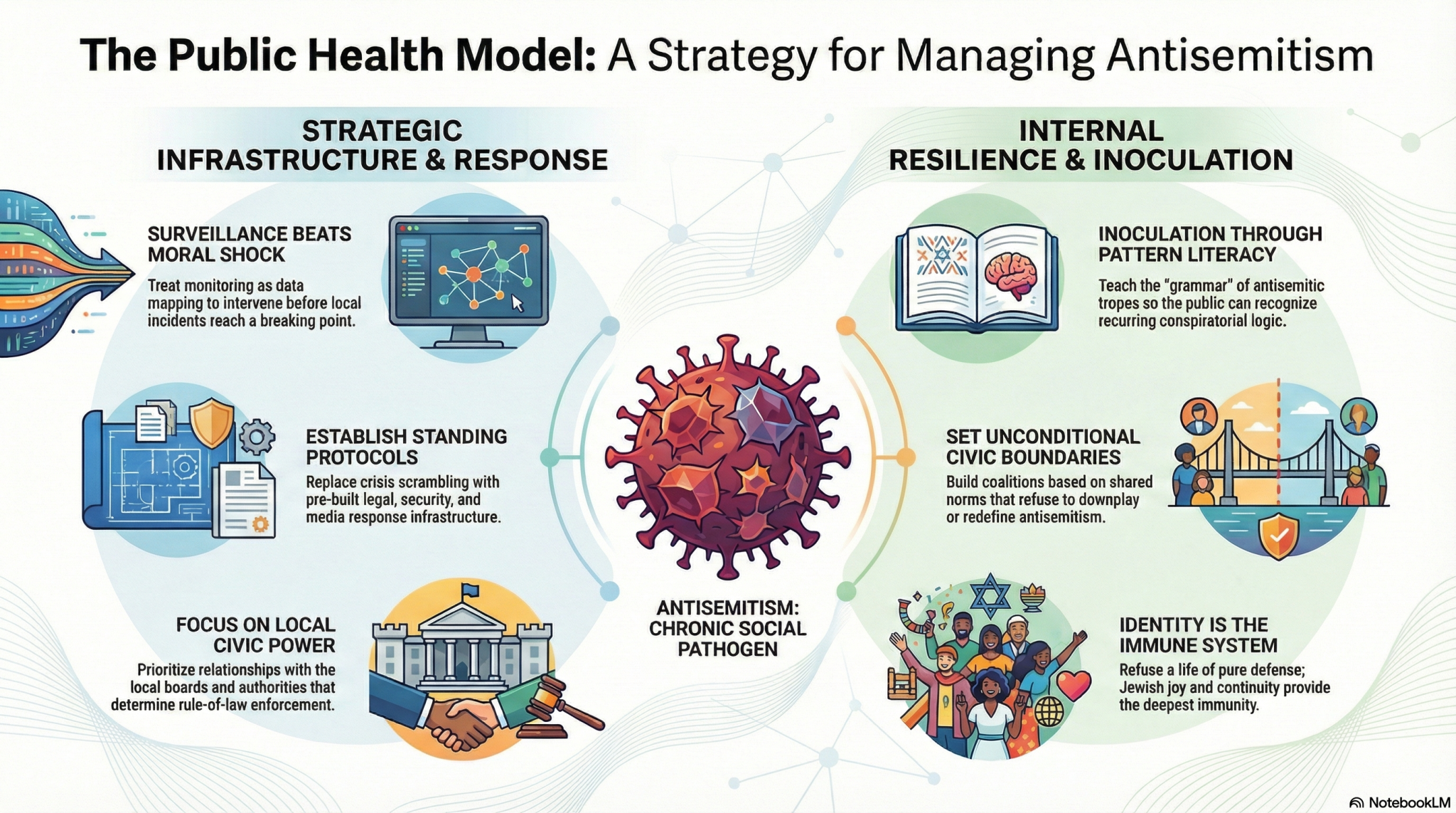
We don’t get to choose whether the pathogen exists. We do get to choose whether we are prepared when it mutates.
Antisemitism does not behave like an opinion. It behaves like a contagion.
It lies dormant in the background of societies that congratulate themselves on progress. It reappears in new costumes when conditions allow: economic anxiety, political polarization, war, social media accelerants, conspiratorial thinking. It mutates so that each generation can say, sincerely, “This is different.” And then, as if on cue, it becomes socially transmissible again—moving from the fringe to the fashionable, from coded insinuations to open intimidation.
If this sounds like a virus, that’s because it functions like one.
For Jews, the strategic question is not whether we can finally “solve” antisemitism through education, dialogue, or moral appeal. Those tools matter, but history is brutal on fantasies of eradication. The strategic question is: How should Jews live wisely in a world where antisemitism periodically becomes epidemic?
Public health offers an answer: you don’t defeat a chronic pathogen by pretending it shouldn’t exist. You manage it with surveillance, prevention, rapid response, resilient infrastructure, and long-term immunity-building.
That is the posture Jews need now—not fatalism, but preparedness.
1) Surveillance: early warning beats moral shock
Communities are often caught flat-footed because antisemitism rarely announces itself as antisemitism at first. It begins as “just questions,” “just criticism,” “just memes,” “just chanting,” “just one incident.”
But outbreaks always have signals: an uptick in conspiratorial narratives, a shift in what institutions tolerate, the normalization of collective blame, the casual use of “Zionist” as an all-purpose slur, the recycling of ancient tropes in modern language.
A serious strategy treats monitoring as a communal norm—tracking local incidents, online narratives, and institutional responses with discipline. Not as paranoia, but as data. When you can map patterns, you can intervene earlier—before the fever breaks.
2) Rapid response: you don’t improvise during a fire
In a crisis, communities often scramble for messaging, legal options, security decisions, and media engagement. That scramble is itself a vulnerability.
Prepared communities have pre-built protocols: who documents incidents, who speaks publicly, who liaises with law enforcement, what legal pathways exist, what coalition partners are activated, what security steps are triggered. They keep records—dates, screenshots, reports—because antisemitism thrives when it remains anecdotal and deniable.
A recurring pathogen demands a standing public health system. Jewish communities should treat rapid response capacity as infrastructure, not a volunteer side project.
3) Prevention: inoculation is not just “education”
Education is often framed as “telling people about Jews.” That’s not inoculation. Inoculation teaches people to recognize the pattern of the disease.
Antisemitism has a grammar: the conspiracy logic of hidden control, the dual-loyalty accusation, the blood libel mutation, the paradox of Jews as simultaneously omnipotent and subhuman. It spreads by narrative, not by fact. So the protective education is not a history unit; it is antisemitism literacy—especially media literacy—aimed at recognizing how memes and slogans smuggle old ideas through new channels.
The movable middle needs this most. The committed antisemite is not the target audience. The target is everyone around them: the people who decide what becomes socially acceptable.
4) Reduce vulnerability: harden institutions without becoming fortress-people
Synagogues, schools, community centers, and Jewish events should not become militarized theaters—but neither can they be naïve. Physical security, training, cyber protection against doxxing and harassment, and consistent coordination with local authorities are basic. So is mental health support after incidents. Trauma accumulates. Resilience is not infinite.
One of antisemitism’s victories is forcing Jews to live as permanent targets. The goal of preparedness is to prevent that victory: to keep Jewish life open and flourishing even while protected.
5) Coalitions: essential, but not unconditional
Allies matter. Antisemitism is too resilient to fight alone, and minority protection is a democratic project.
But coalitions must be built on clear civic norms, not on ideological demands that Jews accept their own delegitimization as the entrance fee. If partnership requires Jews to downplay antisemitism, redefine it out of existence, or tolerate demonization because it wears the right political colors, that partnership is not protection—it is exposure.
A healthy coalition has a baseline requirement: antisemitism literacy and consistent standards. If harassment, intimidation, and collective blame are unacceptable for one minority, they are unacceptable for Jews too.
6) Political strategy: plural, pragmatic, and local
One of the most dangerous Jewish habits is treating antisemitism as belonging to “the other side.” It doesn’t. It travels.
Sometimes it appears as ethno-nationalist hatred. Sometimes as revolutionary scapegoating. Sometimes as religious contempt. Sometimes as intellectual fashion. The carrier changes, the pathogen remains.
That reality demands pragmatic pluralism. Jewish communities should maintain broad relationships across political life where possible, and invest heavily in local civic power—the institutions that actually determine outcomes: school boards, campus administrations, city councils, prosecutors, and police chiefs. These are where rules are enforced or quietly abandoned.
If antisemitism is a public health threat, then consistent rule-of-law enforcement is a vaccine booster.
7) The deepest immunity: Jewish continuity
Here is the uncomfortable truth: antisemitism wants Jews to become nothing but defense. It wants Jewish identity reduced to fear management and crisis response.
The most profound long-term strategy is to refuse that. Jewish continuity—learning, practice, culture, community, joy—is not escapism. It is the immune system.
A community that knows what it is, that has depth, bonds, and internal solidarity, is harder to fracture, harder to intimidate, harder to exhaust. Antisemitism feeds on isolation and fragmentation. Jewish continuity is the opposite of both.
8) The personal layer: awareness without captivity
Preparedness is not only communal. Individuals need boundaries and practices too: when to disengage online, how to report safely, how to avoid feeding harassment machines, where to find support. Antisemitism seeks to occupy Jewish attention permanently. Protecting emotional bandwidth is not weakness; it is survival strategy.
A sober conclusion
The seductive mistake is to imagine that if Jews just explain better, persuade more skillfully, or appeal to morality more eloquently, the world will finally graduate beyond antisemitism.
The record does not support that hope.
Antisemitism’s persistence suggests something darker: that it is not merely ignorance but a recurring social technology—an all-purpose conspiracy framework societies reach for when they want a culprit. Like a virus, it mutates to fit each era’s anxieties, and it spreads fastest where institutions are weak and gatekeepers are cowardly.
So Jews must adopt a strategy equal to the threat: surveillance, rapid response, prevention, resilience, coalitions with boundaries, political pragmatism, and deep continuity.