
A crisis gone to waste
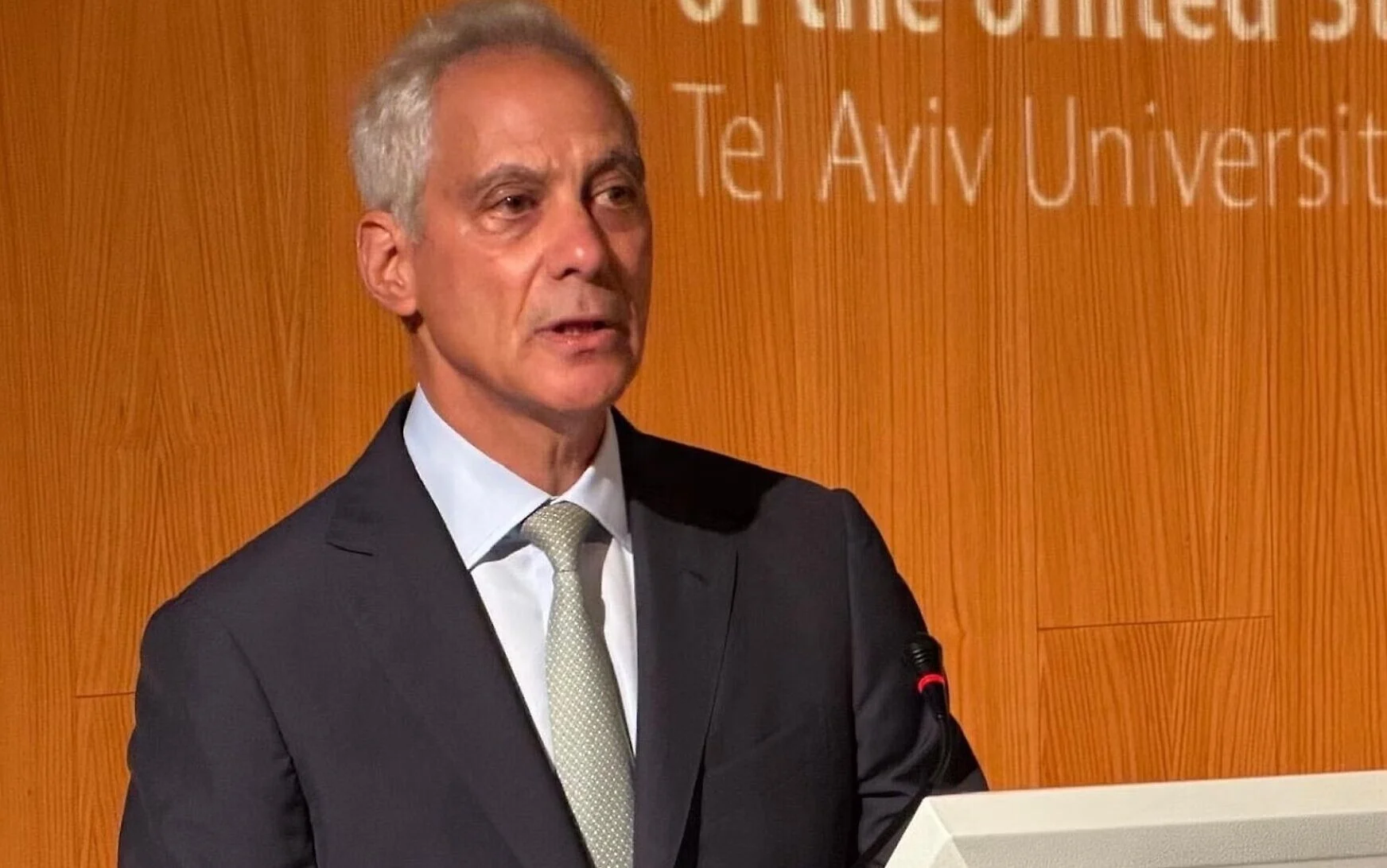
No one has ever launched a presidential campaign on the message that things are basically fine. The product a candidate sells is emergency, and the cure he offers is himself. Rahm Emanuel, doing everything a 2028 hopeful does short of filing the paperwork, understands this mechanism better than any man alive. He wrote its operating manual back in 2008: “You never want a serious crisis to go to waste.”
So when Emanuel stood at Tel Aviv University on Wednesday to announce that the alliance between Washington and Jerusalem cannot survive in its present form, that Israel has turned itself into a “territorial pariah,” that its sole diplomatic gain in three years is Somaliland, that settlers and the banks financing them should be sanctioned, and that salvation lies in a 23-state solution administered by the Arab League, he was doing what candidates do.
Within hours, the angrier precincts of the pro-Israel commentariat reached for the ugliest word in the Jewish political vocabulary. The response is as lazy as it is wrong. Emanuel began his visit at his uncle’s grave on the Mount of Olives, a fighter who fell in the underground, and his Jerusalem-born father fought in the War of Independence. Whatever else the man is, a collaborator he is not, and the Israel-hater label misses just as badly. His condition is more ordinary and more forgivable: the occupational disease of every political hopeful, the compulsion to call the existing situation unsustainable. A candidate who concedes that matters are tolerable has explained why nobody needs him. If the patient is healthy, what is the doctor doing on stage?
I say this without much malice, because weighing in on the Israeli-Palestinian conflict is a perfectly legitimate pursuit; I do it myself. I have argued before, and again more recently, that there will never be a Palestinian state west of the Jordan, and that the only paths toward genuinely ending it are unorthodox: the slow growth of a new, non-eliminationist and non-Palestinian Arab identity in Gaza and in Judea and Samaria, followed by integration with Egypt and Jordan; a generously funded program of voluntary emigration; perhaps a Palestinian state built elsewhere entirely. Each of these is unlikely. Each is still likelier than the two-state incantation coming true. And the likeliest outcome of all, by a wide margin, is that the status quo, or some variation of it, simply carries on.
Here Emanuel and I briefly touch, because buried in the address was a remarkable concession: he called the two-state solution a discredited path. Savor that sentence. Bill Clinton’s Middle East hand, Barack Obama’s chief of staff, standing in Tel Aviv and declaring the holy grail of three decades of American diplomacy dead. Coming from a man who spent those decades pursuing it, that is not a small thing to say out loud, and he deserves credit for saying it.
But having buried one fantasy, he commissioned a larger one. In Emanuel’s telling, the 21 members of the Arab League will now build a Palestinian governing authority that embraces the Jewish bond with this land, stops paying salaries to the murderers of Jews, and rewrites the textbooks. These are the same governments that expelled some 300,000 Palestinians from Kuwait in 1991, still bar the residents of Lebanon’s refugee camps from dozens of professions, and whose Hashemite branch turned artillery on the fedayeen in 1970. A speech that opens by reminding Israelis they offered sovereignty for security three times, and were repaid with Dizengoff, Mahane Yehuda and the Second Intifada, closes by proposing a fourth round with more flags at the table. Multiplying the parties who must perform a miracle does not improve its odds.
We have heard this precise certitude before, from a man of the same party and the same seniority. In December 2016, John Kerry stood at the Saban Forum and lectured his audience that there would be “no advance and separate peace with the Arab world” without the Palestinians — a hard reality, he assured them, that everybody needed to understand. Four years later the United Arab Emirates, Bahrain, Morocco and Sudan signed the Abraham Accords, and the Arab world made its separate peace without waiting for the Palestinians or asking Kerry’s leave. Saudi normalization, when it comes, will be a question of terms rather than principle. The lesson is not that Emanuel is uniquely foolish; it is that the whole school of thought he represents mistakes its own assumptions for the laws of physics, and keeps being surprised when the region declines to obey them.
Since everyone from Emanuel to the annexationist right treats “unsustainable” as an axiom — and consensus is exactly where scrutiny goes to die — it is worth applying some. Pariah states do not sit in the OECD. They do not hold free-trade agreements with the United States, the European Union, Britain and most of Latin America, and their citizens do not board flights to New York without visas. Israel’s exports hit an all-time record of $165 billion last year, in the middle of a regional war; on defense specifically, it now ranks as the world’s third-largest arms exporter, with 7.8 percent of the global market, trailing only the United States and France and outselling Russia, Germany and Britain.
Tel Aviv, meanwhile, was just ranked the world’s fourth most valuable startup ecosystem, behind only Silicon Valley, New York and London, with $250 billion in exits and valuations. This spring alone, Google closed a $32 billion purchase of Wiz and Palo Alto Networks a $25 billion buy of CyberArk. The Bank of Israel projects growth of 4 percent this year and 5.5 percent in 2027 — figures most European finance ministers would trade a kidney for, and enough to outpace every G7 economy. GDP per capita is nearing $70,000, above Germany’s and Britain’s. If this is what leprosy looks like, half of Europe should hope to catch it.
Then there is the map. The Somaliland quip lands only on an audience that stopped reading the news sometime in 2024. Bolivia, which severed relations with Israel twice under its socialist governments, restored them in December, weeks after electing Rodrigo Paz. Kazakhstan acceded to the Abraham Accords in November. Javier Milei is moving Argentina’s embassy to Jerusalem and has midwifed the Isaac Accords, a framework for Israeli–Latin American cooperation billed as the natural continuation of its Abrahamic cousin.
Latin America, a region I have followed for years, keeps supplying examples. Chile replaced Gabriel Boric with José Antonio Kast, who is unwinding his predecessor’s estrangement from Jerusalem. Colombia, whose outgoing president made hatred of the Jewish state the centerpiece of his foreign policy, last month elected Abelardo de la Espriella, who has pledged to restore relations. Even the anti-Zionist press now writes, through gritted teeth, of a pro-Israel wave sweeping the continent — no region has moved toward Israel faster since October 7, which makes it a strange thing to omit while declaring the country friendless.
Even Europe, supposedly lost, is less lost than advertised. Slovenia spent two years as the bloc’s most theatrical baiter of the Jewish state: the first in the union to bar Netanyahu from entering, an arms embargo, a boycott of Eurovision. Then Slovenians voted. The new prime minister, Janez Janša, froze the recognition of Palestine within weeks of taking office, restored the weapons trade and announced that his country’s embassy will move to Jerusalem, where no other EU government keeps one. In Madrid, Pedro Sánchez, the continent’s most dedicated prosecutor of Israel, is sinking under corruption cases that reach his wife, his brother and his own attorney general, while the polls hand the opposition a comfortable majority whenever Spaniards next vote. In Britain, the government that sanctioned Israeli ministers now trails Reform UK in every survey. And in France, an appeals court this week cleared the last obstacle to a Marine Le Pen candidacy in 2027; her National Rally, fiercely anti-Islamist and far warmer toward Israel than the establishment it hopes to replace, now leads polls that show her not merely topping the first round but winning the runoff against every rival. Much can still change before 2027, but the plausible near future is one in which several of Europe’s largest countries are governed by people markedly friendlier to Jerusalem than those in charge today. Vitriol on social media, it turns out, is a poor map of the actual territory.
The strongest section of the speech concerns American opinion, and honesty demands taking it seriously. Fifty-eight percent of Democrats now tell pollsters that Washington is too supportive of Israel, up from 45 percent in early 2024, and favorability among the young has cratered in both parties. Those numbers are real. The argument built on them is another matter, because it works only if a series of propositions Emanuel never pauses to defend all come true at once.
The hostility has to be structural, a permanent fixture rather than the latest in a series of moral fevers that spike and break. Campuses fall hard for a cause and then misplace it. Black Lives Matter is the freshest case: in June 2020, at the height of the George Floyd summer, 67 percent of American adults told Pew they backed it, and corporations pledged billions. Within three years support had slid to around half, those pledges had evaporated, and the movement’s flagship organization had collapsed into scandal. The Israel obsession shows the same arc. As the Gaza fighting has receded, the encampments have thinned; the Anti-Defamation League counted 1,694 campus antisemitic incidents in 2024 and 583 in 2025, with protest-linked incidents down 83 percent. The fever is already breaking; Emanuel proposes rebuilding a foreign policy around its temperature at the peak.
The passion also has to be a reaction to Israeli policy specifically, even as the Democratic Party drifts leftward on markets, policing and borders alike, with Jerusalem carried along in the current. And it assumes today’s TikTok-radicalized twenty-year-old stays frozen at twenty forever, when almost no one carries a sophomore’s convictions into middle age.
Beneath it all sits the largest assumption: that the alliance runs on the mood of the median voter rather than on interests and shared enemies. The median voter worries about his mortgage; a country the size of New Jersey six thousand miles away does not decide his ballot. And the last time he cast one, less than two years ago, he handed the most pro-Israel president in American history a second, non-consecutive term, and every battleground state with it.
Suppose, though, that the opinion did hold, and Israel bowed to it and let the state come into being. The most naive premise of all is that the new neighbor would keep the peace. In 2007, Hamas needed only a few days of street fighting to throw the Palestinian Authority out of Gaza and shoot its officials off rooftops. Name the reason the same would not repeat in a sovereign Palestine, this time with the immunity of statehood. And when it did, does anyone believe the 21-nation Arab coalition Emanuel is counting on would send troops to restore order, rather than urge “both sides” to show restraint and race to condemn Israel the instant it defended itself? Egypt regards Hamas as a genuine threat and has fought its affiliates in Sinai for years, yet never lifted a finger to dislodge it from Gaza next door. Cairo, Riyadh and Amman will not do for a Palestinian state what they would not do for themselves.
The precedents on offer are a mini-Iran in Gaza and Lebanon to the north, where the government watches armed factions wage war from its soil. Let that state’s rockets eventually fly and Israel answer, and the chorus now demanding a Palestinian flag would rediscover its outrage on cue — except that Israel would face it from far weaker ground, having already conceded the state and surrendered the territory, with no leverage left to spend. A country that trades real security for the approval of people who will disapprove again the moment it defends itself has bought nothing and paid everything. Concession from one side forever, from the other never.
Running through every section of the speech is its load-bearing premise: that decades of unconditional American support are at last being withdrawn. This is the first of two scarecrows, because nothing of the kind ever existed. The United States has never signed a mutual defense treaty with Israel, the sort it maintains with Japan, South Korea and every NATO member. Eisenhower threatened sanctions in 1957 to force Ben-Gurion out of Sinai. Ford declared a formal reassessment of ties in 1975 and suspended arms deliveries for six months. James Baker, as secretary of state, read Israel the White House switchboard number before a congressional committee and told it to call when it was serious about peace, then spent a year blocking $10 billion in loan guarantees over settlements. Even the fine print tells the story: those visa-free flights to New York are recent, granted only in 2023, while Chile — nobody’s idea of Washington’s closest ally — has had the privilege since 2014.
Each was called the death of the special relationship at the time; all are footnotes now, because the partnership rests on foundations sturdier than any president’s mood. This past February, American and Israeli aircraft flew coordinated strikes over Tehran while US cyber commands blinded Iranian air defenses, and before the fighting ended Gulf monarchies were firing at Iran from the same side. Alliances on their deathbed do not conduct operations of that intimacy.
His warning against Greater Israel supplies the second scarecrow. It exists as a slogan on the political fringe; no Israeli government has ever adopted it, including this one, which for all its rhetoric has not annexed a single dunam of Judea and Samaria, and Washington has said it would block the attempt. Emanuel sets the phrase beside the genocidal chant about the river and the sea, as though a country’s rowdiest bumper stickers were its strategy. Put the two together and the architecture of the address appears: Israel must abandon a policy it does not have, because America is ending a policy it never had. From a candidate assembling a campaign, this is understandable stagecraft; as analysis of US-Israel relations, it holds no water. What both scarecrows guard is the same demand: two states or twenty-three or the whole land, pick something, anything, so long as the conflict gets solved.
There is nothing left to solve. The conflict has been settled to the extent that it is settleable — imperfectly, unofficially, without a lawn ceremony — and what remains is management: security where necessary, economic cooperation where possible, friction shrunk where it can be. Micah Goodman gave that approach a name, shrinking the conflict, and Naftali Bennett spent years championing it. Gaza is its own tragic file, and nobody should pretend otherwise. But in Judea and Samaria, the arrangement everyone calls unsustainable delivered two decades in which terrorism collapsed from Second Intifada levels, Israeli towns and Palestinian cities both grew, and well over a hundred thousand Palestinians earned their living inside the Israeli economy before the war.
To the degree that anything does demand solving, it is the root and not the symptom. The maximalist, eliminationist cause going by the name “Palestine” is not the organic national awakening its champions pretend; its very identity was assembled in the 1960s by the Soviet KGB as a Cold War instrument against a Western-aligned Jewish state, a fabrication its own architects occasionally admitted, as when the PLO’s Zuheir Mohsen conceded the Palestinian people had been invented to serve the war on Israel. What Moscow manufactured, Tehran inherited and armed, keeping the project breathing for decades with money, rockets and training until a Soviet propaganda line had become a live franchise of the Islamic Revolution. Cut off that supply — as the war against Iran has begun to do, with Khamenei dead and the regime’s proxies degraded from Beirut to Sanaa — and watch how quickly the cause deflates. Deprived of Iranian cash and weapons, “Palestine” would stop being the moral thermometer the whole world is made to read, and settle into the dull register of the planet’s other territorial disputes, somewhere around the Western Sahara: a quarrel occasionally aired at the United Nations over which no one loses sleep.
Western Sahara is not the exception; it is the norm. The world is full of unfinished quarrels it has learned to live beside. Cyprus has been partitioned since 1974, a UN buffer zone running through the middle of an EU capital. Spain has claimed Gibraltar since 1713 without anyone calling Britain a pariah. Transnistria has sat frozen for three decades, Kashmir for seven. None comes with a deadline. Only the Jewish state’s dispute is declared a ticking bomb that must be defused within the current election cycle, usually by whoever happens to be running in it.
None of this means Israel lacks problems; a nation that has fought on half a dozen fronts for three years has plenty. It means the specific claim — that the present arrangement is terminal and must be traded for a diplomatic moonshot — deserves the scrutiny it never gets. Emanuel will keep pronouncing the status quo unsustainable, because his campaign requires a patient in critical condition, and he explained to us seventeen years ago exactly what a good emergency is worth. A country, though, is under no obligation to supply one. Israelis have made their peace with an unsolved conflict. It is the solvers who never will.