

A Day of Protective Presence in the West Bank
I don’t consider myself to be a very political person. To me activism is just about standing up for basic human decency.
Last Monday I went to the West Bank together with an organization called Torat Tzedek to do “protective presence.” What this means is that Israelis come to spend time at Palestinian villages to deter settlers from attacking and to film confrontations that occur.
I took a bus from Tel Aviv to Jerusalem, then walked to the nearby Yellow gas station, where I was picked up by Yoel, a semi-retired gardener who has been active in protective presence for fifteen years.
As we headed out, there was some awkwardness as Yoel had difficulty with my strong American accent. Nevertheless I was curious to learn about his experiences.
Israeli activists confront the settlers much less frequently than they used to because the settlers have become more violent. It used to be effective to just stand in their way and physically block them from approaching. Now the Palestinians mainly do the dirty work.
Turning to the (Israeli) authorities used to sometimes bear fruit but now it is more likely to backfire. The military’s new way of “responding” to these complaints is declaring the area a closed military zone and then preventing people like Yoel from entering, while offering the settlers trail mix as they head out to resume their rampage.
The profession of shepherding is out of fashion these days as the pastures are mostly gone.
We passed by a settlement called Binyamin. Yoel explained that, “This is where we go to the police station submit testimony (on behalf of Palestinians who get arrested for defending their property).” I asked if I should expect to see some action and he responded that there usually is an incident once a day.
Our first stop was a village called Taybe. An attack happened there a week ago and the victim recently saw a settler on the prowl and requested for us to come and spend time with him so he could feel more secure.
This fence was quickly built following the attack.
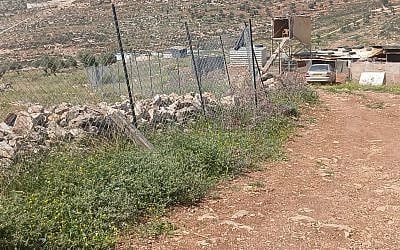 Ziyad was sitting in this building. He was attacked a week ago. He was beaten, and his herd and all of his money were stolen.
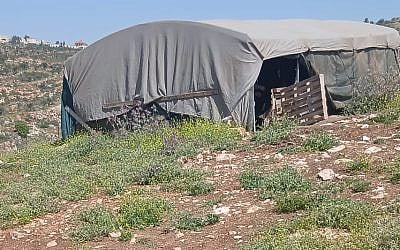 My job is to film and Yoel’s job is to confront the intruder because it’s my first time. It is likely that the fence will prevent a confrontation. Yoel conversed with Ziyad by speaking into google translate. I didn’t know how to use audio input on my Translate app so I communicated by typing.
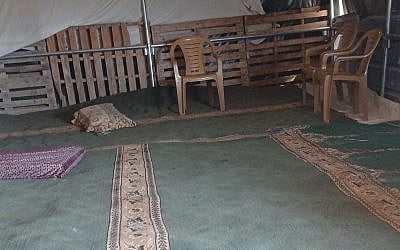 I asked him if this is his home, if this is where he sleeps and he said yes. I translated from English to Arabic and he translated from Arabic to Hebrew. I wanted to tell him that I’m from America and more things about myself, and to ask him more about himself and his way of life, but he seemed to have more pressing things on his mind.
Ziyad added that the settler also terrorized the women and children.
He asked both of us for some money because he is unemployed and he needs food for his children. Yoel reluctantly agreed. I said that I would check my account when I got home and get in touch with him. Ziyad wouldn’t let up, and finally I agreed also. A heavy silence settled around us. Neither Yoel nor I came there with the intention of parting with some of our money, although Yoel does hope he will be able to fundraise the money back.
We went back to the car to leave Taybe. “I don’t think there actually was a settler,” Yoel said. “He just wanted us to come so he could ask us for money.” Zayid used to live somewhere else but settler violence forced him to flee to his current location.
It took me a few minutes to process the whole situation. When I hear the word “unemployed,” my first thoughts are about unemployment benefits and applying for a new job. Ziyab isn’t unemployed because he got fired. He’s unemployed because his herd was stolen from him and he can’t buy a new herd because the people who stole his herd also stole his money. The whole shepherd thing is all he knows and this could be the end of a family tradition that was passed down for generations.
We drove for a few minutes to Mahmous, a small village that is filled with large houses.
“Rich people live here,” Yoel explained. “A lot of them have family in America.”
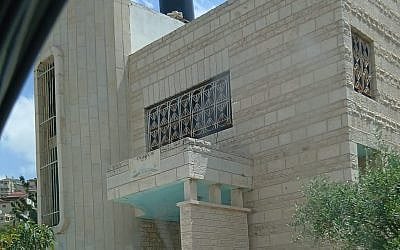 I couldn’t help but wonder why we needed to be the ones who provided Zayib with financial assistance.
“Has there been any effort to get his herd back?” I asked.
“The police wouldn’t do anything.”
On the other hand, if Zayib were to hop into a jeep with some of his cousins and drive around until he found his sheep, then the “police,” would suddenly awaken from their slumber and stop him from taking them back.
We drove past some more large houses.
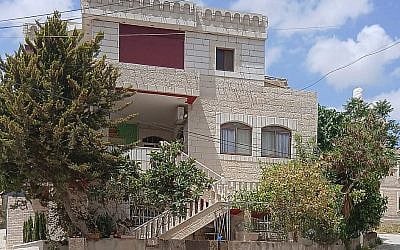 “Do the people here help out the poor shepherds who live nearby?” I asked.
“They have lookouts. They come with sticks and stones to confront the settlers. Someone got killed once when a settler responded with live fire.”
That wasn’t exactly what I meant to ask; I was referring to help with money, but I decided to let it go.
We pulled over at the edge of the village and talked to Salim, a fit, young man who speaks English with a perfect American accent. Salim is in charge of the security of the chicken coops. I eyed the rectangular buildings behind the road.
Whenever I see chicken coops, I always want to peek inside and assess their accommodations, to see if they live in cages, or if perhaps they are free to wander around a crowded concrete floor all day. This time I chose to leave my curiosity unsatisfied.
Local villagers recently erected a sturdy wall surrounding the compound following attempts by settlers to burn down the chicken coops.
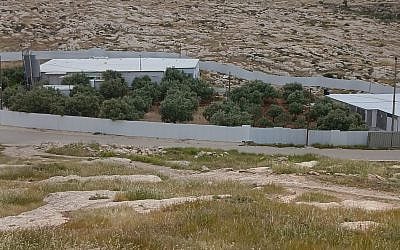 Salim instructed us to go up to a lookout point.
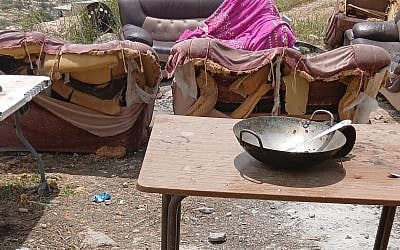 We climbed up the hill until we reached a small structure with some old couches and chairs. Our job was to film what happens. Palestinians were at another lookout point armed with stones.
I took out my lunch: whole wheat pita, tahini, chips, and hardboiled free range eggs that hopefully were laid by chickens who have a higher quality of life than the ones we are protecting.
The hours drifted by.
“I think I see people,” Yoel said.
“Where?”
“Over there, by those houses.”
We walked to the side to get a better view. I couldn’t see anyone.
“Even if there are people, they could just be the people who live in the houses,” I said.
“No one lives there, ” Yoel responded.
Another hour floated by before Yoel explained why no one lives there.
If you look closely, past the row of olive trees, you can see the small houses that I’m referring to.
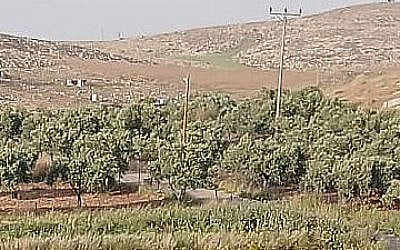 There used to be more houses over there but they got burned down, forcing the inhabitants to flee for their lives. The ones we can see are just skeletal structures that are burnt on the inside.
“Could you stay until seven?” Yoel asked.
Originally I said that I need to be back in Jerusalem by six so I could get home to Tel Aviv at a reasonable hour. However Yoel was convinced that the settlers weren’t planning on taking the day off, and it would be a shame for us to have sat there the whole day only to leave right when the action was about to start.
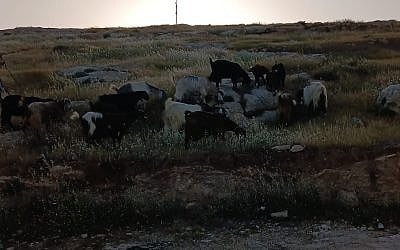
The sun was setting. A woman accompanying a crowd of hungry goats wandered by. I resisted the temptation to walk over and pick up one of the little ones.
 Finally, Yoel said that it was time to go. We walked back down to the chicken coops and said goodbye to Salim.
“Is someone else coming?” Salim asked.
“No,” Yoel responded.
I could see the way Salim’s face dropped, but that didn’t stop him from giving us a friendly goodbye.
As we were pulling out an activist named Ezzy arrived. Ezzy wore a kippa and spoke with an American accent that was almost as bad as mine. I learned that Ziyad, the first person we visited, used to have a herd of 100 heads, and they stole all of his money, gold and all. An international organization funded the fence that was quickly built around his home following the attack.
I wish I understood why someone would have a smartphone but not a bank account. I doubt any sci-fi writer from a previous generation could have dreamed up a breed of people that carry the internet in their pockets and defend their chicken coops with sticks and stones.
We stopped by the local mini market to get a snack. After we returned to the car, the phone rang. The settlers came. Apparently they were watching us the whole time and were waiting for us to leave. The kippa-wearing activist pulled in front of us and we followed after him. We passed by some kids who were standing in the middle of the street and looking in the direction we were driving. Everyone in the village knew what was going down.
Ezzy stopped again and told us that we can go home. The settlers had left. It wouldn’t be an early night for me.
What did I accomplish? For one thing, I helped prevent a news story from happening. I helped rob the reporters of something to write about, and I may have even saved the lives of people and chickens. I’m also glad that I had an opportunity to see with my own eyes that which is being done in my name.