A flicker in the dark: my day at Nova
As news of the Bondi Beach attack began to surface on social media, I was getting ready to travel to Re’im, the site of the Nova massacre. I had been in Israel for about a week by then, as part of a volunteer mission organized by the Jewish Federation of Los Angeles and Birthright Israel.
I had not slept a wink that night. I have never been to the concentration camps in Europe and was terrified of seeing the killing fields of October 7. In the previous days Instagram had flooded my feed with haunting footage of the Beautiful Six, the young hostages, including Hersh Goldberg Polin, lighting Hanukkah candles in the tunnels in Gaza months before they would be brutally executed by their Hamas captors. All night, these precious souls creating light in the darkest of places played on a loop in my mind. It was in that sleep-deprived state that I boarded the bus to the Gaza envelope.
On the way down, we learned that all sorts of nightmarish scenarios were unfolding in the Diaspora on the eve of Hanukkah, including reports of an attack on the Jewish community in Sydney, the extent of which was not yet clear, as well as a whole string of other attacks around the world, including a foiled plot in our hometown of Los Angeles. The dichotomy between the rolling fields outside the window and the headlines scrolling on my phone felt surreal.
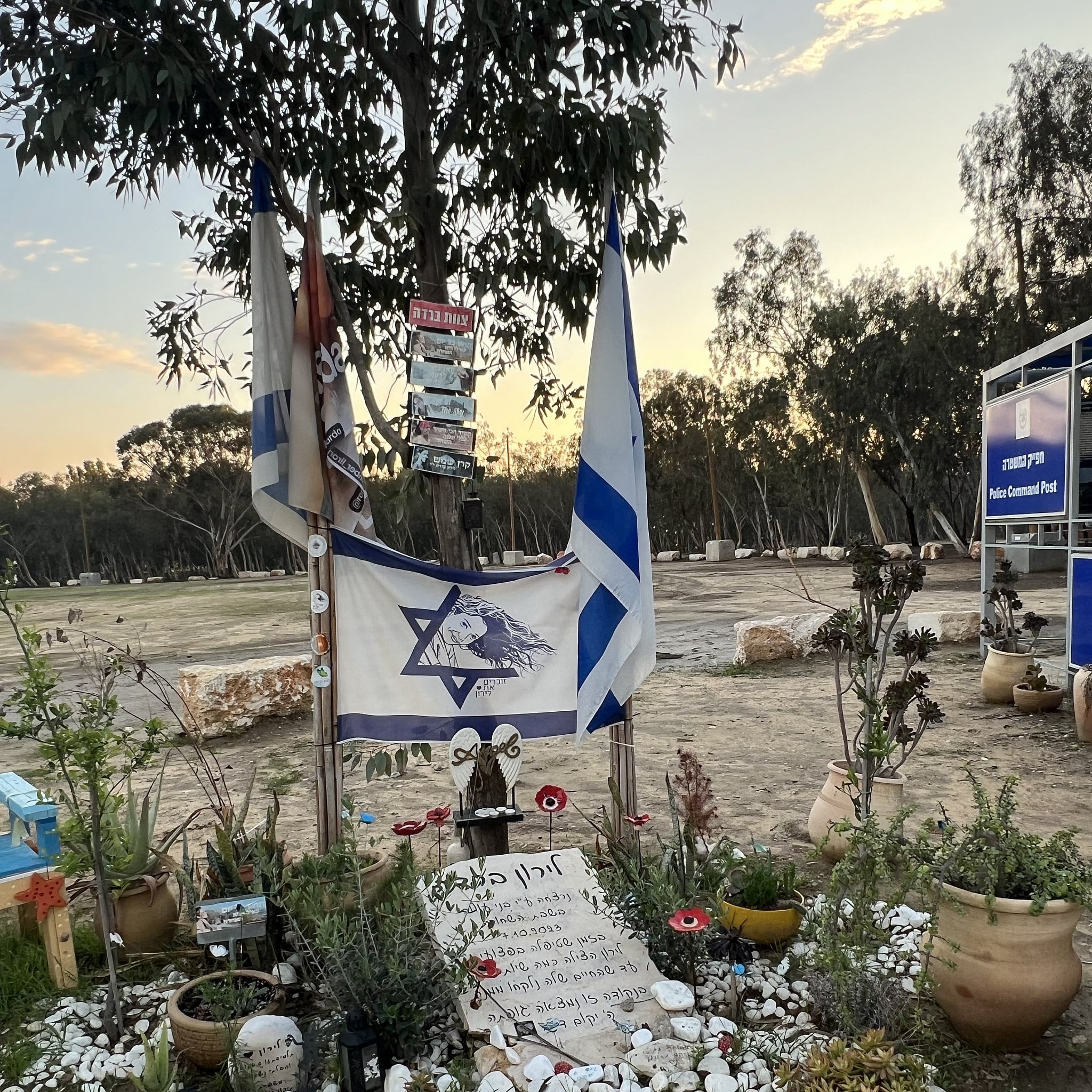
After spending the morning building a garden for refugees from Kibbutz Kfar Aza, one of the hardest hit kibbutzim, we headed to Nova. December days are short, and we arrived as dusk was setting in, rays of low light filtering through the trees. Despite having seen countless images of the site online, the grounds were nothing like what I had imagined.
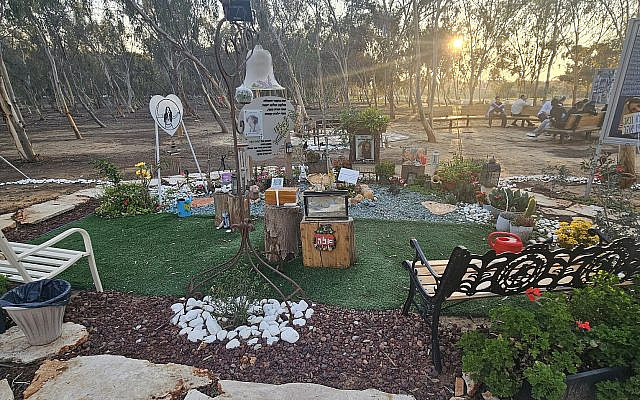
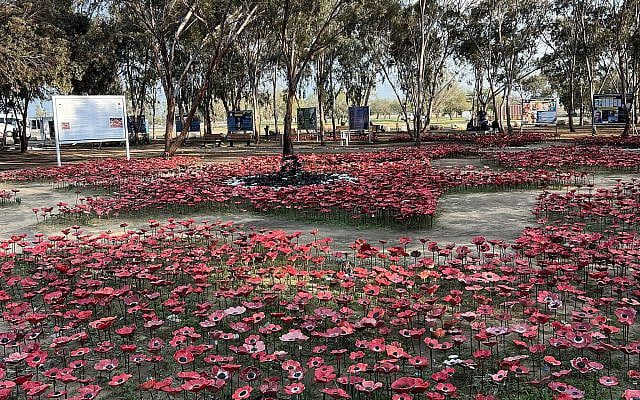
Three hundred seventy-eight people were murdered there that day. Dozens more were kidnapped into Gaza. And yet, the place does not feel like a cemetery. Because it is not a formal memorial yet, it is not stiff, dark, or lifeless. Instead, it is a living, organic organism that is constantly evolving. And since it is in part being curated by the survivors, it has maintained the spirit of that party community. It is full of color, texture, and feeling. It is, paradoxically, full of life.
You can feel the souls of all those joyful young people who just wanted to dance. It is beautiful and haunted. There were soldiers and tourists walking around. People were praying. Someone was singing HaTikvah. I said the Mourner’s Kaddish. I cried.
The group I traveled to Israel with was diverse: a mix of ages ranging from their 20s to 40s, people who had grown up in the United States, the Soviet Union, Israel, and Iran. Everyone in the group had been to Israel many times; several people had even lived in Israel, like me. Everyone, that is, except one thoughtful gentleman. For the sake of his privacy, let’s call him Kevin. It was Kevin’s first time in Israel.
Coming from the progressive world, he had found his life transformed in the last two years. Too many interactions, he told me, from romantic to social to professional settings, had turned into litmus tests. It was a story, versions of which I have heard all too often since October 7. In his words, he had come to Israel because he wanted to be in a place where, when people learned he was Jewish, they would not question whether he was the “right” kind of Jew, but would instead just say, “welcome.” Observing Kevin experience Israel for the first time was one of the most delightful and meaningful parts of this journey for me.
At Nova, our group gathered to hear a presentation by a survivor of that day. We met a young man named Atir, who shared his harrowing story. His friends convinced him to come to the festival as one last party before starting university. Atir described in terrifying detail the scene as the music halted at 6:29, the DJ announced a red alert, and confused partygoers scattered seeking shelter. He and his friends had come by bus, so they attempted to hitchhike, but the scene was too chaotic. Then they saw a policeman stumbling toward them, riddled with bullet holes. Before collapsing, he said, “Run east.”
That’s when they understood that this was more than a rocket attack. All that lay to the east was flat farmland with no shade and nowhere to hide. Those are the images the world saw of partygoers running through the fields. He and his friend ran, gunshots ringing around them, for many miles. One of the girls with them was catatonic from shock, and they had to carry her. Another guy had no shoes, and his feet were bloodied with lacerations.
Eventually, eight of them hid in a greenhouse. It was excruciatingly hot, and they were dangerously dehydrated. They saw a farm in the distance. Atir knew they would not last much longer without water, so they decided to risk going there. Outside the farm, they found a hose and one of the boys began drinking from it. That’s when he looked up and found a man with an Arabic accent asking who he was and what he was doing there. Terrified, he asked the man if he was a terrorist.
“No,” the man replied. “I am a Bedouin. I work here.” His name was Yunes.
Yunes took the terrified partygoers into his farm and gave them water and food. He had a group of Thai migrant workers on the property who were keeping guard around the perimeter. The young Jews finally felt safe as he fed and sheltered them in his kitchen, until one of the farm workers ran in, motioning with his wrists that he saw motorcycles approaching. The terrorists had arrived. Yunes told the Israelis to hide in the brush.
With a brilliant self-defense instinct, one of Atir’s friends noticed a gap under the floorboards of the farmhouse. One by one they wedged their bodies beneath the baseboards. From there, they could see Yunes’s feet as he, rather than hiding, locked the gate and went out to confront Hamas. None of the Israelis were fluent in Arabic, but they understood enough to know that the terrorists immediately began asking where the “naked Jews” were. They must have seen the shirts the partygoers had shed while running. The gunmen demanded that he open the gate.
With indescribable bravery, Yunes said, “I don’t have a key to the gate, and I am alone here. There are no Jews. I am a Muslim. I just work here.” From beneath the floorboards, the eight young people listened as Yunes pleaded and begged the terrorists to leave him alone, continuing to insist that he was alone. By sheer miracle, after searching around the perimeter, the Hamas fighters got back on their bikes and continued on to a nearby kibbutz.
An estimated 20 Bedouin Muslims were murdered on October 7, and another six were taken hostage. Yunes could have easily been one of them. He saved the group of eight Jews, and they, along with all the Thai workers, were successfully rescued later that day.
With regret in his voice, Atir told us that they didn’t even thank Yunes as they left. They were all in shock. The next day, Atir was drafted into reserve duty and went straight to war. It wasn’t until later, after one of his tours in Gaza, that he went back to find this Righteous Gentile who had risked his life to save eight strangers.
“And,” he said, turning around, “he is here with me today.”
It was then that a middle-aged man with a kind face, who had been standing in the crowd quietly listening, stepped forward. They embraced like family.
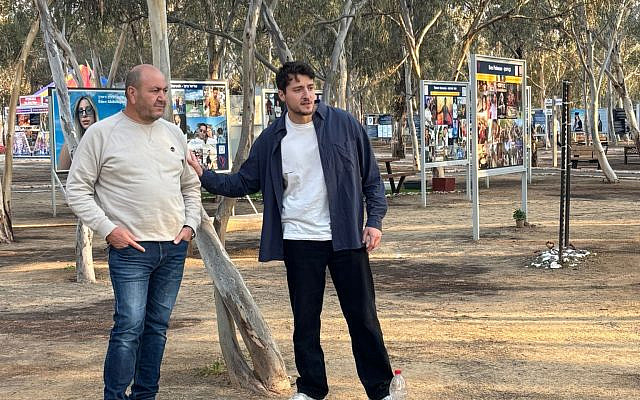
Now it was Yunes’s turn to tell his side of the story. He had a dry sense of humor and a kind, calm demeanor. One personal detail he shared was that he had a son who had died of cancer. He had spent many weeks in the hospital, and he knew what it was to feel helpless. As the terrorists approached his farm, he told us that he thought to himself, “I am not entirely helpless here. I couldn’t save my son, but maybe I can save these kids. I can at least try.”
After Yunes’s presentation, the group dispersed. People went to spend some private time processing. Kevin, our first-timer to Israel, approached Yunes, the heroic Bedouin.
This is the story he shared with him. During the Holocaust, Kevin’s grandmother, her sister, and their father were saved by a Polish farmer who hid them under the floorboards of his farmhouse. Kevin told Yunes that he had always dreamed of finding the heroic farmer’s grandchildren and thanking them. Without his heroism, Kevin would never have been born. But, it was unlikely that he would ever be able to find them, he said, because even the farmer’s wife didn’t know that her husband was hiding Jews. It is possible that the farmer’s grandchildren do not know to this day of their grandfather’s bravery. And so, Kevin said, if he never gets to thank them, he was grateful he could meet and thank Yunes. Yunes shook Kevin’s hand with tears in his eyes.
We drove back to Tel Aviv in silence, the only sounds an occasional sob and sniffle.
That night, we lit the candle for the first night of Hanukkah. I thought of the murdered hostages lighting candles in the tunnel; of the Australians lighting candles minutes before the terrorists opened fire; of Kevin’s grandmother hiding under the floorboards of a Polish farm, and of my own grandparents narrowly escaping being murdered at Babi Yar. We added our flame to two thousand years of survival and resilience, and we had Kevin do the honors for us, for the first time in his ancestral homeland.
Later, a group of us headed to a candlelight memorial for the victims of Bondi Beach. After spending two years attending vigils and rallies for Israel in the Diaspora, here we were in Israel, attending a vigil for the Diaspora.
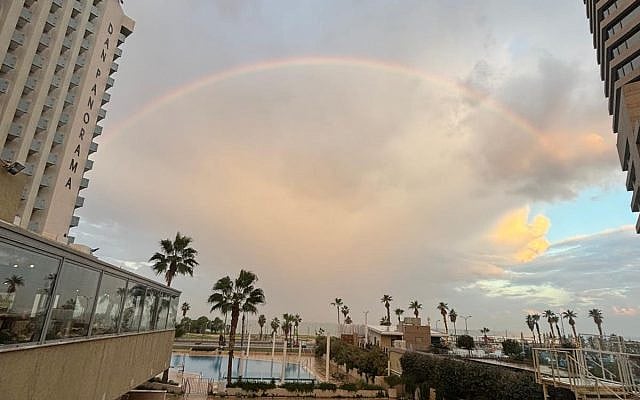
The next morning, we woke up to a stunning rainbow over Tel Aviv. I texted a photo to my husband. “Lamrot hakol,” he replied. In spite of everything. “Am Yisrael Chai,” I answered.