
A History of Tribal Humor Infotainment
Two months ago, I reposted a statement from Donald Trump into a WhatsApp group chat after one of the flare-ups involving Iran. I remember the statement clearly because of how strange it sounded in the moment. Very early on, Trump declared: “We won.” I was taking the statement literally, or at least seriously enough to discuss its implications. The reaction I received was unexpectedly revealing: several people responded as though I were being intentionally obtuse.
The assumption seemed to be that I could not possibly be reading Trump’s words straightforwardly. The “correct” interpretive framework, at least within that social environment, was to understand the statement performatively rather than literally. Trump was expressing emotion, posture, morale, dominance, vibes. Parsing the words themselves too carefully was treated almost like a category error.
Two months later, I found myself arguing with a friend about the decline of American political culture. The more revealing moment came when he invoked Joe Biden as an example of an older, more decent political culture. I brought up Biden’s 2012 statement accusing Mitt Romney of wanting to “put y’all back in chains.”
For him, the statement was contextual, rhetorical, explainable. For me, even years later, it still feels wildly outside acceptable political boundaries. Not because it was the single worst thing ever said in American politics, but because it reflected a normalization of moral escalation and tribal demonization that many people in my generation experienced directly.
What struck me afterward was not merely the disagreement itself, but the realization that we were operating from entirely different media histories.
For older liberals, the story of American political deterioration often begins with talk radio, Fox News, and the weaponization of outrage by the political right. For many younger conservatives or politically heterodox millennials, the formative memory was different: irony-soaked political comedy, online social shaming, activist moral absolutism, and a style of progressive politics that often treated disagreement as evidence of moral contamination.
Both sides remember themselves primarily as reacting.
And that may point toward the deeper story. American political polarization cannot be understood solely through ideology or partisanship. Something structurally more important happened over the last forty years. Existing entertainment forms — talk radio, late-night comedy, internet forums, meme culture, influencer platforms — were gradually transformed into systems of political identity formation.
Politics became entertainment. But more importantly, entertainment became tribal politics.
The key mechanism was humor.
Humor is socially adhesive. Laughing together creates trust, belonging, and shared assumptions. In ordinary contexts, this is harmless and often healthy. Every community develops internal humor and symbolic language. But when political information itself becomes filtered through humor, mockery, irony, and performative outrage, those same mechanisms begin organizing political identity.
The audience is no longer simply consuming information. They are participating in an in-group.
This is why the phrase “infotainment” feels incomplete. The problem was not merely that politics became entertaining. It was that humor became an engine of tribal cohesion.
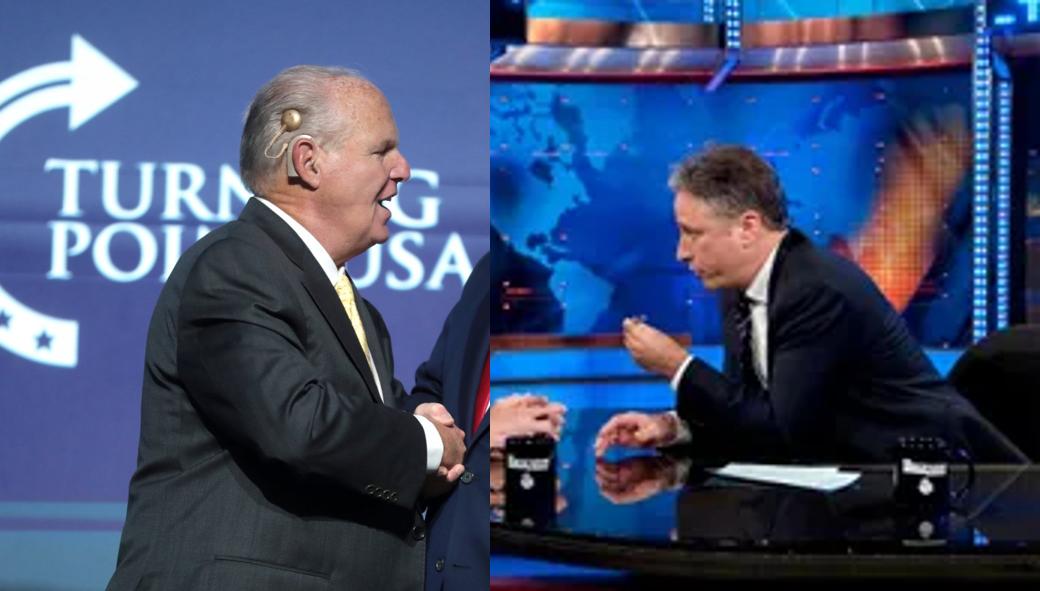
Rush Limbaugh did not invent outrage politics from nothing. He inherited the grammar of talk radio and shock-jock entertainment — emotionally provocative broadcasting, parasocial intimacy, audience bonding through ridicule — and fused it with political identity. Listening to Limbaugh was not simply learning conservative ideas. It was participating in a daily emotional ritual of anti-elite solidarity.
Jon Stewart and Stephen Colbert inherited a different entertainment form: late-night comedy and satirical television. Their innovation was subtler but equally powerful. They transformed irony into a form of political authority. Their audiences often experienced them not merely as comedians but as interpreters of reality — figures who exposed hypocrisy, absurdity, and institutional dishonesty through humor.
In both cases, existing entertainment forms mutated into political identity systems.
As those formats spread, they became increasingly standardized and mass-produced throughout American media. But the internet introduced a more consequential shift: the audience ceased being merely an audience.
Politics became participatory.
The early internet ecosystems that pioneered participatory political culture were not initially mainstream social media platforms. They were strange subcultural laboratories like 4chan and Tumblr. Even now, one can still see echoes of their cultures throughout the modern internet.
4chan inherited the grammar of anonymous imageboards, hacker culture, trolling, gaming forums, and edgy countercultural humor. It pioneered irony layering, meme warfare, ambiguity between sincerity and performance, and a style of politics where jokes, conspiracies, and tribal identity blurred together.
Tumblr inherited the grammar of fandom culture, identity blogging, artistic communities, and emotional self-expression. It helped pioneer online callout culture, therapeutic political language, activist identity formation, and highly participatory forms of moral norm enforcement.
Neither platform mattered because of sheer size alone. They mattered because they functioned as innovation laboratories for internet-native political identity formation.
The larger platforms later scaled what those ecosystems discovered.
X became the industrialization of irony-heavy participatory political conflict. Politics there often functions through virality, conflict, sarcasm, clipped context, tribal signaling, and real-time emotional escalation. The modern online political right appears especially concentrated there in part because the platform rewards anti-establishment conflict dynamics, meme fluency, and adversarial participation.
Meanwhile, platforms like TikTok and Instagram scaled different forms of participatory political identity. Politics on those platforms is often intertwined with aesthetics, personal identity, lifestyle branding, emotional storytelling, therapeutic language, and influencer culture. The political left online often appears more distributed across these systems because its media culture is less concentrated around a single oppositional platform and more embedded within broader creator ecosystems.
The important point is that platforms do not merely host political culture. They selectively amplify particular psychological styles.
Over time, these ecosystems slowly reshape baseline assumptions. People are rarely persuaded by one decisive argument. Instead, they absorb thousands of emotionally charged fragments:
- memes,
- jokes,
- clips,
- ironic commentary,
- conspiracy-adjacent insinuations,
- viral humiliations,
- and recurring villains.
Eventually, people stop merely holding political opinions. They begin inhabiting political atmospheres.
And those atmospheres shape how language itself is interpreted.
Some people still process political speech literally and institutionally. Others process it performatively, tribally, or ironically. Some interpret political rhetoric as moral claims requiring accountability. Others interpret it primarily as symbolic combat within an ongoing entertainment ecosystem.
This helps explain why one person hears a statement from Trump and asks, “Did he literally mean that?” while another hears the same statement and thinks, “You’re not supposed to read it that way.”
It also explains why some people hear Biden’s “back in chains” remark as wildly inappropriate racialized rhetoric, while others hear it merely as normal campaign hyperbole.
We are no longer simply disagreeing about politics.
We are disagreeing about the ontology of political speech itself.