A Call to the Moral Debate the World Refuses to Face — A Black Jewish Voice Speaks for Israel and Global Jewry
A Holy People, Not a Holy Exemption
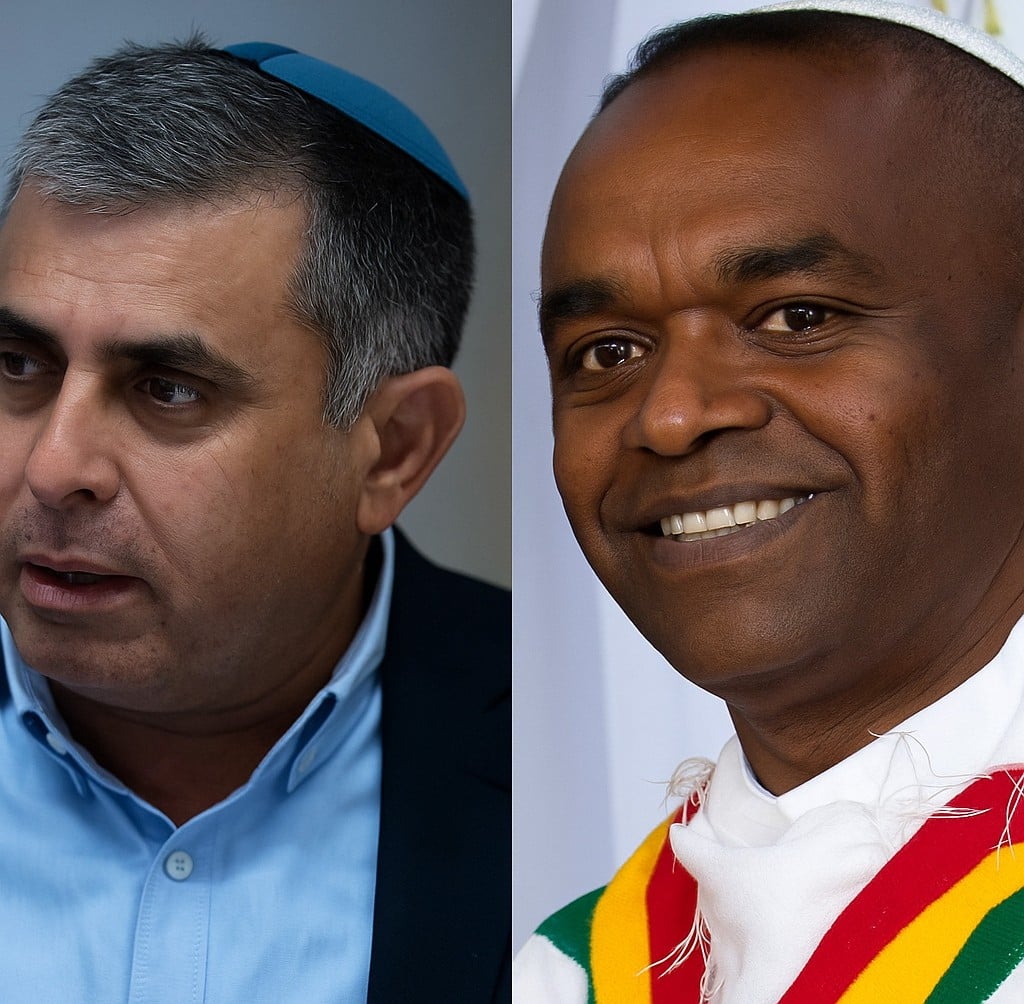
Aliyah and Integration Minister Minister Ofir Sofer holds a press conference at the Knesset, the Israeli parliament in Jerusalem, December 1, 2025 (photo credit: YONATAN SINDEL/FLASH90) (Jeremy Mayer, for the portrait of Dr. Shmuel Legesse)
By Dr. Shmuel Legesse: Upcoming Author of Moral Diplomacy for a Broken World: Inspired by the Vision of Rabbi Jonathan Sacks
When Aliyah Minister Moshe Sofer announced that he would “vote against the Haredi draft bill — even if Prime Minister Netanyahu fires me,” he spoke with the kind of thunder that rattles both Parliament microphones and family Shabbat tables. In one sentence, he became a symbol: a man of conviction ready to risk power for principle.
His principle? That Torah study itself protects the Jewish people. That every yeshivah student poring over Talmud is a spiritual soldier, guarding the nation from within while others defend it from without. To him, compelling such students into military or national service would not strengthen Israel but endanger its soul. It would, in his view, conscript holiness.
That view deserves respect. But reverence for faith cannot mean an exemption from citizenship. A nation that owes its survival to shared sacrifice cannot afford spiritual aristocracy. We can honor the scholar without excusing the citizen.
Service Is the Language of Belonging
A healthy democracy doesn’t run on charisma; it runs on contribution. Israel is the rare country where 18-year-olds learn that freedom requires obligation. Some shoulder rifles, some drive ambulances, some teach new immigrants how to conjugate Hebrew verbs but all shoulder something. Service, not speech, is what turns a population into a people. That is why Sofer’s stance unsettles so many Israelis across the political map. It suggests two kinds of belonging: those who defend the covenant and those defended by it. That division weakens not only security but solidarity. It turns the idea of Am Yisrael Chai “The people of Israel live” into a spectator sport. Yet the solution is not punishment or coercion. It is creativity. National service can be tailored to conscience without surrendering equality. Those who cannot fight can heal, build, teach, translate, research, rescue, counsel, or mentor. The test is not uniformity but usefulness.
Imagine a social contract that asks every citizen Jew, Muslim, Christian, Druze, atheist one simple question: How will you serve the country that serves you? A Muslim doctor in Beersheva could fulfill his duty in emergency medicine. A Christian social-worker in Nazareth might lead programs for at-risk youth. A Haredi scholar could run after-school Torah-ethics lessons for soldiers’ children. Different callings, same covenant. The ancient rabbis taught that all Israel is responsible for one another. They did not add, “unless your prayer schedule is full.” Even the yeshivah world’s own texts teem with examples of sages who balanced study and service farmers, judges, physicians, warriors of spirit and of sword. The idea that holiness requires isolation is historically fragile and theologically flimsy.
Besides, shared responsibility is the best social glue. Anyone who has served in the IDF or Sherut Leumi knows the quiet miracle of a bus ride where an Ethiopian immigrant, a Tel Aviv vegan, and a yeshivah dropout argue politics, share sunflower seeds, and by sunset call each other achi brother. You can’t legislate that kind of nation-building, but you can require the setting where it happens. Humor helps us swallow hard truths. So picture this: If every Israeli who tweets about politics spent just one weekend a month volunteering for national service, the internet would crash from lack of content. That blackout alone might bring more peace than any cease-fire.
Torah and Citizenship Are Partners, Not Rivals
Sofer is right about one thing: Torah study is national treasure. But so are soldiers. And so are social workers in battered-women shelters. A moral society doesn’t rank holiness by wardrobe. It measures it by responsibility.
The Book of Nehemiah describes how half the people built Jerusalem’s wall while the other half stood guard with spears. Both groups were holy; neither was exempt. The same partnership built modern Israel: those who prayed for the state and those who bled for it. Our tragedy is that some now pray for the soldiers but refuse to stand beside them. Even halachah recognizes limits to exemption. The Talmud excuses only the irreplaceable scholar whose absence would impoverish the nation’s wisdom. Let’s be honest: there are few such sages in any century. If everyone who quotes Rashi were irreplaceable, God Himself would need a waiting list for commentators.
A wiser path is to broaden the definition of service. Create a national-service corps flexible enough to honor religious observance, kosher food, prayer times, modesty concerns — while insisting that every citizen give tangible time. Yeshiva students could staff literacy programs, assist hospitals, support disaster relief, or mentor new olim. The Torah would still be studied, it would simply also be applied. This is not secular coercion; it is spiritual consistency. Judaism commands action. As Rabbi Sacks taught, “Faith is a verb before it is a noun.” Prayer that never leaves the synagogue is like theory that never meets experiment. A people who recite V’ahavta l’re’acha kamocha — “Love your neighbor as yourself” must eventually show up for the neighbor. The practical benefits are immense. Universal service would narrow socioeconomic gaps, mix populations that rarely meet, and provide thousands of hands for under-funded hospitals, classrooms, and care homes. It would transform civic obligation into moral education. And it would remind every 19-year-old that they are not consumers of a country but co-authors of it.
The spiritual benefit is deeper still. When Torah and citizenship walk together, the result is neither theocracy nor secularism but covenantal democracy, a society bound by shared duties before shared privileges. That is the Israel Rabbi Sacks envisioned: a nation both particular and universal, faithful and free.
Minister Sofer’s devotion to Torah is real. His fear of losing spiritual identity is understandable. But the greater danger is losing moral unity. Israel can survive enemies outside its borders; it cannot survive factions that refuse to carry one another’s weight. The miracle of Jewish history is that we learned to pray while plowing, to study while building, to argue while serving. That rhythm is our resilience. So let every Israeli give something back in uniform, in clinic, in classroom, in conscience. Let holiness be measured not by who avoids the draft but by who embraces duty. As Micah said, “Do justice, love mercy, and walk humbly with your God.” Do, love, walk all verbs. Faith moves. If Sofer truly wishes to defend the Jewish people, the best shield he can raise is shared service. Because a nation where everyone contributes is a nation already under divine protection. And if God ever wanted proof that the Torah lives, He could find it not only in the beit midrash, but in the volunteer tent, the hospital ward, and the soldier’s open hand.
That’s not a secular compromise. That’s sacred cooperation. And it’s time we all reported for duty.
Related Topics