A Jewish Child, Three Popes, and the One Who Said Nothing
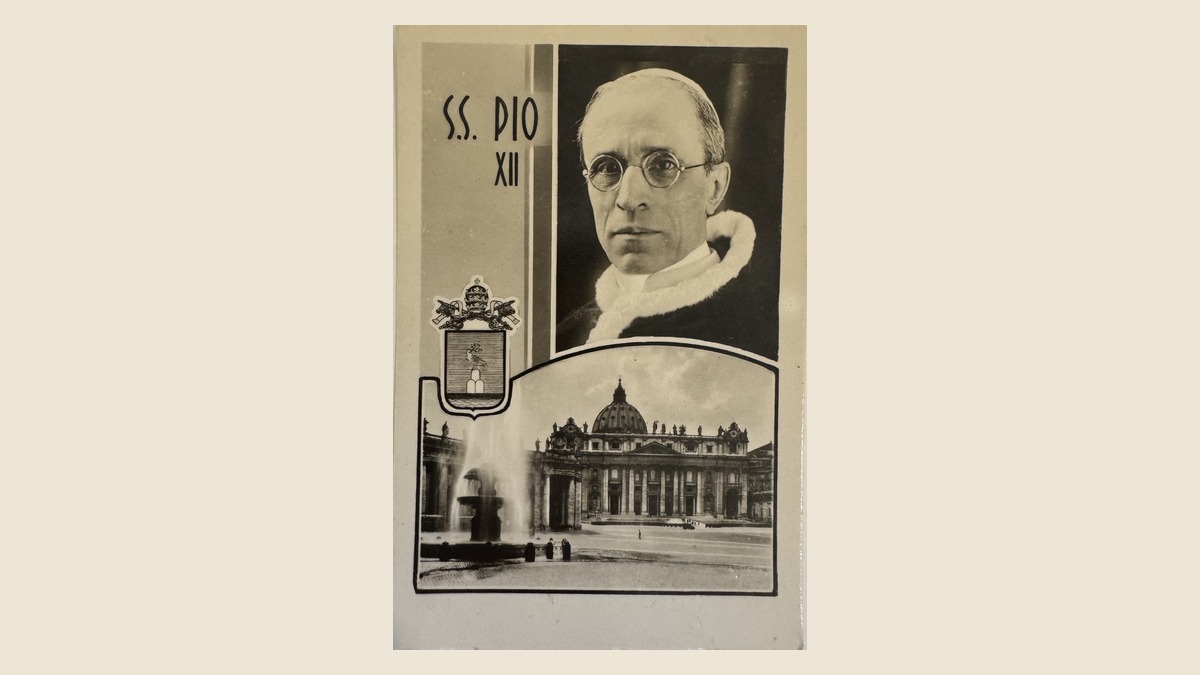
In November 1946, a twelve-year-old girl stood before Pius XII and received a medal.
She was a Jewish child from the Warsaw Ghetto, passing as a Catholic orphan.
The Pope blessed her. He made the sign of the cross over her head. He told her, in Italian, that the Lord would reward her bravery.
She thanked him. She accepted the cross-shaped medal.
She did not say who she was.
She could not say. Not then. Not there. Not even after the war was over.
I have thought about that moment for years.
A Jewish girl, decorated by a Pope whose silence during the Holocaust is still argued over eighty years later. Blessed by the very man historians cannot agree about. Honored as a Catholic war hero by a spiritual authority who, depending on whom you ask, either helped save thousands of Jews in secret or stood by while millions were murdered.
Edna never resolved that question.
Neither has history.
A Jewish child stood before one of the most powerful moral voices in the world.
Neither of them could speak the truth.
To understand the controversy around Pius XII, you have to look beyond him.
You have to look at the Pope who came before him, and the Pope who has tried to reckon with him in our own time.
Three popes. One century.
One question about what a moral voice owes the world when evil is on the march.
Pius XI: The Pope Who Spoke
Before Pius XII, there was Pius XI.
He watched Mussolini rise in Italy. He watched Hitler take power in Germany. And unlike his successor, he did not remain silent.
In 1937, as Jewish persecution intensified, he issued the encyclical Mit brennender Sorge, “With Burning Concern.”
It condemned Nazi racial ideology. It denounced the myth of race and blood. It defended the Old Testament at a moment when the Nazis were trying to sever Christianity from its Jewish roots.
It warned of what was coming.
Whoever exalts race, or the people, or the State, above their standard value and divinizes them to an idolatrous level, perverts and falsifies the order of things.
Hitler was enraged. The document was suppressed. Those who distributed it were punished.
In 1938, when Mussolini invited Hitler to Rome, Pius XI left the city rather than meet him.
He was preparing a second encyclical, one that would have condemned antisemitism directly and without qualification.
He died before he could deliver it.
The draft was buried.
His successor never published it.
Pius XII: The Pope Who Did Not
That successor was Pius XII.
Within months of his election in 1939, Europe was at war.
Within a few years, the machinery of extermination was in motion.
Pius XII never publicly named the Jews as the primary victims of the Holocaust. He never condemned it directly.
In his 1942 Christmas address, he referred only to “hundreds of thousands” who, “sometimes only by reason of their nationality or race,” were being killed.
It was the closest he came.
It was not close.
His defenders argue that he worked quietly. That churches and convents sheltered Jews. That public protest might have made things worse, as it did in the Netherlands when open opposition triggered harsher reprisals.
His critics argue something else.
That the most visible moral authority in Europe chose not to speak clearly at the moment clarity mattered most. That a man who had helped draft Mit brennender Sorge had the language, and chose not to use it.
That neutrality in the face of genocide is not neutrality.
It is a choice.
In 1946, into that silence walked a twelve-year-old Jewish girl with a medal pinned to her chest, disguised as a Catholic orphan.
The Pope himself had decorated a Jewish child.
He had no idea.
She remembered the trembling in her legs. The vast marble floor. The golden throne. The sign of the cross made over her head.
She remembered drifting toward the back of the room.
And with a small penknife she carried in her pocket, she carved her nom de guerre into the door molding:
Kajtek.
She left her name in a place that could not contain who she was.
A Jewish child, honored for a life she had to invent, marked the walls of a Vatican that did not know her.
Francis: The Pope Who Opened the Archives
In 2020, Francis opened the Vatican’s wartime archives.
Millions of pages. Eight decades sealed.
Historians were finally allowed to look.
What they found was not resolution, but complexity.
Evidence of real rescue efforts. Evidence of quiet diplomacy. Evidence that Pius XII knew far more, far earlier, than had once been acknowledged. Evidence that he chose, again and again, not to speak publicly.
The archives did not settle the debate.
They deepened it.
Francis was explicit about the larger question.
He condemned antisemitism without qualification.
He called the Holocaust an unspeakable crime.
He said that silence in the face of evil is complicity.
Opening the archives did not answer the question.
It made it unavoidable.
What Edna Knew
My mother-in-law carried that 1946 audience with her for the rest of her life.
She remembered the blessing. The Italian words. The weight of pretending.
She also remembered what was hardest to hold.
That she had been welcomed as a Catholic child by a Church that had not, when it mattered most, spoken for children like her.
That her survival had been invisible.
That she was honored for a courage no one there understood.
Three popes.
One who spoke, and died before he could do more.
One who had the words, and did not use them.
One who, decades later, opened the record and forced the question back into the light.
The question they leave us is not only a Catholic question.
It is a human one.
What do we owe the world when evil is on the march?
What does a moral voice owe those it claims to speak for?
When is silence prudence?
When is it something else?
Edna could not ask those questions.
She was twelve.
She was pretending.
She was staying alive.
We can ask them.
The questions are ours now.
History does not end the argument.
It hands it to us.
Janet Bond Brill, PhD, is the author of Little Edna’s War, based on her mother-in-law’s Holocaust testimony, published on January 27, 2026, on International Holocaust Remembrance Day. Order Now