A Jewish Name on a Borneo Waterfront
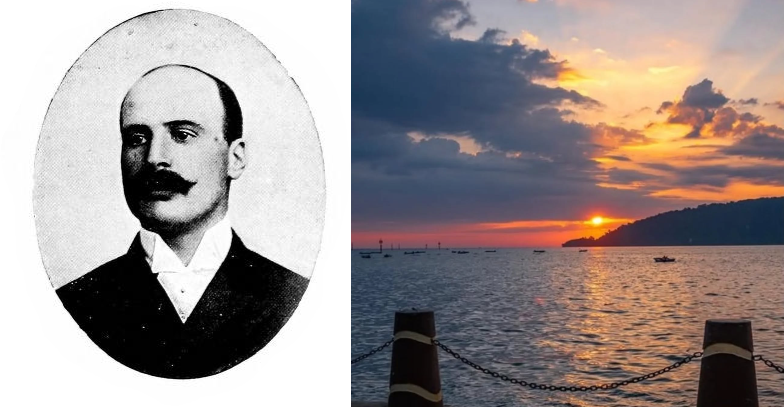
I stood at Jesselton Point last week watching people queue for speedboats to the islands. The wind carried the smell of petrol across the harbor as boats idled at the pier. Beyond them, the sea glowed an almost impossible blue, broken only by forest-clad islands on the horizon. Closer in, fishing boats rocked gently against the waves. Around me, hundreds of travelers clutched towels, goggles, and bright orange life jackets while conversations drifted between Malay, Cantonese, Mandarin, English, French, and Italian. It is the sort of place people pass through rather than stop to consider.
But I lingered.
A large sign marked the departure point: Jesselton. One name, no explanation. I found myself asking the question visitors almost never bother to ask: who was Jessel?
I expected an explorer or a colonial governor, another stern-faced Victorian imperial administrator staring down from an oil portrait. What I found was a Jewish lawyer from London who, as far as historians can determine, almost certainly never visited the city named after him.
Sir Charles James Jessel (1860–1928) served as vice-chairman of the British North Borneo Company, a Royal Chartered enterprise that governed a sizable stretch of what is now Malaysia. In 1899, the company established a new settlement on the North Borneo coast and named it Jesselton in his honor. The city held that name for nearly seven decades before being renamed Kota Kinabalu. But the ferry terminal and surrounding waterfront area kept the old name. So Jesselton Point persists, the last toponym of a man most visitors have never heard of.
But Charles Jessel is only half the story.
His father was Sir George Jessel (1824–1883), one of the most consequential legal minds of the Victorian era and the first Jew to hold high judicial office in England. As Solicitor-General and then Master of the Rolls, George Jessel reshaped English equity law; his judgments are still cited. But when he was young, none of that seemed possible. He was barred from Oxford and Cambridge by religious disabilities that made a university degree contingent on accepting a Christian oath. He went instead to University College London, founded, not coincidentally, partly by Jewish families who wanted a university where Jews and Dissenters could study without swearing to a faith not their own.
George Jessel built one of the great legal careers of his century. He was the first Jew on the Privy Council. He never stopped practicing his faith. He was, in the parlance of the Victorian Jewish establishment, a proof of concept — evidence that emancipation had not been a mistake.
Charles inherited what his father had fought for. He went to Rugby School, then Balliol College, Oxford, the path his father had been denied. He became a barrister, built a career in law and business, and when his father died in 1883, Queen Victoria made him a baronet — a title conferred in tribute to George’s memory.
Then Charles married Edith Goldsmid.
The Goldsmids were the other great dynasty of Victorian Anglo-Jewish public life. Edith’s grandfather, Sir Isaac Lyon Goldsmid, was the first Jew to receive an English hereditary title. Her father, Sir Julian Goldsmid, spent decades in Parliament and served as president of the Anglo-Jewish Association, advocating for Jewish communities across Eastern Europe. The same family had been instrumental in founding University College London, the very institution George Jessel had needed because no other was open to him.
Charles and Edith’s wedding, in 1890, was something like a merger of the two most prominent families in Victorian Anglo-Jewry.
None of this appears on any sign at Jesselton Point.
What appears is just the name: Jesselton. And standing there at the water’s edge, I understood it as a compressed history of what Jewish emancipation in Britain actually meant. Within living memory of the Jewish Disabilities Removal Act, within a single generation of a man who had been unable to study at Oxford because he was Jewish, a Jewish family name had become the name of a city on the far side of the world.
Charles Jessel probably never saw the city himself. When his great-grandson visited Sabah in 2011 hoping to find evidence of a visit, he found none. The family concluded Jessel most likely died without ever setting eyes on the place that bore his name. Yet under his direction, the British North Borneo Company developed it into a thriving trading post — the same waterfront that still carries his name today.
In 1968, Malaysia renamed the city Kota Kinabalu, after the great mountain that dominates the Bornean interior and that the Dusun people had considered sacred for centuries.
But Jesselton Point kept its name. Every day, tourists buy their tickets there, check the ferry schedule, message their hotels that they’re almost back from the islands. They say a Jewish name in Borneo without knowing whose name it is.