A Jewish Response to 60 Years of “The Dialogue” since Nostra Aetate
I offer these reflections on the occasion of the 60th anniversary of “Nostra Aetate” (which occurs this month), as a rabbi, Jewish educator and interreligious peacebuilder who has been involved in dialogue and action for the past 35 years.
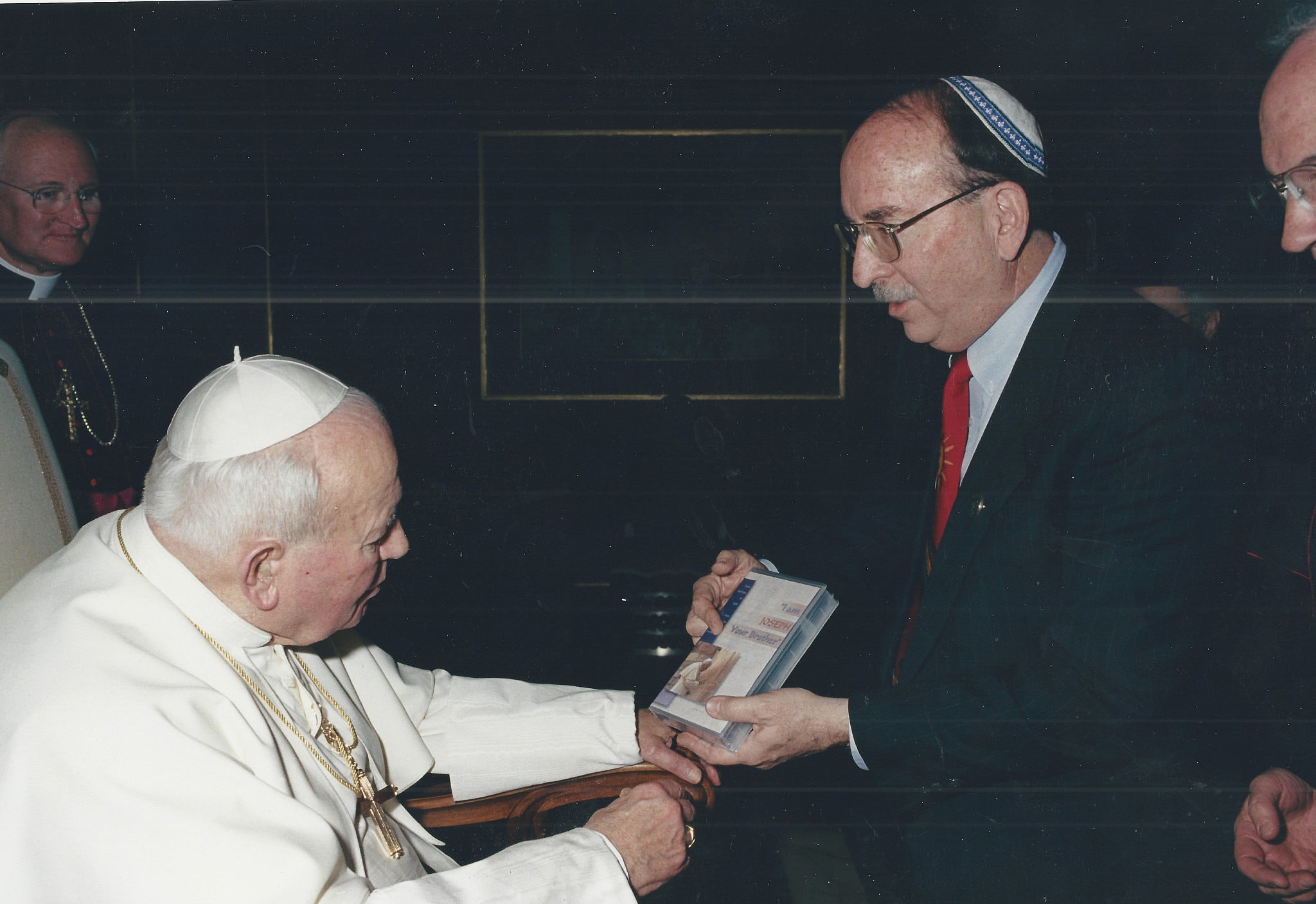
There is no question that the document Nostra Aetate (“In our Time”)—promulgated by the Second Vatican Council in October 1965—changed the discourse in the field of Jewish-Christian dialogue in particular, and interreligious dialogue in general, in the contemporary period. I explained this clearly in a film called “I am Joseph Your Brother” which was produced by the organization which I founded and directed for 24 years—The Interreligious Coordinating Council in Israel– in 2001. We made this film following the visit of Pope John Paul II to Israel in March 2000.
In the film, I said:
We have moved from persecution to partnership, from confrontation to cooperation, from diatribe to dialogue.
Not only did this famous document Nostra Aetate open up a new dialogue between the Catholic Church and the Jewish People, but it initiated a dialogue between the Catholic Church and other religions, including and especially Islam, as I will discuss below. Indeed, it made dialogue between leaders and followers of the major monotheistic religions “kosher” (i.e., legitimate) and mainstream.
It is now accepted practice for leaders of religious communities at all levels to be in dialogue with each other in many places in the world and to work together in common cause wherever possible to heal the world. It is fair to say that this is a direct result of the major shift in policy of the Catholic Church, which was expressed in Nostra Aetate, which subsequently influenced many other contemporary church movements to rethink their relationships to Judaism, Israel and other religions.
Much has been written about the many positive developments in Jewish-Christian Relations over the past 60 years. A great deal of progress has been made! It is quite amazing, even unprecedented. Now it is time to look towards the future and think about the challenges that face us as we look forward to the next 60 years!
As we look forward, I want to emphasize that I believe that we need to focus on cooperation and action partnerships for the betterment of all humanity, and not only on “dialogue” and discussions. We need to heal the world together, what we Jews call Tikkun Olam. This ought to be the outcome of genuine dialogue, and this certainly should be a new emphasis for us in the years ahead.
With this said, one of the most important and still neglected areas of our work for the future should be in the area of EDUCATION.
The number one problem that we face is ignorance. After all these years, our lay people –Jewish and Christian–still do not know very much about each other. Too much of the Dialogue has been restricted to the leadership. Accordingly, we still need a multi-faceted, sustained and systematic educational program in many and diverse settings: schools, seminaries, teacher-training schools and universities, in the curricula of Jewish and Catholic schools, in newspapers and magazines, in scholarly journals, in conferences and workshops, in formal and informal education, in dialogues and seminars, and through the media.
There have been many historic statements and documents on Jews and Judaism made by the Church during the past 600 years. The truth is that church movements—both Catholic and Protestant– have done much more to educate their people about Jews and Judaism than we Jews have done to teach about Christians and Christianity. This is, no doubt, due to the asymmetrical nature of Jewish-Christian history, and the fact that Judaism is more integral to Christianity than the reverse. In any event, the Catholic Church has felt the imperative to change their curricula, and we Jews have not, at least not yet. In my humble opinion, this must not continue this way.
At the end of our film, I said:
It ought to be impossible for Jews to continue to teach about Catholics – or Christians in general – in a pre- Vatican II way, just as it would be inconceivable for Christians to teach about Jews in a pre-Zionist or pre-Israel fashion. We Jews – in the Diaspora and in Israel – will have to do much more in the future to educate our communities about the revolutionary changes in Christian thinking concerning Jews and Judaism that have occurred in recent decades.
Moreover, for a long time, I have felt that the Dialogue was more about “community relations” than about actually learning from each other. In my view, this too has to change. We need to develop a genuine interreligious dialogue; a dialogue based on mutuality, and the existential need to learn about each other and from each other towards the practical end of finding better ways to live together in the future.
Our dialogue needs to be more reciprocal, with both sides taking responsibility for improving the relations vis-a-vis the other religions within their own communities. This new era of reciprocity will inevitably lead us into theological territory. We need not be afraid of this. We need to learn about each other’s basic beliefs – as is increasingly being done in new dialogues, seminars and conferences in recent years – if we really intend to understand one another and be able to live together in peaceful coexistence.
Moreover, the Dialogue needs to not only be between Christians and Jews, but it must include leaders and followers from other religions, especially Islam. The document “Nostra Aetate” specifically called for dialogue with Muslims, not only with Jews:
The Church regards with esteem also the Moslems. They adore the one God, living and subsisting in Himself; merciful and all-powerful, the Creator of heaven and earth, who has spoken to men; Since in the course of centuries not a few quarrels and hostilities have arisen between Christians and Moslems, this sacred synod urges all to forget the past and to work sincerely for mutual understanding and to preserve as well as to promote together for the benefit of all mankind social justice and moral welfare, as well as peace and freedom.
Over the years, the Catholic Church developed a very healthy dialogue with the Muslim community, based on this document. Much of this was done during the term of Archbishop Michael Fitzgerald, who served as the Secretary of the Pontifical Council for Interreligious Relations (which handles dialogue with many other religions, other than the Jews,). Moreover, in recent years, both Pope Benedict and Pope Francis have continued to reach out to Muslims, as did their predecessors since Vatican II.
Fostering hatred of another’s religion—due to the fanatical acts of certain extremist groups who claim to be inspired by this religion but actually distort it unrecognizably—is not a good prescription for building a better world for all of God’s children. Accordingly, I would argue that developing a genuine dialogue with Muslims around the world—beginning in our local communities—is one of the highest religious and ethical imperatives for Jews and Christians now and for the future. We can no longer engage in denial and apathy on this issue.
As part of my own personal journey, I have been engaged in dialogue with Muslims in Israel for much of the past 35 years, and in so doing, I have come to know well another kind of Islam, not the one in the news every day and not the one on the internet every minute. I have encountered many kadis, imams, sheikhs and ordinary Muslims—both in Israel and internationally — who preach and teach a moderate brand of Islam, one that is not reported in the media, one that espouses ethical and righteous ideals, which are very similar to the basic humanistic values that are shared by mainstream Judaism and Christianity.
For the sake of peace and justice—and to prevent ongoing wars and bloodshed– we Jews and Christians need to engage with Muslim leaders and followers of Islam, sensitively and substantively in the years ahead.
At the end of our film, Dr Eugene Fisher, former secretary for interreligious dialogue for the U.S. Conference of Catholic Bishops, and a Catholic partner in dialogue with me for many years, said:
The clean-up has begun, and we can now structure the future so that certainly the next 2000 years will be more productive, so that, for that period, Jews and Christians [and I would add Muslims] will be able to stand together to address the problems of the world.
Indeed, I would agree that on the heels of this historic period of reconciliation between Christians and Jews, we can look forward to more cooperation and partnership in the decades ahead on issues of common concern to us and to all humankind.
The film “I am Joseph Your Brother” is now available on the internet via this link: https://www.youtube.com/watch?v=q_N3TtsYBb4