


A Letter to a Keffiyeh-Clad University Colleague
Dear Rice University Colleague:
On the evening of Saturday, May 10, 2025, at the procession leading to the undergraduate commencement ceremony at the Rice University football stadium, two Rice faculty members were marching wearing regalia, and, on top of that, keffiyehs. The keffiyeh is a traditional headdress worn by men from parts of the Middle East, but it has recently come to symbolize also solidarity with Palestinians.
Some parents who attended the commencement ceremony were outraged by the politicization of an event that is supposed to highlight their children’s academic achievements. I received emails from parents, with photographs of these two faculty members. Some parents wanted to confront these faculty members, but their children stopped them, as they did not want to be “outed” as Israelis. The parents wished to submit a complaint to Rice President Reginald DesRoches, so they asked me if I knew who these two faculty members were. I recognized one, but not the other, so I posted the photograph on Twitter, asking if anyone recognized the photograph.
Today I received email from a colleague whom I esteem. She identified you as the second keffiyeh-clad faculty member, and asked me if I’d remove the Twitter post with your photograph. Out of respect for her, I removed the post, even though I did not find her rationale compelling.
“It makes her feel vulnerable to being doxxed,” said the email. Really? Doxxing is a form of cyber-bullying that uses sensitive or secret information, statements, or records for the harassment, exposure, financial harm, or other exploitation of the intended victim. Another colleague of yours even accused me of doxxing you. But you chose to wear a kefiyyeh in a very public event to make a strong political statement. Did you think you were anonymous? My Twitter post gave you additional publicity, which one would think would make your political statement stronger, but suddenly you are publicity-averse.
“We are in a very complicated political moment, as you know all too well,” elaborated the email request, “and there are people who are eager to find targets for their bad behavior. So I am asking, for community, for the sake of protecting each other in this awful moment in which so many of us are feeling very vulnerable, if you could help make my colleague feel just a little safer.”
Causing harm to you, my keffiyeh-clad colleague, is furthest from my intentions, but where were you when my safety at Rice was ignored since February 2024? On Feb. 15, 2024, anti-Israeli protesters on the campus of Rice University, for whom your keffiyeh presumably expressed support, chanted “Globalize the Intifada.” As I have explained last year, the Second Intifada was a 2000–2005 terror campaign aimed at Israeli civilians — which included suicide bombings, shootings, and stabbings — resulting in over 1,000 people murdered. I lost a very good friend in the Passover Massacre, a suicide bombing carried out by Hamas at the Park Hotel in Netanya, Israel, in March 2002, during a Passover festive meal, in which 30 civilians were killed and 140 were injured.
In fact, the keffiyah that you wore is not only a symbol of Palestinian aspirations, but also a symbol of Palestinian violence, as demonstrated by the following image posted by the Rice student club of Students for Justice in Palestine on their Instagram page last fall:
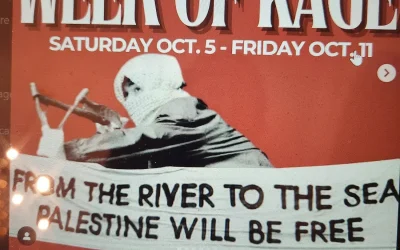
Complaints by me and other Israelis on the Rice campus were dismissed by Rice University. “Intifada,” we were told, symbolizes the Palestinian aspiration for Palestinian freedom. If we do not feel safe, we were told, we should seek counseling. Except that by now we know what “Globalize the Intifada” means. On May 21, 2025, Yaron Lischinsky and Sarah Lynn Milgrim, two Israeli Embassy staffers, were murdered in Washington, DC. The murder suspect, Elias Rodriguez, told police on the scene, “I did it for Palestine, I did it for Gaza,” according to the charging documents. Witnesses recounted hearing him chant, “Free Palestine” after he was taken into custody. A week and a half later, on June 1, a group gathered in Boulder, Colorado, to raise awareness for hostages held in Gaza was attacked, leaving 12 people injured. The suspect, Mohammed Sabry Soliman, accused of throwing incendiary devices at them, allegedly planned the attack for a year, and told police he wanted to “kill all Zionist people,” according to court documents. On June 5, 2025, the Federal Bureau of Investigation (FBI) and the Department of Homeland Security (DHS) issued a Public Service Announcement to highlight potential public safety concerns related to ongoing threats to Jewish and Israeli communities.
So no, I am not safe at Rice. This is why I avoided attending commencement this year, as well as last year. Your wearing keffiyehs during commencement does not make the campus safer for me. Yet, I do want you to feel safe at Rice, my keffiyeh-clad colleague, which is why I removed the Twitter post. I just wish you, and Rice University, would care also about my safety.
P.S. Do you think your colleagues would have risen up in your defense had you chosen to clad yourself during the commencement ceremony with a Confederate Flag, rather than a keffiyeh?