


A letter to an American Friend
I have a story I want to share, but I worry you won’t want to hear it because it might be hard for you to hear anything positive about life in Israel. The pummeling Israel has taken in the US press hasn’t left much space for other kinds of information. So you can stop reading if you want.
But I hope you won’t.
This is not a long story with a beginning, middle and end. It’s just a thing that is happening that makes me smile and feel glad to live here.
Being glad to live here has been a feeling I haven’t had for a while. Ever since the widespread acceptance that people are hungry in Gaza. Ever since it looks like the people running the war don’t know what they are doing—or maybe they do know what they’re doing, are doing it on purpose, and have been misleading us.
So, here’s what’s on my mind.
I live in a neighborhood called Neve Tzedek, which used to be a slum. It’s been gentrified mostly, but with enough dusty, peeling-paint shabbiness to lend an authentically-old, artsy vibe to the place. It has very narrow streets with brightly flowering bushes and trees that canopy the sidewalks. It is one of the few places where some buildings are painted in colors and not the sandy beige that is common in Israel.
Anyway, there is only one building on my street that has not been renovated. That’s where Yonit lives.
She’s certifiably crazy. She sits on the small landing outside of her door and yells into her telephone– often very late at night. She can go on for hours. We debate whether she’s having a conversation with a real person or just pretending so she can broadcast her frustrations to everyone in earshot. My Hebrew isn’t good enough for me to follow the drift of her rants, but it’s clear she feels strongly.
She also yells at people who are driving too fast or not cleaning up after their dogs. Or parking where she thinks they shouldn’t.
She also coos at people walking past with children in strollers. To the men walking by after their morning prayers at the small synagogue nearby, she has brief little chats that end with a lilting, “Hy-loff-yooo!” That’s I love you! in a Hebrew accent.
My family and I also get a Hy-loff-yooo when we walk past her door or wave from our kitchen window which overlooks her stoop. But this wasn’t always true. There have been times when Yonit has turned her wrath on me, Nate (my son) and Smajj (his wife).
To be honest, Yonit scared me until I realized she wouldn’t hurt us. As time went on, I began to identify with her. I could easily imagine myself losing all patience with inconsiderate people making a mess. I could see myself becoming the angry lady demanding people behave. Gradually, my fear morphed into a kind of wary appreciation.
Once I came outside and found a woman I didn’t recognize screaming at Yonit with all her might! Yonit sat still, resolute. Jaw clenched. Eyes ablaze. I tried to position myself to get the woman’s attention so Yonit wouldn’t see me. I twirled my finger at my temple and tried to indicate with my hands that the woman should calm down—that Yonit was nuts and the rage wasn’t going to do any good.
Of course, the woman only screamed louder, this time including me in her tongue-lashing. I got away as quickly as I could, surprised by how much I wished I could protect Yonit.
And that, I think, is my point. That as difficult as Yonit is, we have become connected. It’s something that happened over time, after struggling with each other and figuring out how to co-exist. A kind of loyalty has developed. It’s been a relationship like no other I have had before. Certainly not in sedate, polite New England, where I’m from.
Since the war started, Yonit has been rather quiet. We wave and exchange pleasantries when we see her from our kitchen window. We notice when we haven’t seen her for a while, and we worry.
What I didn’t know is that Nate has done more than just worry. He now gives her a hand with chores. It started when she asked him to pick up some meds she needed. She has some kind of heart condition, and we can sometimes hear her coughing violently.
And from time to time, she needs some food picked up. Nate delivers bottled water to her weekly because it’s too hot and too heavy for her to carry herself.
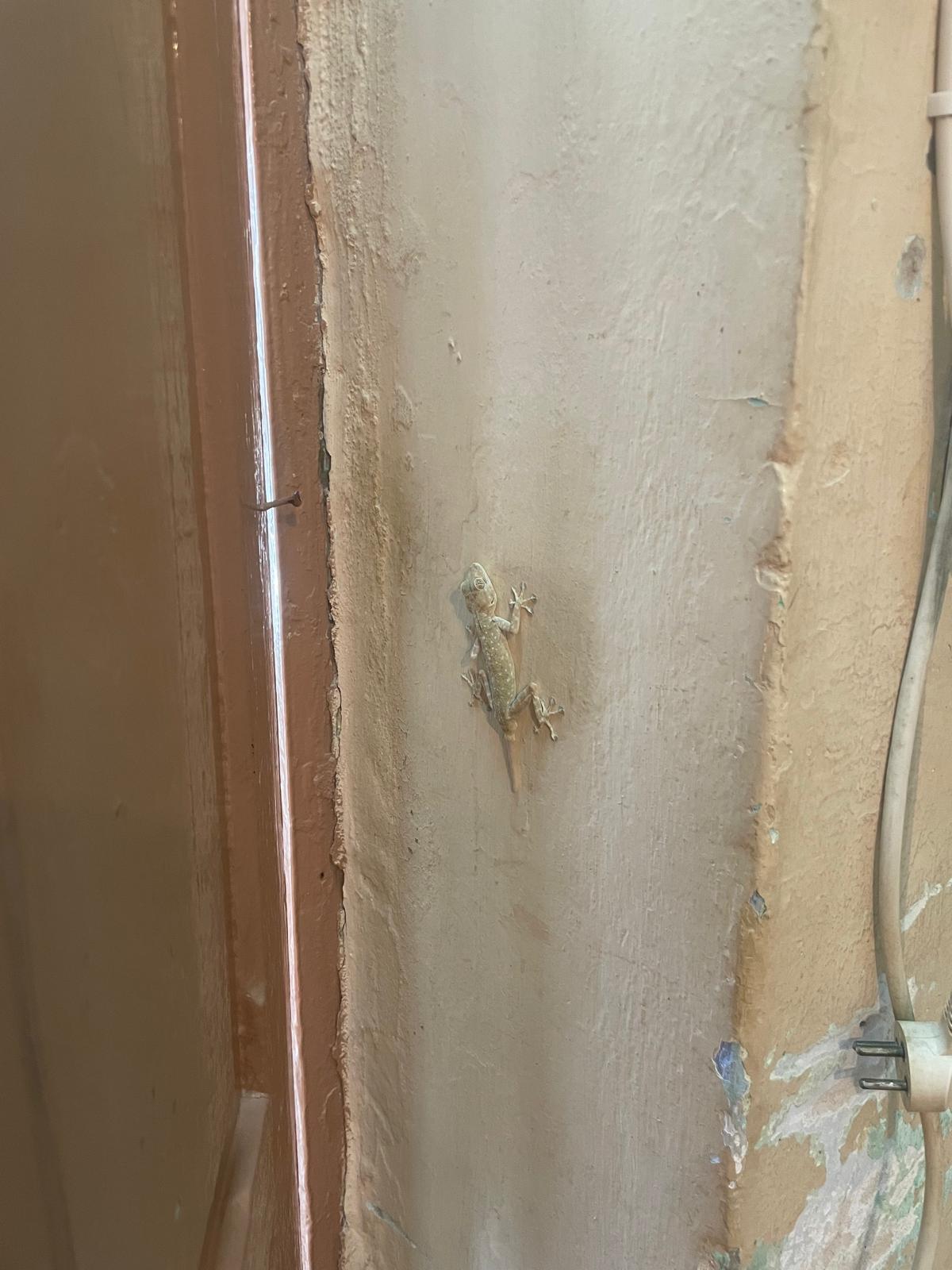
She has his phone number which she has been using recently to get his help inside her home with a lizard.
You heard me: a lizard.
She says the lizard has been bothering her for 30 years. And every time she gets rid of it, it gets back in. (For the record, Yonit has windows at sidewalk level with no coverings at all. I assumed stray cats and rodents got inside all the time. I’m relieved it’s only a lizard.)
Anyway, she phones Nate–whom she calls Yoni even though we’ve told her often his name is Nate–when she wants help catching her lizard. Nate says it’s pretty big, and hard to see because it changes color. The best Nate/Yoni can do is chase the creature around her home until it disappears in a hiding place.
So why am I telling you all this? Because Yonit is one of the characters that makes living here so quirky and challenging –and wonderful.
Like most, I’ve been profoundly distressed by the war in Gaza. Upset that the world doesn’t see the impossible situation Hamas has created. Ashamed of Israel’s role in the harm the Gazans are enduring. Grieving over every lost IDF soldier. Desperate to see this awfulness end. I had lost sight that I’ve been happy here.
Hearing about Yonit’s lizard and Nate/Yoni’s involvement in this zany situation has reminded me that there’s more to this country than the war. There are reasons to laugh and marvel at how peculiar and lively and loveable this place can be. How sometimes the daily hassles let you discover tolerant and compassionate corners of your soul you never knew existed. And how glad I am that my family and I ended up here.