Human Rights Attorney
Featured Post
A loyalty test for a latte
A Brooklyn coffee shop's public shaming of a Jewish congressman exposes a society sliding into bigotry – one 'we don't serve your kind' at a time
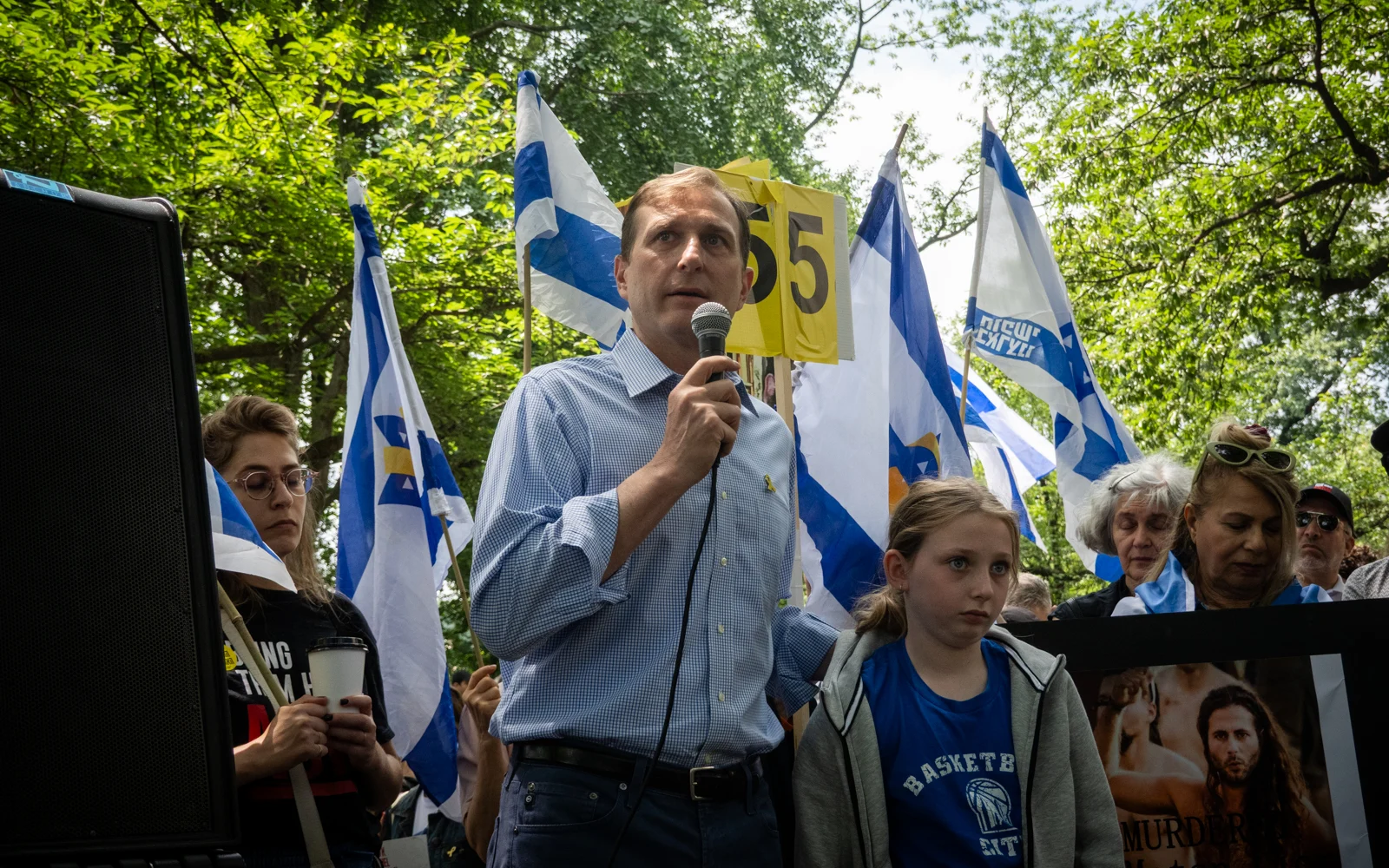
US Rep. Dan Goldman at a rally for Israeli hostages in Gaza in Central Park, New York City, June 8, 2025. (Luke Tress/Times of Israel)
A Brooklyn coffee shop told a sitting congressman it would have thrown him out. The law has a word for that, and it is not “activism.” It is discrimination, and we should stop pretending otherwise.
Last weekend, a Democratic congressman walked into a Williamsburg coffee shop with his seven-year-old daughter, bought a coffee, and left. The barista, by the congressman’s own account, was kind. She let his daughter use the bathroom. He bought a coffee in return for the kindness.
Then the shop posted his photograph to the internet.
Poetica Coffee tagged Representative Dan Goldman directly, published an interior image of him standing at the counter, and announced that his coffee did not “taste like genocide juice.” It informed him that “here at Poetica, we don’t serve racists, fascists, homophobes, genocide enablers, or anyone in between.” It told him that “too bad we didn’t recognize you right away, or we would have turned you away.” It refunded his money, unasked, with the explanation that “we don’t need your money (it’s probably coming from AIPAC anyways).” It closed: “Don’t ever come to Poetica.”
Let us be precise about what happened, because precision is the whole point. A business open to the public identified a customer, decided after the fact that he belonged to a forbidden category, voided the transaction he had completed, and posted a standing notice that people like him are not welcome and will be turned away on sight. The shop’s own website promises that “whoever walks through the door is treated with unconditional dignity,” that “the door doesn’t close on anyone.”
The door closed. It closed on a Jewish public official because the shop treated Israel, AIPAC, and pro-Israel civic participation as proxies for a forbidden identity.
This was not a boycott of a policy. It was the marking of a person, which is what these boycotts are really about to begin with: racism against a people, dressed up as a disagreement with a state.
The oldest trick, run again
The defense writes itself, and Poetica’s supporters have already written it: We didn’t refuse him because he’s Jewish. We refused him because he supports genocide. It sounds like a distinction. But it isn’t. It is the oldest trick in the discrimination playbook, and the law stopped falling for it a long time ago.
Civil rights law does not require a bigot to announce himself with a slur. It has always understood that discrimination hides behind proxies – that “we don’t serve your kind” can be dressed in a hundred euphemisms, and that the euphemism is not a defense but a tell. A landlord who rejects an applicant for his “neighborhood” when the neighborhood is a stand-in for his race has still discriminated. An employer who passes over a candidate for her “accent” when the accent is a stand-in for her national origin has still discriminated. And a coffee shop that refuses a customer for “AIPAC money” – invoking a classic antisemitic libel, the one about Jewish money and hidden Jewish influence – when AIPAC is a stand-in for his Jewishness and his connection to Israel has still discriminated.
“Israel” was the pretext. “AIPAC” was the pretext. “Genocide enabler” was the pretext. But strip the excuses away and what remains is a Jew, refused for being one.
You cannot launder discrimination through a foreign policy you disapprove of. The New York City Human Rights Law – one of the broadest civil-rights statutes in the nation – makes it unlawful for a place of public accommodation to deny service, “directly or indirectly,” because of a person’s actual or perceived creed or national origin. It separately makes it unlawful to publish a notice that a class of customers is unwelcome. Poetica did both, in writing, with a photograph, and a flourish. The statute reaches the indirect as surely as the direct. It reaches the proxy as surely as the slur. The shop did not need to say the word. It said everything but the word, and the word was the point.
A line of doors, closing
If this were one shop, one barista, one bad day, it would be a small ugliness and not worth a column. It is not one shop. It is a pattern, and the pattern is accelerating.
In Park Slope, the Food Coop voted to boycott Israeli goods – to make its shelves a political checkpoint, to tell its neighbors that some products, and the people associated with them, are unwelcome on the basis of national origin. In Williamsburg, a coffee shop now tells a Jewish congressman he will be turned away at the door. And over all of it hangs the ascent of a mayoralty that has made the loyalty test fashionable.
Consider the calendar. On June 18, at a Brooklyn rally headlined by Bernie Sanders, Mayor Zohran Mamdani called AIPAC “monsters,” accused the organization of moving “millions in dark money” to “turn us against one another,” and declared that the only thing AIPAC fears more than democracy is “an end to genocide.” Days later, a coffee shop a few subway stops away refused a Jewish congressman and explained that it did not want his money because it was “probably coming from AIPAC anyways.” And on June 22 – the very day the coffee-shop story went national – the mayor stood at City Hall and declined to take any of it back.
The coffee shop did not invent that vocabulary. It inherited it. “AIPAC money” as a slur, “dark money” as a dog whistle, Jewish institutions as a hidden hand turning the city against itself – this is not the language of foreign-policy disagreement. It is, as Congressman Josh Gottheimer put it, the oldest antisemitic conspiracy theory in the books: swap “AIPAC” for “Jews,” and you have it exactly. Even some of the mayor’s own Jewish allies winced at the “dark money” framing and its unmistakable echo of the grand conspiracy libel.
When the most powerful man in the city makes the litmus test respectable, it should surprise no one when others try to enforce it. That is how normalization works. It does not arrive by decree. It arrives one refused latte at a time, each one a little more blatant than the last, each one met with applause instead of consequence, until the thing that was unthinkable on Monday is policy by Friday and a brand identity by Sunday.
We have seen where lines of closing doors lead. We are not there. But we are on the road, and the road runs downhill. A society does not fall off the cliff all at once. It is nudged toward the edge, one “we don’t serve your kind” at a time, by people who are quite sure they are the good guys.
That last part matters. The people closing these doors do not think of themselves as bigots. They think of themselves as anti-racists. They have convinced themselves that this particular discrimination is the righteous kind, the progressive kind, the kind that does not count. It counts. The law does not have a carve-out for discrimination committed by people with good politics, and neither does history. Every closed door in the long catalog of closed doors was, in the mind of the person closing it, justified.
The line, and who draws it
So this is the line. Not a metaphor, but a legal one.
No New Yorker should have to pass an Israel loyalty test to buy a cup of coffee. A Jew should not have to disavow Israel, AIPAC, Zionism, or his own community to be served at a counter that serves everyone else.
And the principle is only worth anything if it has nothing to do with Israel at all. A coffee shop cannot refuse a Chinese-American customer because it disapproves of Beijing’s conduct in Xinjiang. It cannot refund a Russian émigré’s money because it has decided he answers for the war in Ukraine. It cannot throw out an Ethiopian-American over Tigray, or a Turkish-American over the Kurds, or an Indian-American over Kashmir. In every one of those cases, the shop would be doing exactly what Poetica did – reaching past a person’s politics to punish him for the creed or the country written into his identity – and in every one of those cases, it would be just as illegal. The protection does not belong to Jews. It belongs to everyone, which is precisely why it reaches Jews too. That is what makes it law and not faction.
This is not about defending one congressman, who can defend himself, or one advocacy group, which needs no defense. It is about whether the privileges of ordinary public life in this city – a coffee, a sandwich, a seat – remain open to Jews on the same terms as everyone else, or whether they are now conditional on a political confession. That question has only one acceptable answer, and the law already gave it.
On behalf of The Lawfare Project, I referred this matter to the New York City Commission on Human Rights, asking it to open an investigation and bring an enforcement action against Poetica Coffee for the discriminatory denial of a public accommodation, the publication of a discriminatory notice, and an unlawful refusal to sell. We have asked the Commission to use the full reach of the law, including its authority to act on its own initiative in the public interest, because this is a public injury and not a private grievance.
The barista was kind to a little girl. The shop that employs her chose to be something else, and chose to put it in writing. The law will now decide which choice the city stands behind.
Draw the line here, now, while there is still a line to draw.
Related Posts