A Mensch with Flour on His Hands
Strudel, Amber, and Pikuach Nefesh
Odesa native Uriel Shtern preserves recipes and Jewish memory, transforms Ukrainian amber into Judaica, and helps women reach a doctor in places where war has made an ordinary medical exam nearly inaccessible. At first glance, these seem like separate lives. In fact, they are one form of responsibility for another person.
I should admit at the beginning what journalists usually admit in the final paragraph, if they admit it at all: Uriel Shtern is my friend. He is also an Odesan, as I am. So I will not pretend to be disinterested. Friendship, however, is no exemption from accuracy. This is an attempt to understand someone I have known for a long time, but whose life still refuses to fit inside a simple definition.
We met about twenty years ago at Rabbi Zalman Liberov’s synagogue, when my brother Dmitriy was just beginning his professional boxing career. Many faces, conversations, and events remain from that period, but Uriel stood out for a quality that is difficult to perform for an audience: the willingness not only to listen to another person’s concern, but to take that concern on as his own.
In Jewish tradition, compassion does not end with a kind feeling. Rachamim must acquire hands. It must become gemilut chasadim: concrete acts of loving-kindness. That, I believe, is what connects everything Uriel Shtern does.
Search for Uriel online and you may conclude that you have found three different people.
The first is a cook and television host. In Kyiv, Shtern hosted a program about kosher cooking on Ukrainian national television. Stars of Ukrainian show business came to his kitchen, and Jewish tradition entered viewers’ homes not as a museum exhibit but as a living culture: through conversation, humor, the aroma of baking, and food that could be made in one’s own kitchen.
A special place in that work belongs to his book Myths and Legends of Odessa Cuisine. The title already carries the right Odessa intonation: a recipe never exists apart from a story, and a story never exists apart from a little embellishment. In Shtern’s hands, Odessa cuisine is not a list of dishes but a biography of the city, composed of Jewish, Ukrainian, Moldovan, Greek, and other voices. Forshmak, strudel, and stuffed fish matter not only for their taste. Behind every dish stand a family, a street, a market, an argument over the one true recipe, and the memory of people no longer at the table.
That work later continued online: kosher baking, video lessons, Viennese apple strudel, Jerusalem bourekas with brined cheese and roasted eggplant, fisinjan, and the foods of old Odessa. Over the years, Shtern built a large audience. In Ukraine, he became known not only as a member of the Jewish community but as a recognizable public figure who could speak about Jewish life openly, clearly, and without turning it into folklore.
For him, however, this was never merely a cultural project. Uriel is an observant Jew, a baal teshuva, and a Chabad Hasid. Baal teshuva literally means one who has returned: a person who has consciously turned his life toward Torah and mitzvot. In Uriel’s case, that return did not become a retreat from the world. It gave direction to everything he does within it.
In the Chabad tradition, the warmth of a Jewish home is not meant to remain locked inside that home. It is shared. Sometimes through Torah study, sometimes around a Shabbat table, and sometimes through a recipe explained to a television audience. Shtern’s kosher kitchen offered precisely that kind of invitation: an entrance into Jewish life not through argument or slogan, but through hospitality.
The second person is an artist and the founder of Shtern Amber Collection. His workshop creates Judaica from Ukrainian amber and Italian smalti: paintings, mezuzot, Torah pointers, challah boards, yahrzeit memorial boards, and donor walls for synagogues.
The third person is the founder of Kvitna, a charitable foundation that helps Ukrainian women obtain preventive examinations and timely diagnosis of breast conditions.
They are all the same person.
The longer one looks at these three lives, the clearer their common purpose becomes. The cook preserves taste and family memory. The artist preserves names. The philanthropist helps preserve health and life. Beneath each endeavor lies the same movement of the soul: to notice what may be lost and to refuse to walk past it.
Let us begin with compassion.
Shtern understood early what charitable organizations do not always say aloud: private help is essential, but isolated acts of kindness are not enough. If examinations and treatment are inaccessible to many women, mercy must become a system – prevention, early diagnosis, a doctor, and equipment close enough to reach.
Judaism has a principle called pikuach nefesh, the obligation to preserve human life. To save a life, nearly every other religious commandment may be set aside. This is not an attractive abstraction. It is intensely practical wisdom: do not wait until danger becomes undeniable and loud; act while something can still be done.
Kvitna created a project whose name explained its purpose: ‘Take Your Mother, Go With Your Wife, Tell Your Sister.’ Well-known Ukrainian men urged women to receive regular breast examinations.
Anyone raised in the post-Soviet world will understand why that was almost radical. In a culture where a man says the word ‘breast’ either in a joke or not at all, the foundation asked men to say it seriously, on camera, while speaking about the health of their own mothers, wives, and sisters. It was uncomfortable. In this case, discomfort was part of the medicine.
Then came the full-scale war, and public education could do little for someone whose nearest functioning ultrasound office lay beyond a destroyed bridge, or whose local hospital had closed.
The foundation’s team arrived at a simple answer: if a woman cannot reach the doctor, the doctor must reach the woman.
That answer became a mobile medical platform – a van equipped as a clinical office, where doctors perform ultrasound examinations of the breasts and pelvic organs. The platform was brought from the United States with the support of sponsors and American partners. It travels to places with large displaced populations, damaged hospitals, or no appropriate equipment.
The team does not change locations every day simply to produce an impressive map. It remains in a community for as long as necessary to see the women who have registered. For security reasons, exact locations are not announced publicly in advance.
The foundation’s director, Oleksandra Vielkova, told a story that explains the platform better than any statistic. A woman underwent an examination. While the mobile office was still in her town, she sought further care and had surgery. Then she returned to say thank you. The platform had not yet driven away, but her life had already turned in another direction.
The foundation also works with VETERANKA, a movement of women who serve or have served in the Ukrainian military. The mobile platform has traveled directly to a military unit. Servicewomen often lack the time and opportunity for routine examinations; military units have no breast specialists or gynecologists, and equipment is still designed primarily for male bodies. A mobile clinic cannot solve all of these problems. It can, however, do what is possible immediately: bring a doctor and equipment to where the women are.
The platform serves civilians, displaced women, service members, and veterans. It also visits Jewish communities. Here the three people from the beginning of this story come together most clearly: the cook preserving kosher recipes; the artist creating objects for Jewish homes and synagogues; and the foundation’s founder helping a doctor reach a woman before illness has a chance to speak loudly.
His connection to Jewish life is not limited to television, recipes, or Judaica. He assists Jewish communities and participates in charitable work without trying to turn every good deed into a publicity campaign. Yiddish has a word for this: mensch. It means more than someone successful or gifted. It describes a decent and dependable person who accepts responsibility for another. In English it takes a sentence. Of Uriel, sometimes one word is enough: he is a mensch.
Now, the amber.
We tend to imagine amber in small forms: beads, pendants, souvenirs. Shtern Amber works with it differently. Alongside objects for the home, the workshop creates large yahrzeit memorial boards, donor walls, and Tree of Life installations for synagogues and Jewish institutions.
A memorial board preserves the names of those a community has lost; on a yahrzeit, a light is illuminated beside the name. A donor wall preserves a different form of memory – the names of those who helped build, support, or restore the community. Such boards are usually functional objects. Shtern tries to make them works before which a person will stop.
Amber does not shine like metal. It appears to hold light inside itself. Names surrounded by this stone cease to look like lines in a list and become part of a large luminous composition. Religious function and art do not compete here.
But the material itself matters. Amber is fossilized tree resin. A tree releases resin to protect an injured place. Millions of years pass, and what began as a means of survival becomes a stone that people hold against the light and call beautiful.
Shtern takes that stone and forms a board of names so that the dead will not be forgotten. The same material becomes paintings whose sale has helped raise funds for the mobile medical center. Resin that once closed a tree’s wound now helps pay for a clinic where a woman can be told in time that a newly discovered change can still be examined and treated.
The metaphor is almost too precise. One wants to refuse it. It refuses to leave.
At a prayer breakfast in Washington, Shtern presented a mezuzah made by Ukrainian artisans and adorned with Ukrainian amber. A mezuzah does not simply hang on a wall. It is affixed to a doorpost, at the boundary between the world outside and the home one seeks to protect. An object from Ukraine arrived in the American capital, made for a doorway and speaking about protection. Sometimes an object completes the thought its maker chose not to turn into a speech.
Shtern has also written another, still unpublished book, this one about Ukraine. I hope it finds a serious publisher. Uriel is able not only to see and analyze events but, at times, to perceive their direction before it becomes obvious to everyone else.
There is a quality in him that, as his friend and fellow Odesan, I would call Jewish intuition. I do not mean a mystical gift or an ethnic stereotype. I mean the habit of reading the present through memory, noticing small signs, and asking not only ‘What is happening now?’ but ‘Where will this lead?’ Perhaps this is why early diagnosis is so close to his heart: seeing danger while it is still small is another form of responsibility for another person.
On a resume, all of this becomes a set of parallel lines: television and Myths and Legends of Odessa Cuisine, a charitable foundation, an amber workshop, and an unpublished book about Ukraine. Resumes have a way of turning a life into a table in which every line exists separately.
But I keep returning to the strudel.
A good strudel cannot be rushed. The dough must be stretched until it is nearly transparent without being torn. The filling must be distributed so that it lasts to the end of the roll. It is work for someone who knows patience, understands proportion, and is not afraid to get flour on his hands.
Compassion also requires patience. It begins with the ability to notice another’s fragility, but it is tested by whether one is prepared to do something: feed someone, preserve a name, bring a doctor, help a community, turn memory into light.
One wants to find the seam in Uriel’s life: where Odessa cuisine ends and the workshop begins; where the workshop ends and the ultrasound van appears at the gates of a military unit; where religious life becomes public service, and friendship becomes responsibility. 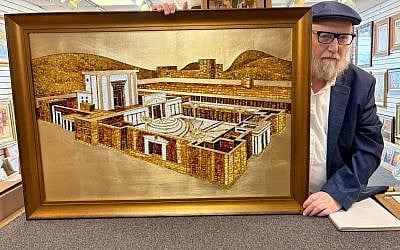 It takes a long time to find that seam. There is no seam. There is resin.