London based entrepreneur, cybersecurity analyst doing a PhD in AI
A Middle East Peace Corps.
The Shepherd’s Test — and an institutional architecture for peace
The Middle East does not suffer from a shortage of history.
It suffers from too much history weaponised against the present.
Every stone can become evidence. Every ancestry can become a claim. Every scripture can become a boundary. Every grievance can be inherited by people who were not alive when it began.
Yet the Abrahamic traditions contain a corrective to precisely this kind of politics:
covenant rather than blood; deeds rather than lineage; stewardship rather than possession; justice even toward enemies; and shepherding rather than political theatre.
If those principles mean anything politically, they should eventually produce institutions.
My proposal is a Middle East Joint Peace Corps: not an aid charity and not another diplomatic talking shop, but a treaty-based multinational military peacekeeping task force composed substantially of states that currently distrust one another.
Its role would be narrowly defined: preserve ceasefires, separate belligerents, protect civilians and hospitals, secure humanitarian corridors, counter terrorism under agreed law, prevent reprisals from becoming wars, protect holy sites, guarantee agreed access to Al-Aqsa, and provide immediate stabilisation when local security collapses.
Its intellectual starting point is much older than the modern state.
It begins with Ibrāhīm (Abraham) عليه السلام.
1. The Chief Rabbi’s statement
In August 2026, Israel’s Sephardic Chief Rabbi David Yosef was reported as saying during an address at Jerusalem’s Gush Katif Museum:
“There is no such thing as a Palestinian people, and they have no rights.”
Reports also attributed to him claims concerning Israeli sovereignty over Gaza, Nablus and Jenin and the eventual return of Jewish settlement to Gaza. Because a complete official transcript of the speech is not readily available, these are best described as reported remarks.
I do not regard either Palestinian or Israeli as an ultimate theological category. Nor do I regard Egyptian, Jordanian, Syrian, British, French or Malaysian as one.
That does not mean such peoples or national identities do not exist. They plainly do.
My point is different.
I am not from the Middle East and do not derive my identity from an Arab, Palestinian, Israeli or Jewish national culture. That allows me to approach the controversy through another lens.
For Islam, the Muslim’s defining religious identity is not Palestinian, Arab, Pakistani, Algerian, Malaysian, Nigerian or British.
It is:
Muslim.
The Qur’anic category is the Ummah.
National identity may tell us something important about history, language and belonging.
It is not the highest unit of religious allegiance.
2. The Ummah crosses the womb
The Arabic umm means mother. Ummah denotes a community or people. They belong to the same broad linguistic family, although ummah should not simply be translated as “mother.”
There is an even more explicit linguistic relationship in the Sunnah between kinship and Divine mercy.
Ar-Raḥm — الرَّحِم refers to the womb and, by extension, ties of kinship.
Among the Names of Allah is:
Ar-Raḥmān — الرَّحْمَٰن
Abū Hurayrah رضي الله عنه narrated that Prophet Muhammad ﷺ said:
“The word ‘Ar-Raḥm’ derives its name from Ar-Raḥmān … and Allah said: ‘I will keep good relation with the one who keeps good relation with you, and sever the relation with the one who severs relation with you.’”
— Ṣaḥīḥ al-Bukhārī 5988, Book 78, Hadith 19
The Arabic contains:
إِنَّ الرَّحِمَ شُجْنَةٌ مِنَ الرَّحْمَنِ
The womb is therefore not treated trivially. Kinship carries moral responsibility.
Yet Islam establishes a religious community capable of extending far beyond biological kinship.
A Senegalese Muslim and a Malaysian Muslim need share no ancestry. A Bosnian Muslim and an Ethiopian Muslim need share no language. A British Muslim and an Indonesian Muslim need share no national history.
Salmān al-Fārisī رضي الله عنه is a beautiful early example. He was Persian, not Arab, yet became one of the distinguished Companions of Prophet Muhammad ﷺ.
The Muslim Ummah is therefore not a race.
It is not fundamentally united by blood, colour, cuisine, language, passport or national mythology.
It is united by covenant:
Lā ilāha illā Allāh.
Muḥammadun Rasūl Allāh ﷺ.
Allah says:
“Indeed, this community of yours is one community, and I am your Lord, so worship Me.”
— Qur’an 21:92
Ibn Kathīr رحمه الله records from Ibn ʿAbbās رضي الله عنهما, Mujāhid, Saʿīd ibn Jubayr and others the explanation:
“Your religion is one religion.”
Qur’an 21:92 — Tafsīr Ibn Kathīr
This is theological unity, not ethnic uniformity.
I do not need to become Arab to love Prophet Muhammad ﷺ. Nor is every Arab custom automatically Sunnah.
Indeed, the Prophetic mission abolished practices deeply embedded in Arabian society, most obviously idolatry. We always love our heroes and want to copy them. This is natural. So for example, if I wear a Thawb because it follows the Prophetic Sunnah of Modesty, or I enjoy Melon like the Prophet (saws) did – I do not need to enjoy every aspect of Arab culture to be Muslim. For example, I tried camel milk, and I didn’t like it. That is not the test of Islam. To be a Muslim, I don’t need to drink Camel Milk. This is an individual preference.
Islam measures culture against revelation.
It does not sanctify culture merely because of geography.
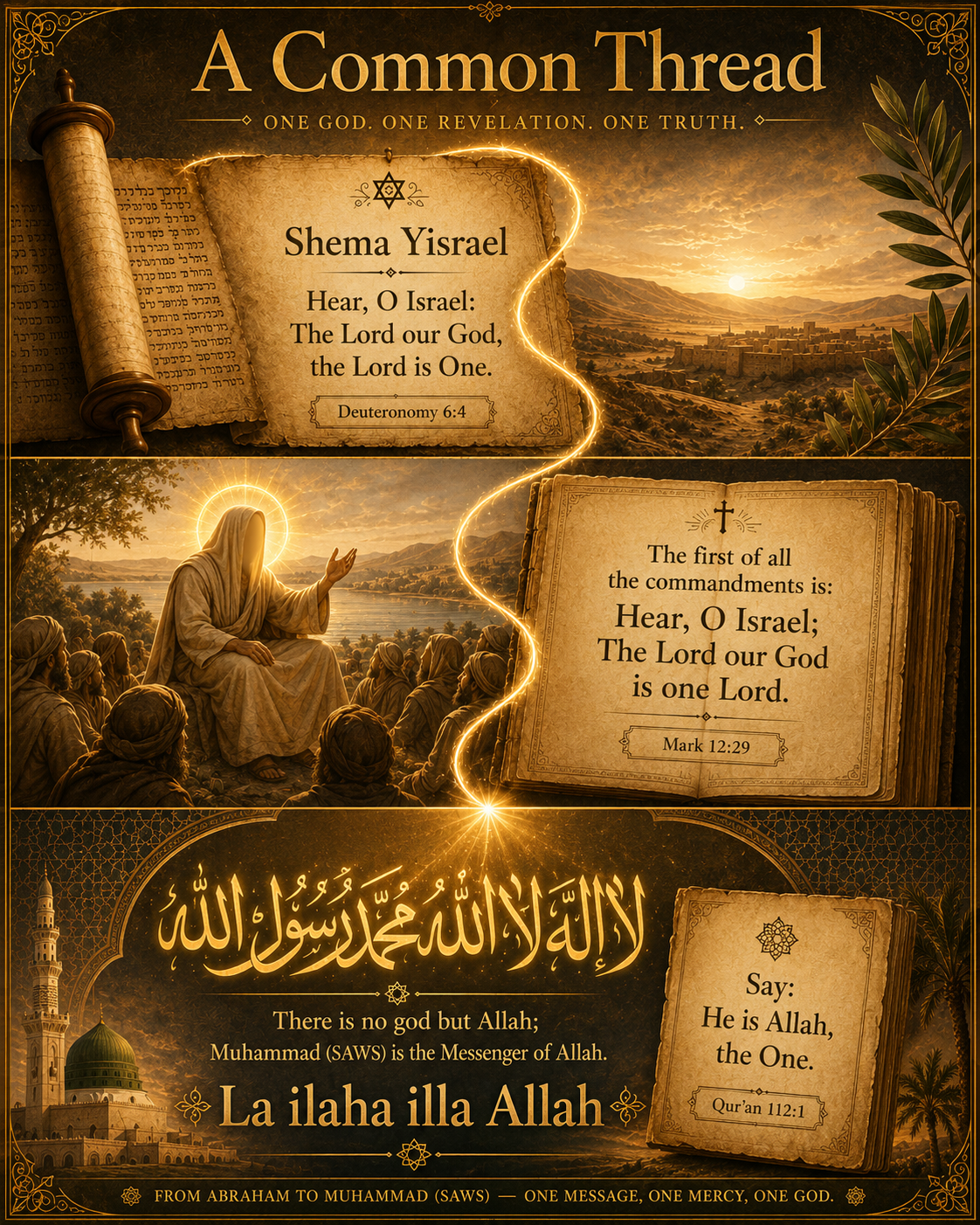
3. A Common Thread
The Torah declares in the Shema:
“Hear, O Israel: the LORD our God, the LORD is One.”
— Deuteronomy 6:4
The Gospel of Mark later records ʿĪsā (Jesus) عليه السلام being asked for the foremost commandment. His answer begins:
“Hear, O Israel: The Lord our God, the Lord is one.”
— Mark 12:29
Matthew records the related command:
“Love the Lord your God with all your heart and with all your soul and with all your mind.”
— Matthew 22:37
Matthew 22:37 does not itself contain the explicit formulation that God is One; that wording is in Mark 12:29.
I believe that “should” in theory close the debate on the trinity, but I am not so naive to believe it would practically.
The Islamic Adhān then publicly announces:
Ashhadu an lā ilāha illā Allāh
and concludes:
Lā ilāha illā Allāh.
Its wording is preserved in Ṣaḥīḥ Muslim 379.
The Qur’an expresses the same uncompromising Divine uniqueness:
“Say: He is Allah, the One.
Allah, the Eternal Refuge.
He neither begets nor is born,
nor is there to Him any equivalent.”
— Qur’an 112:1–4
Judaism, Christianity and Islam are not theologically interchangeable. Islam rejects the Trinity and understands ʿĪsā عليه السلام as Messiah and Prophet rather than God.
But from the Islamic perspective, there is a single prophetic trajectory through Ibrāhīm عليه السلام, Mūsā (Moses) عليه السلام, Dāwūd (David) عليه السلام, Sulaymān (Solomon) عليه السلام, ʿĪsā عليه السلام and finally Prophet Muhammad ﷺ.
Allah says:
“He has ordained for you the religion which He enjoined upon Noah, and what We revealed to you, and what We enjoined upon Abraham, Moses and Jesus…”
— Qur’an 42:13
Many rabbis, openly say, that Arabs and Jews worship the same God, while rejecting the trinity. So, the question naturally comes, if you are worshipping the same God, and he listens to you, then why are you fighting each other? Isn’t this more about human nature than about God?
Ibn Kathīr رحمه الله explains the passage through the principle that the fundamental religion of the Messengers is one, while particular laws may differ.
Qur’an 42:13 — Tafsīr Ibn Kathīr
The implication for politics is uncomfortable: if God alone is ultimate, then race, state, army, territory, religious establishment and leader are not.
The Qur’an consequently commands:
“Stand firm for justice as witnesses for Allah even if it is against yourselves, your parents, or close relatives.”
— Qur’an 4:135
Monotheism therefore contains a political proposition:
my own group can be wrong.
4. Ibrāhīm عليه السلام: covenant is tested, not inherited automatically
Ibrāhīm عليه السلام was not chosen because he possessed Abrahamic ancestry.
There was no Abrahamic lineage before him.
He was tested.
He fulfilled the test.
Then came leadership.
Allah says:
“When Abraham was tested by his Lord with certain commandments, which he fulfilled, He said, ‘I will make you an imam for humanity.’ Abraham said, ‘And from my descendants?’ He replied, ‘My covenant does not extend to the wrongdoers.’”
— Qur’an 2:124
Qur’an 2:124 — Tafsīr Ibn Kathīr
That order matters:
test → fulfilment → leadership.
Only then does lineage enter the conversation.
And immediately comes the qualification:
“My covenant does not extend to the wrongdoers.”
The principle is not anti-lineage. It is anti-entitlement.
Prophet Muhammad ﷺ makes the same principle personal:
“Whoever is slowed by his deeds will not be hastened forward by his lineage.”
— Ṣaḥīḥ Muslim 2699a
A Nobel laureate’s son may inherit extraordinary tutoring, networks and opportunity.
He does not inherit the Nobel Prize.
Eventually, he has to do the work.
Sacred genealogy cannot be less demanding than ordinary achievement.
Lineage tells us something about inheritance.
Deeds tell us what was done with it.
5. The enemy is still inside justice
Allah says:
“Do not let the hatred of a people lead you away from justice. Be just; that is closer to righteousness.”
— Qur’an 5:8
Qur’an 5:8 — Tafsīr Ibn Kathīr
This makes the enemy the place where morality becomes measurable.
Justice toward friends is easy.
The difficult questions arise when people are afraid, bereaved, humiliated or angry; when retaliation is popular; when one’s own side has committed the wrong.
The verse removes the easiest political excuse available:
“But look what they did.”
Their wrongdoing does not automatically sanctify yours.
That principle should sit at the centre of any regional security architecture.
6. ʿUmar رضي الله عنه and Jerusalem
Jerusalem came under Muslim rule during the caliphate of ʿUmar ibn al-Khaṭṭāb رضي الله عنه, around 637–638 CE.
Prophet Muhammad ﷺ said:
“If there were to be a prophet after me, it would have been ʿUmar ibn al-Khaṭṭāb.”
— Jāmiʿ al-Tirmidhī 3686
This does not make ʿUmar رضي الله عنه a prophet; Prophet Muhammad ﷺ is the final Prophet. The report indicates his extraordinary stature.
A famous later historical tradition states that Patriarch Sophronius invited ʿUmar رضي الله عنه to pray inside the Church of the Holy Sepulchre.
ʿUmar declined, according to the tradition, because later Muslims might use his prayer there as a precedent for appropriating the church.
The account comes through later sources and should not be treated as a verbatim contemporary transcript.
Its enduring principle, however, is clear:
Having power does not oblige you to exercise every power available to you.
Muslim tradition also connects ʿUmar رضي الله عنه with an early Muslim prayer space on the sanctuary platform. The monumental architecture visible there today developed mainly afterward. The Dome of the Rock was commissioned by the Umayyad caliph ʿAbd al-Malik and completed around 691–692 CE, while the major mosque complex developed under the Umayyads and underwent later reconstruction.
The historically responsible position is therefore straightforward:
Muslim civilisation produced the monumental Islamic sanctuary architecture that substantially defines Haram al-Sharif today; the site simultaneously possesses a much older Jewish sacred history.
Historical maturity does not require one chapter to erase another.
7. The Shepherd’s Test
Abū Hurayrah رضي الله عنه narrated that Prophet Muhammad ﷺ said:
“Allah did not send any prophet except that he shepherded sheep.”
— Ṣaḥīḥ al-Bukhārī 2262
Another hadith gives the metaphor its political meaning:
“Every one of you is a shepherd and every one of you is responsible for his flock.”
It then says:
“The ruler of the people is a shepherd and is responsible for his subjects.”
— Ṣaḥīḥ al-Bukhārī 7138
This is government reduced to one image.
The ruler is not primarily a celebrity, influencer or performer.
The shepherd asks who is hungry, injured, frightened or missing.
The political entertainer counts applause.
The shepherd counts the missing sheep.
The same standard applies to war.
At Hunayn, portions of the Muslim army retreated during a sudden attack. Al-Barāʾ رضي الله عنه was asked what happened.
He replied:
“By Allah, the Messenger of Allah ﷺ did not flee.”
— Ṣaḥīḥ al-Bukhārī 2874
A modern president need not literally charge into battle. The transferable principle is that leaders should not manufacture courage entirely from other people’s bodies.
If a leader demands war, citizens can reasonably ask for the objective, evidence, alternatives attempted, civilian consequences, exit condition, circumstances that would change the policy, and responsibility if the judgment proves wrong.
The Shepherd’s Test is therefore not theatrical bravery.
It is exposure to responsibility.
8. A Middle East Joint Peace Corps
These principles become meaningful only when translated into institutions.
The proposed Corps would be a joint multinational military peacekeeping force, not a regional development charity.
Potential treaty participants could include:
Israel, Palestinian representation, Jordan, Egypt, Saudi Arabia, Iran, Iraq, Syria, Lebanon, Qatar, Kuwait, Oman, the UAE and Türkiye.
Personnel would train together before deployment and serve under a unified professional command.
Its treaty mandate could include:
- enforcing agreed ceasefires and separating belligerents;
- protecting civilians, hospitals, aid convoys and humanitarian corridors;
- disrupting terrorist attacks under defined legal authority;
- preventing revenge attacks and collective reprisals;
- securing agreed holy sites and security zones;
- facilitating civilian evacuation during emergencies;
- stabilising areas where local security institutions temporarily collapse.
It would not have a standing licence to intervene anywhere it wished. Deployment would have to arise from the founding treaty and agreed legal mechanisms.
The significance of the force lies partly in its composition.
An Iranian officer and an Israeli officer need not agree about history.
A Saudi soldier and a Syrian soldier need not share political ideology.
They would instead share rules of engagement, training, command procedures and an operational mission.
An attack on such a force would also risk simultaneously harming personnel from several competing regional powers.
That creates a practical incentive for restraint that diplomatic communiqués alone cannot manufacture.
9. Al-Aqsa as a practical test
Al-Aqsa/Haram al-Sharif could become one of the Corps’ clearest responsibilities during periods of acute tension.
Its role would not be to adjudicate theology or rewrite sovereignty.
It would be to prevent violence and protect previously agreed arrangements.
The compact could preserve Muslim worship and the Islamic religious character of Al-Aqsa, Jordanian and Waqf custodial functions, the mosque and Dome of the Rock, lawful arrangements for non-Muslim visitors, and the protection of Jewish and Christian holy places elsewhere.
Multinational peacekeepers could serve as a temporary buffer when tensions threaten to overwhelm normal policing.
The aim is predictability:
religious communities should know that temporary political advantage will not be converted overnight into irreversible alteration of sacred space.
10. External observers
The Corps should have outside observers, but observer is the operative word.
They would not govern the Middle East, vote on sovereignty or possess a great-power veto.
Their role would be verification: whether ceasefires were breached, civilians deliberately targeted, humanitarian corridors obstructed, peacekeepers exceeded their mandate, or holy-site arrangements violated.
A deliberately mixed observer group could include:
Spain, France, India, China and South Korea.
The point is not that these countries are perfectly neutral.
No country is.
Spain and France bring European diplomatic and military experience. India has substantial relationships with Israel, Iran, the Gulf and the wider Muslim world. China possesses enormous economic influence across competing regional blocs. South Korea is a formal US ally but has been far less directly associated with the Middle East’s recent wars and brings substantial military, engineering, medical and infrastructure expertise.
Together they offer strategic diversity rather than imaginary purity.
The United States and Russia could remain diplomatic participants, but both are deeply embedded in regional strategic competition and therefore need not police the institution.
Likewise, Germany and Japan could contribute substantially to reconstruction, medicine and technology without serving in the initial observer panel. Contemporary Germans and Japanese do not inherit personal guilt for earlier regimes, but the legacies of Nazi Germany and Imperial Japan create unnecessary symbolism for an institution dealing directly with militarised nationalism, territorial expansion and civilian protection.
11. What success would look like
The most important property of the Corps would be that success is visible through what does not happen.
A ceasefire does not collapse.
A terrorist attack is intercepted without collective retaliation.
A hospital remains functioning.
Worshippers reach a holy site without a riot.
An armed confrontation is contained before neighbouring states enter it.
A humanitarian convoy passes without becoming part of the conflict.
Two governments that will not negotiate comprehensively still cooperate because their soldiers are operating inside the same peacekeeping structure.
There is something deeply consistent between such an institution and the theological principles with which this article began.
ʿUmar رضي الله عنه became remembered not only for possessing power in Jerusalem, but for the possibility of restraining it.
The ruler was described not as the owner of the flock but its shepherd.
And the Abrahamic proclamation running through the Shema, the words attributed to ʿĪsā عليه السلام, the Adhān and Sūrat al-Ikhlāṣ continually removes earthly things from the position of the Absolute.
Perhaps, this is what a Middle East peacekeeping force should institutionalise:
not agreement about every version of history,
but agreement that history does not have to determine the next bullet.
For generations, the argument has been:
Who inherited Ibrāhīm (Abraham) عليه السلام?
A more demanding political question is:
Who is prepared to behave in a way which is worthy of Ibrāhīm’s (a.s.) inheritance?
A Joint Peace Corps would turn that question from theology into practice.
Related Topics
Related Posts