
A Moral Vending Machine of Online Hate in England

My dear friends in England, while we in Israel experience direct rocket attacks from our visible enemies, you unfortunately live among unseen enemies who only venture out from beneath their ‘rocks’ when called to action by a Facebook post written by an officially elected member of Parliament, with a history of open support for the enemies of England. These brave keyboard warriors invoke centuries old anti Jewish tropes and conspiracy theories based on a very dangerous and misleading statement from a politician who has very deep and personal connections to so many proscribed terrorist groups.
I’m writing because you might not realize the kind of air you’re breathing. Not the London air, which already tastes like bus exhaust and regret. I mean the online air. The comment-section fog. The place where a blue tick posts a few righteous words and, within minutes, somebody’s uncle in a leather jacket profile photo starts connecting “Israel,” “the government,” and “the Rothschilds” like he’s doing a children’s dot-to-dot puzzle.
You’ve probably seen the original spark. A short post, sharp enough to cut bread. “Massacre.” “War crimes.” “Complicit.” Big courtroom words thrown like bricks. No slow walk through evidence, no “if true,” no “alleged,” no “pending investigation.” Just the vibe of a verdict, delivered by someone who knows that online, the difference between a legal finding and a political accusation is about the same as the difference between a locked door and a “Please keep shut” sign.
And it works. That’s the annoying part. It’s simple and punchy. It repeats the word “troubled” like a comedian doing stand up. It sets up a neat hypocrisy trap, ‘if your Foreign Secretary says she’s “deeply troubled” but the policy doesn’t change, then she’s not troubled, she’s acting’. The post doesn’t need to convince skeptics. It’s not for them. It’s for the people already simmering, the ones who want a clean villain and a cleaner betrayal.
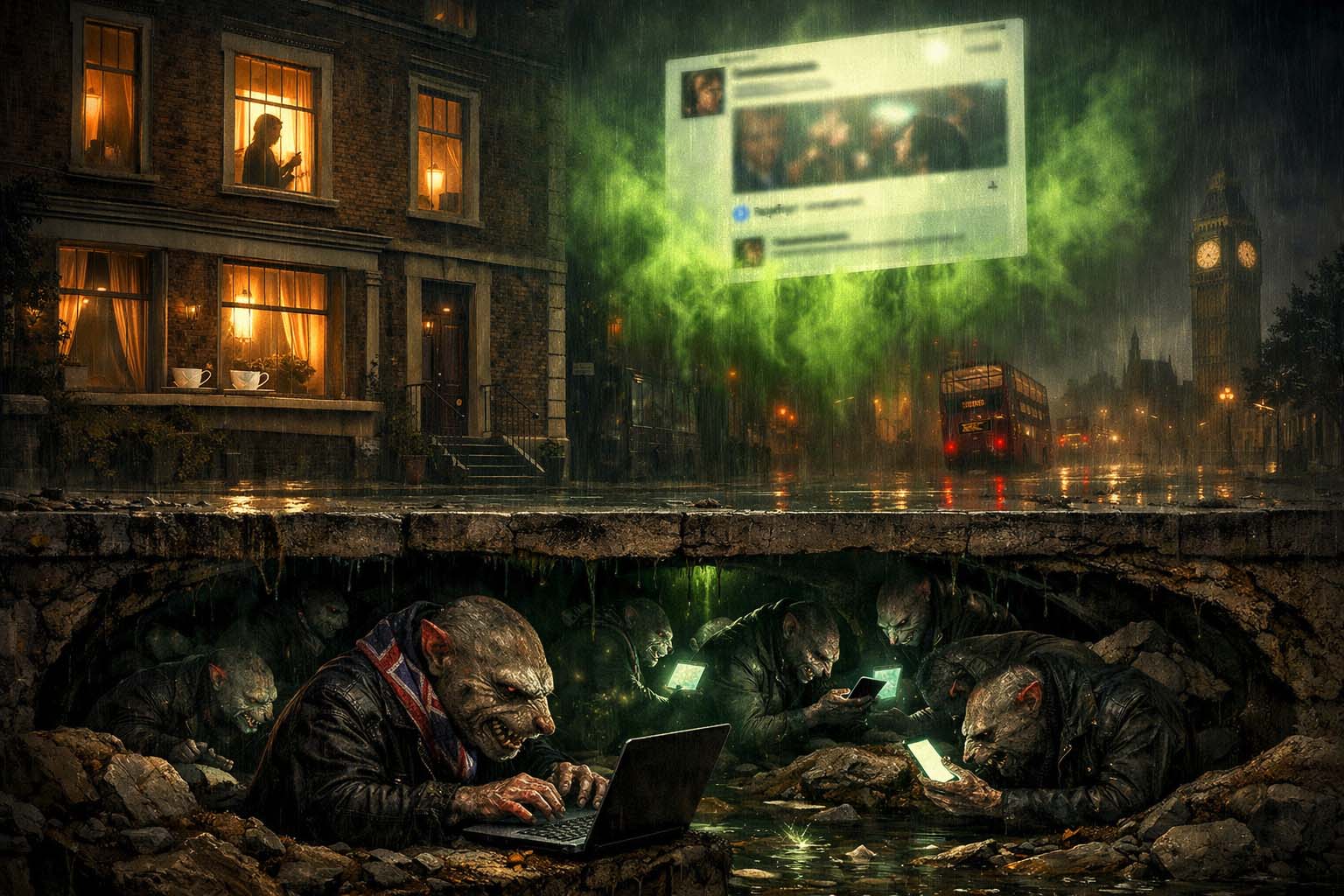
Then the comments arrive. And this is where your invisible enemies crawl out, blinking, delighted, and somehow always holding the same antique book of conspiracy clichés like it’s a family recipe.
“They all work for Israel and for the Rothschild family.”
There it is. A sentence that takes a complicated mess of diplomacy, war, ideology, and history and turns it into a secret puppet show. The Rothschild name isn’t some random finance trivia. It’s a neon sign from the old hate museum. A prepackaged myth that has survived centuries because it’s useful to people who can’t tolerate complexity. If there’s suffering, someone must be controlling it. If there’s politics, someone must be bribing it. If there’s a Jewish-sounding name available, well, how convenient.
And then someone replies, trying to be sensible: “Rothschilds are English.”
Bless them. This is like telling a mugger, “Actually, that’s not your wallet. That’s a British wallet.” The conspiracy doesn’t care about passports. It’s not a geography argument. It’s a story structure: hidden Jewish power, pulling strings, corrupting the “West,” whatever that means today, since the “West” in a Facebook thread usually includes everything from the BBC to your neighbor’s recycling habits.
The original commenter’s “Nice! Good to know” is almost funny in its honesty. Not “Oh, I was wrong.” Not “Thanks for correcting me.” Just a cheery little stamp collecting moment. Another fact-shaped object added to a display case labeled “Still Definitely A Plot.”
Then comes the next level, the one that stops being merely embarrassing and starts being genuinely dangerous. The talk of infiltration, corruption, puppets, “Zionist rule,” carving Europe out from beneath it. It’s the same old superstition wearing a new coat. Sometimes “Zionist” is used narrowly and politically. But in that kind of comment, it’s not narrow. It’s an all-purpose enemy category. It’s a way to talk about Jews without saying Jews, while still smuggling in the exact same imagery: secret control, contamination, takeover.
You should know how this works mechanically, because it’s not magic. It’s a pipeline.
Step one, moral absolutism at the top. The post frames the world as prosecution, not discussion. It doesn’t explore. It declares.
Step two, the hypocrisy hook. If the government is “troubled” but doesn’t act, then the government is lying or bought.
Step three, the comment-section leaps. If the government is bought, who bought it? Someone powerful. Someone hidden. Someone with an old name people have been trained to hate. The conspiracy crowd doesn’t need to be invited. They just need to feel permitted. A big emotional post is like ringing a dinner bell. They arrive drooling, not for truth, but for a target.
And you might say, “It’s just comments.” But comments are how people practice. They rehearse blaming groups. They try out words like “infiltrate” and “puppets” the way teenagers try on a new jacket in a shop window. If it gets likes, if nobody pushes back, if the only consequence is a little blue thumbs-up icon and maybe an angry-face emoji, then the language gets bolder next time. The line moves. Quietly. Like damp spreading across a wall.

Meanwhile, you’re in England making tea, thinking you’re dealing with “debate.” You’re not. You’re dealing with a kind of moral vending machine. Insert outrage, receive a conspiracy. Press “Reply,” get an ancient myth refurbished for modern use.
Here’s the part that’s almost darkly comedic. The people screaming about “puppets” tend to be the most easily puppeted. Give them one emotionally loaded political post and they’ll immediately outsource their thinking to a story that’s been copy-pasted for generations. It’s like watching someone boast about being immune to advertising while buying the exact same product as every other guy in the room.
So consider this a warning from a place that at least knows what a direct threat looks like. When a rocket alarm goes off here, you don’t argue about whether it’s “deeply troubling.” You move. You grab your kid, your keys, the dog, and you go to the shelter with the peeling paint and the broken fluorescent light. It’s concrete. It’s stupidly real.

Your threat is quieter. It shows up as a confident sentence under a politician’s post. It wears the mask of “just asking questions.” It pretends it’s about governments, then it slides toward families, then toward whole populations, then toward fantasies of “carving out” continents. It’s an old sickness that learned to use new buttons.
If you want one small, unglamorous thing to do, it’s this. Treat those tropes like smoke in your kitchen. Don’t stand there admiring the pattern. Open a window. Say, plainly, “No, that’s antisemitic conspiracy rubbish.” Don’t debate the puppet-master lore like it deserves a seminar. Don’t let it sit in the room because arguing is uncomfortable and you’d rather scroll.
Because the unseen enemies under the rocks are counting on exactly that.