A Nakba Day Reflection on the Politics of Recognition
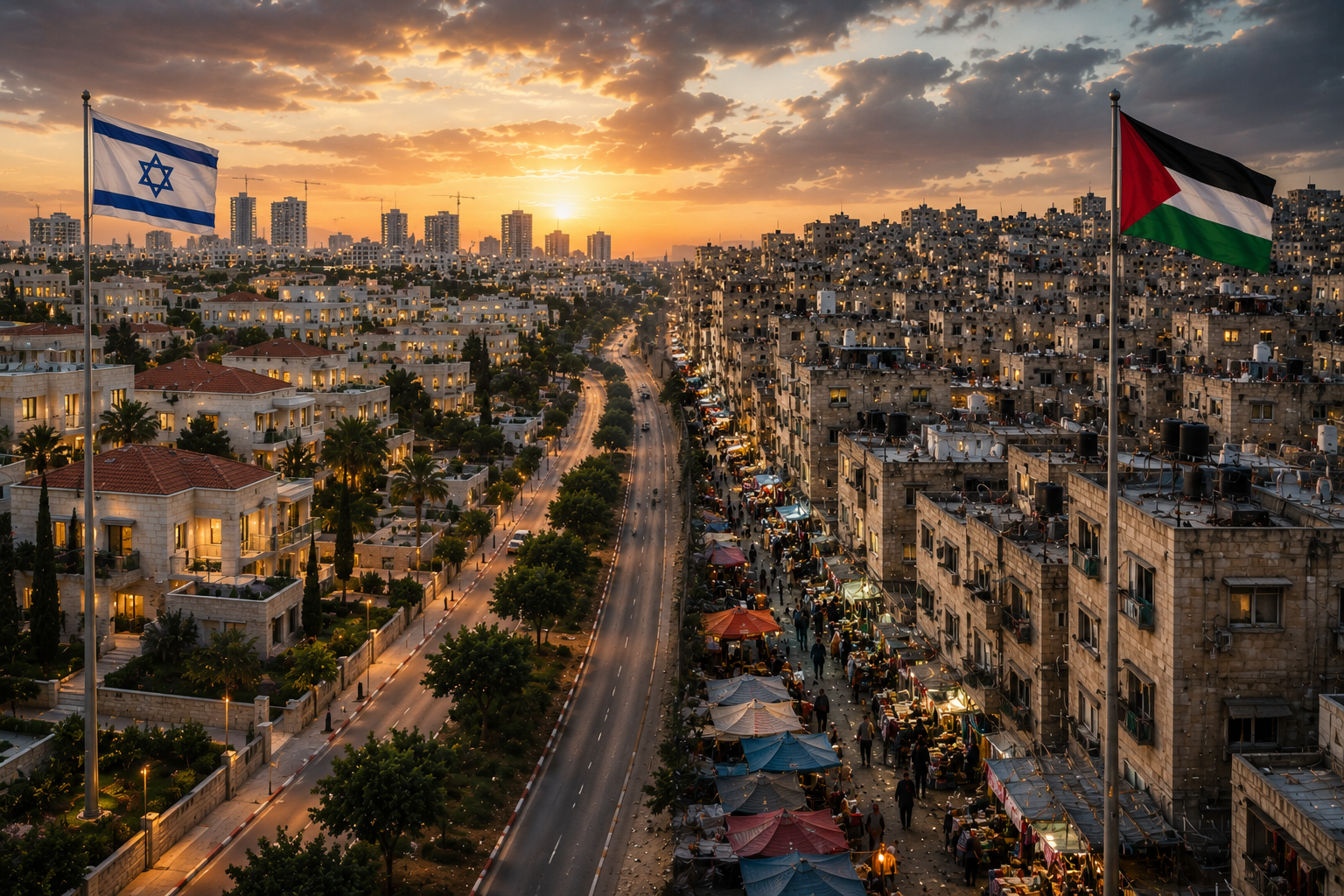
The power asymmetry between Israelis and Palestinians is shaped by the unequal condition of statehood and statelessness within a twentieth-century international order that increasingly organized political legitimacy through the nation-state. As older imperial, multinational, and pan-national frameworks weakened, peoples became most politically visible through state-recognized nationality, territorial sovereignty, citizenship, and borders.
Statelessness is one of the most profound experiences Jews and Palestinians share, and it is also at the heart of what separates them. After some of the most catastrophic periods in their history, Jews reconstituted themselves most securely through Israel and, differently, through the United States and other diasporic centers. Palestinians, by contrast, continue to live statelessness as an immediate political condition, or as an unstable minority status within Israel. That condition is especially jarring given that it unfolded in a region where Arab majorities and pan-Arab idioms often promised protection against colonial partition, foreign rule, and political fragmentation.
There was no obvious reason Palestinians, or the wider Arab world, would accept Zionist settlement and state-building in Palestine, especially as these developed under British imperial rule. Nor was it surprising that, after Palestinians lost their territorial majority through war and displacement, their national cause came to be recognized by postcolonial movements, international institutions, and international law. Yet international recognition has not prevented occupation, statelessness, settlement, blockade, devastation, or what many human rights bodies and legal scholars describe as genocidal violence in Gaza.
Today, on Nakba Day, this must be said without evasion. It was the destruction of a world. Villages were emptied or destroyed. Families became refugees. Property was lost. Return was denied. A people whose life had been organized around towns, fields, roads, shrines, schools, markets, homes, maqams, and memory was made politically discontinuous. The Nakba became a continuing structure of exile, occupation, statelessness, suspended return, and threatened futurity. Any language of mutual recognition that cannot say this plainly is not recognition at all.
And power must be named. Modern politics does not recognize peoples by justice alone. Israel has state power, military power, territorial control, diplomatic backing, and the capacity to govern Palestinian life. The asymmetry must not be dissolved into moral equivalence. Yet asymmetry does not remove the need to understand how each people’s fear became politically organized and why one people’s answer to vulnerability became the other people’s experience of vulnerability.
The nation-state did not invent war, taxation, bureaucracy, education, conscription, borders, or imperial administration. Empires had long exercised these powers. But the modern nation-state became an unusually efficient apparatus for concentrating them. It mobilized populations more deeply, standardized identity more effectively, administered territory more intensively, and translated collective belonging into the categories of citizenship, nationality, security, and sovereignty. It also converted complex forms of collective life into recognizable categories of majority and minority, through which political belonging could be organized and legitimized, depending on the political culture, electorally, racially, ethnically, culturally, economically, or religiously. Externally, the modern state projects military force, demography, diplomacy, territorial control, alliances, economic capacity, and the power to create facts to which others must respond.
This does not mean that every state is a pure nation-state, or that multinational, federal, and minority arrangements do not exist. Many states contain multiple peoples, cultures, languages, religions, and histories, but even these arrangements become politically intelligible through nationally defined territory and majoritarian forms of legitimacy, which help decide which identities can endure publicly and which appear as permitted, tolerated, private, foreign, or suspect. Even equality does not mean every group’s way of life is equally protected in public when the national form is the measure through which equality is recognized.
Modern politics did not encounter Jews as blank slates waiting to become a people. They inhabited worlds of memory, attachment, ritual, language, law, place, institutions, solidarity, and collective consciousness. They had courts, councils, religious authorities, charitable networks, schools, languages, communal institutions, and patterns of self-government in many settings, though never everywhere in the same way. They were never one thing, but neither were they merely many unrelated things. They possessed the materials through which a people experiences itself as a people.
Yet Jewish collective life did not fit easily into an order that increasingly recognized peoples through borders, national languages, territorial cultures, citizenship, and statehood. This pressure produced a wide range of modern Jewish responses, such as, emancipation, religious reform, liberal citizenship, minority rights, cultural autonomy, international socialism, diaspora nationalism, and Zionism. Some sought civic inclusion; others demanded national-cultural rights; still others concluded that weak minority protections, twentieth-century catastrophes, and the international privileging of the nation-state made statehood appear the most secure answer.
Thus, Jews and Palestinians are positioned differently within the modern international order of nation-states, with each people facing a different and opposed form of vulnerability. Palestinians appear as a territorial people whose national claim is concentrated in one land, even when dispersed by exile and mediated through the wider Arab world or the United Nations. Jews appear as a dispersed people formed across Christian, Muslim, imperial, and modern settings, with Israeli Jewish society after 1948 becoming one powerful but particular form of Jewish life. Palestinians fear being turned from a rooted people into refugees, occupied subjects, minorities, or strangers in their own land, while Jews fear being reduced to foreignness, religion, or unprotected minority existence. The question is whether political life can be built without requiring either people to disappear from the world of recognition.