A Name That Lasts
Yesterday, Palm Beach International Airport officially became President Donald J. Trump International Airport. New signs are now up on the highway, and the familiar airport code of PBI will soon become DJT. The name of one of the most famous people in the world is now written in enormous letters across a major gateway into South Florida.
Depending on your politics, you may have celebrated the change or opposed it. Personally, I was mostly wondering whether JetBlue would change the name on my son’s itinerary when he flies home from camp in the Catskills in a few weeks.
Politics aside, quite a few presidents have earned themselves these naming rights, and there is something undeniably powerful about seeing your name placed on an international airport.
But the rest of us will most likely never have an airport named in our honor. We will not see our initials printed on boarding passes or have buildings and stadiums bearing our names.
Yet the desire behind it is deeply human. We all want to know that we mattered. We want our name, our life, and our contribution to society to continue even after we are no longer here. We want to know that we left our mark.
Remarkably, this week’s first Torah portion closes with an almost identical story of a powerful man changing the name of a city to carry his own name.
At the very end of Parshas Matos, the Torah tells us about a descendant of Menashe named Novach. He conquered the city of Kenath and its surrounding villages on the east side of the Jordan River. “And he called the city Novach, after his own name.” (Num. 32:42)
Thousands of years before anyone placed three giant initials on an airport, Novach had the same idea. He conquered a city and wanted his name written across it. Like his relative Yair who also named the surrounding villages by his name, these men wanted to ensure their eternity, to be remembered even after they were gone.
Rashi, the primary commentator in the Torah, points out a tiny, yet important, detail. In the Hebrew words “vayikra lah (he called it)” the final letter hey in the word “lah” is unusually soft, without the dot that would ordinarily make it pronounced. It thus could sound like the word “lo” which means no.
The hint our Rabbis see in this small grammatical anomaly is that the name did not endure. Novach called the city after himself, but the name did not last.
The letters may have been large, but the legacy was small.
That does not mean there is anything wrong with placing someone’s name on a building. Naming a synagogue, school, or airport can be a beautiful honor. It can express gratitude and it can inspire future generations.
But the Torah reminds us not to confuse a sign with a life well lived. Buildings can be replaced. Airports can be renamed. Even names carved into a gravestone eventually weather and fade.
What endures of our name comes from the way we lived. It is our actions and good deeds that give our names longevity. It is our kindness, our teachings, our sharing, and caring that makes others truly remember who we were.
Just hours before the PBI-DJT name change went into effect, I experienced first-hand the contrast and power of a name that truly lasts.
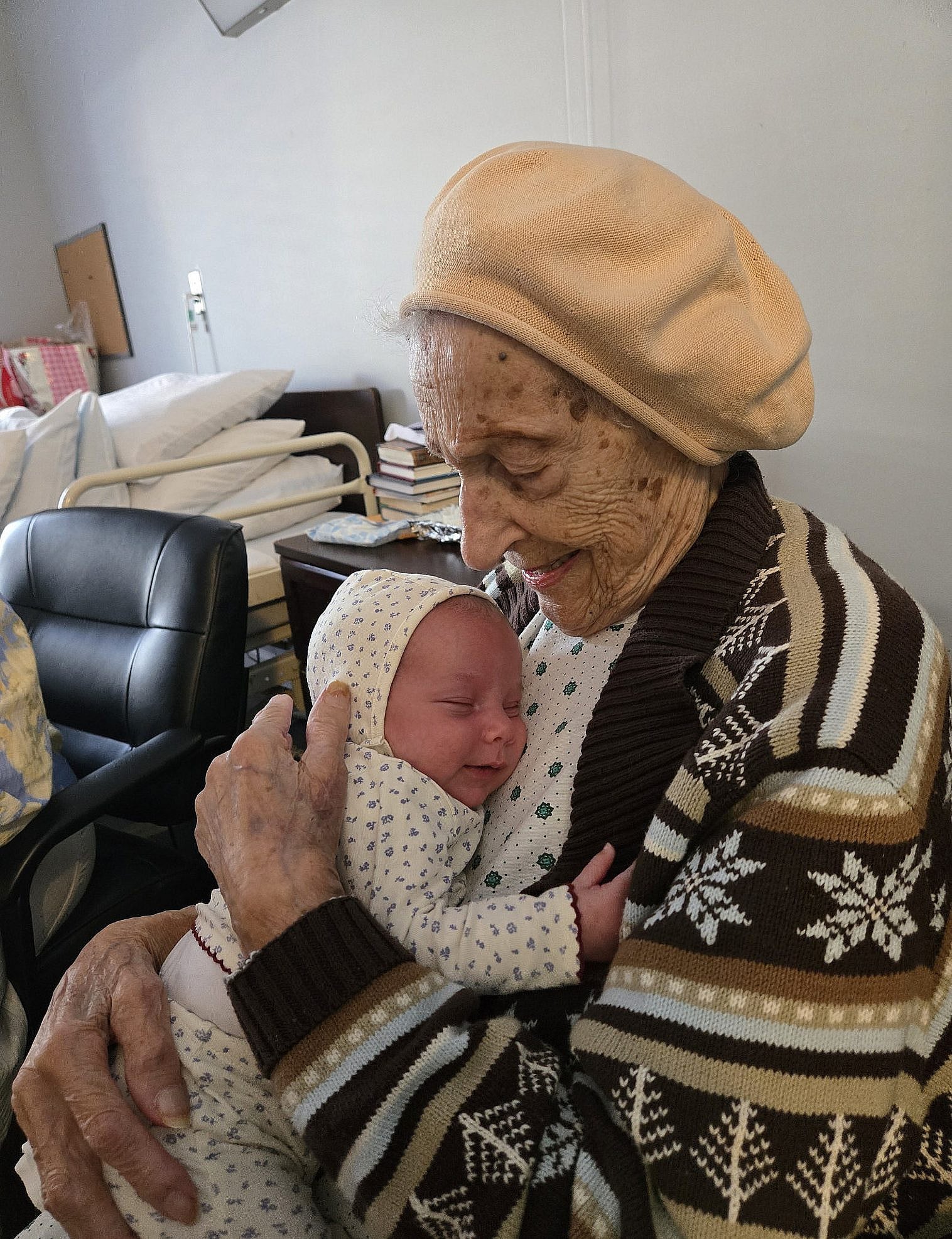
Wednesday evening I went to visit my grandmother together with our five-week-old son, Yehuda Leib. He is named after her husband, my grandfather, who passed away several years ago. Since the baby was born, she has been asking my father when I would finally bring the baby to her rehab, so she could personally see the newest great-grandchild carrying her late husband’s name.
There was no unveiling ceremony in her room. There were no television cameras, giant letters, or official proclamation. There was simply a great-grandmother looking into the face of a tiny baby and seeing that the name of the man with whom she had spent 67 years, the man with whom she had built a beautiful family, was still alive.
What a powerful contrast between my grandfather Yehuda Leib, and the conqueror Novach.
A person can place his name on a city and still have the name disappear. But when a child is named for someone and is raised to carry forward that person’s values, faith, and Jewish commitment, that name has entered the future.
A Jewish name is not merely a memorial. It is a mission. We do not name a child simply so that people will remember what someone was called. We give a name because we hope that something of that person’s soul, character, kindness and goodness will continue to shine through the child.
Of course, a child must become his own person, with his own personality, gifts, and journey. But he carries a sacred connection to someone who came before him, and he is now able to add yet another chapter to a story that is not yet over.
We spend so much of our lives trying to put our name on physical things. We want tangible, visible recognition for what we do, and we want to see our names engraved on the wall.
We want to be remembered long after we leave.
And plaques are important. Jewish law teaches that there is value in acknowledging those who give and those who do good. It is even described as a mitzvah to publicly honor those who give, because that can inspire others to give as well.
But nothing physical is forever.
Ultimately, it is only the name passed from one generation to the next, lived with purpose, and strengthened by Jewish behavior, that can endure forever. Ultimately, it is our children and grandchildren who carry the names that truly last.
Jewish law contains a fascinating reminder of this.
When a person enters a cemetery, he is meant to cover his tzitzis, because those who have passed on can no longer perform Mitzvot. By proudly wearing the tzitzis that a dead person can no longer wear, it is considered like “mocking the poor”.
Interestingly, Jewish law is not concerned about someone walking into the cemetery wearing an expensive Rolex watch or designer clothing. Jewish law is not concerned that the people buried there will be jealous of your jewelry, your car, or your bank account.
Because these things no longer impress anyone in the World of Truth. But tzitzis must be covered, because one more mitzvah, one more prayer, another moment used to bring G-d into this world… that still matters forever.
The secret to a name that lasts is when that name becomes a blessing in another person’s life. A name lasts when its values are lived by a family who carry it on. A name lasts when it is connected to Torah, prayer, charity, kindness, and a life of purpose.
This week, I saw both kinds of names.
I saw one name going up in enormous letters over an international airport. And I saw another name, carried by a five-week-old Jewish child, resting peacefully in the arms of his great-grandmother.
We may never have an airport named after us. But every one of us can build something far more lasting. We can build a Jewish life that makes our name worth carrying.
Good Shabbos!
Rabbi Yankie & Chana Denburg