A New Paradigm for Judea and Samaria
Leaving Oslo to Reach Peace
For more than thirty years, the Oslo process has structured all discussion about the Israeli–Palestinian future. It has shaped institutions, diplomatic language, and even the expectations of the international community. Yet it must be acknowledged that this framework has brought neither peace, nor security, nor the emergence of a stable and responsible neighbor.
Changing paradigms does not mean abandoning a political solution; it means recognizing that the imported statehood model ignored social realities. Oslo attempted to create a state before building the conditions for its viability. The result is well known: a Palestinian Authority that is contested, corrupt, and unable to contain violence.
Leaving Oslo today could be an act of optimism. It would mean accepting that peace will not be born from a grand conference under international pressure, but from gradual stabilization rooted in the daily lives of the populations. It would also mean recognizing that Israeli security is not an obstacle to peace, but its prerequisite.
Such a shift in perspective would open a new space: that of non-ideological, non-binary solutions, which do not seek to “resolve the conflict” in a single stroke, but to de-conflict it sustainably.
The Alternative Model: Urban Autonomy under Strategic Control
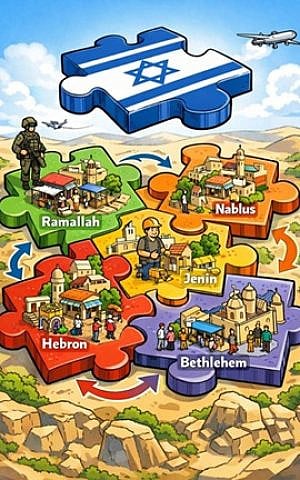
From this perspective, a model inspired by the formation of the United Arab Emirates (1)—based on the autonomy of the main Palestinian cities under Israeli security control—deserves consideration.
These cities and their suburbs (2) encompass the vast majority of the population—Ramallah, Nablus, Jenin, Hebron, Bethlehem, Jericho, Tulkarem—where the vital forces and economic realities are concentrated.
Concretely, governance would be entrusted to these cities as hubs endowed with their local elites, their own economies, and their social and clan networks.
They would exercise broad civil powers: municipal administration, economic development, taxation, education, justice, culture, ecology, and more.
They would form a functional confederation, without a capital and without a central government.
A council of cities would coordinate shared issues—water, energy, transport, economic standards, the environment—through joint agencies.
Israel would retain security responsibilities, counterterrorism—including oversight of school textbooks—as well as control of airspace, defense, and foreign policy.
The question of the nationality of the inhabitants of these cities is often presented as the heart of the conflict. It should no longer be so.
In this model, based on urban autonomy and a functional confederation, residents would not belong to a sovereign state nationality, but to a local citizenship rooted in their city, complemented by a stable personal status of permanent confederal residency.
This status, recognized by Israel, would guarantee local voting rights, civil protection, and travel documents, without any claim to military or diplomatic sovereignty.
International experience shows comparable cases: Hong Kong, Andorra, the Åland Islands, or Puerto Rico have functioned sustainably with hybrid statuses separating civil rights, local identity, and strategic sovereignty.
The prospects of this model rest on several factors:
- It restores local responsibility. Urban leaders can no longer hide behind an abstract national cause to mask corruption or failure. They are judged on concrete results: employment, security, services.
- It rewards stability. The calmer, better governed, and more economically integrated a city is, the more its residents benefit from investment and opportunities. Violence ceases to be a profitable political lever.
- It offers Israel security legitimized by acknowledged institutions.
This model promises a gradual and lasting improvement in daily life, without outbreaks of violence at every stage.
It does not deny identities; it gives them an appropriate framework. It holds that peace is not decreed but emerges from a cumulative process. It rests on a simple idea: societies are transformed more reliably through responsibility than through rhetoric.
Changing paradigms, therefore, is not an admission of failure. It may well be, today, the condition for optimism that is finally credible.
- Established in 1853 as the Maritime Truce States (‘Trucial States’) with Great Britain.
2. Including East Jerusalem