
‘A Person Should Own the Algorithm’: Watching ‘The Social Reckoning’ with My Son
My son Michael just joined social media. So when Aaron Sorkin’s The Social Reckoning opened in theaters on October 9, I knew we had to see it together. A few nights earlier we had watched The Social Network, Sorkin’s 2010 film about how Facebook was born. This one is about what it became.
There was another reason I wanted to see it. Jim Goldman, founder of MOTVOICE, a podcast focused on management in Jewish philanthropy, had posed a question that stuck with me: Who would you want on the board of a Jewish organization, Mark Zuckerberg or Warren Buffett?
Sorkin wrote and directed the film as a companion piece to The Social Network. It tells the true story of Frances Haugen, played by Oscar winner Mikey Madison, a young Facebook engineer who brings the company’s internal documents to Wall Street Journal reporter Jeff Horwitz, played by Jeremy Allen White. Jeremy Strong plays a grown-up Mark Zuckerberg, still awkward but now running one of the most powerful companies on earth.
Afterward, I decided to interview Michael about the movie and his thoughts on social media. He is not new to these questions. Michael recently joined IMPACT as the student champion for Westchester Torah Academy, where he is organizing a group of his friends to combat Jewish hatred and amplify Jewish joy and resilience, online and on the ground.
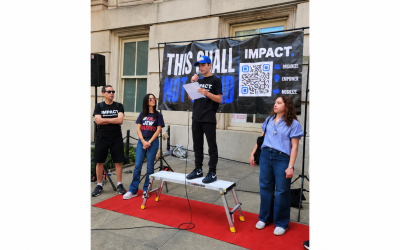
He has been interviewing influencers and activists, including The Midnight and D’Anna Morgan, an incredible ally and activist in our community. He also knows the rise of antisemitism firsthand. Unfortunately, he has been a target of Jewish hatred himself. Instead of letting that experience silence him, he pushed forward. After learning what some public school teachers had been saying in their classrooms and online, he spoke at his first rally, outside the Department of Education, to call out the antisemitism that Jewish teachers and students are facing in public schools and to show that the younger generation has a voice.
So I asked him what he thought of the film.
“It was very interesting,” he said. “It was like a twisted story. You could see how having an app or being on social media can change everything and can affect you.”
What Facebook knew
The film is built on The Facebook Files, the Journal’s 2021 investigation based on the documents Haugen provided. The series showed that a program called XCheck exempted millions of high-profile users from rules everyone else had to follow. It showed that Facebook’s own researchers had found Instagram was harmful to many teenage girls, while the company played down those effects in public. One internal slide put it bluntly: “Teens blame Instagram for increases in the rate of anxiety and depression.”
Most relevant to our community, Facebook’s own staff warned that misinformation, toxicity and violent content spread disproportionately through reshares, and that the News Feed algorithm rewarded divisive content. In other words, every share trains the machine.
Even the film’s stars are uneasy. White told AFP that he has real fears about what these companies ultimately want. “They want all of our time,” he said. Madison has chosen to stay off social media entirely.
“An algorithm shouldn’t own a person. A person should own the algorithm.”
An eighth grader’s verdict
Michael picked up on the actors’ choices. Andrew Garfield, who played Facebook co-founder Eduardo Saverin in The Social Network, has long stayed off social media, and Michael saw the lesson. “It is good if you’re using it the right way,” he told me. “If you search up things that are not good, that are not appropriate, then you should not be using it. But if you use it for influential things, then it is good, and it’s good for people to have connections and to be social.”
I asked him about the business side, the way the film shows data being used to keep people hooked because engagement means money.
“It’s not good to manipulate people for money,” he said. “If you want to start a business, you shouldn’t manipulate people.”
Then I told him what keeps me up at night. As antisemitism has surged, the algorithm has been fed a steady diet of Jew hatred, shared and reshared, until the hate feels normal. You don’t realize it, but the algorithm starts to own you.
Michael didn’t hesitate. “An algorithm shouldn’t own a person. A person should own the algorithm,” he said. “It’s not good for the algorithm to be fed hate. That’s not how it should work. It shouldn’t only be one-sided.”
I have read a lot of policy papers on online hate. None of them said it better.
When hate goes viral
The numbers explain why this matters. In its guide When Hate Goes Viral: Bias and Antisemitism on Social Media, the ADL cites a 2024 Pew Research study finding that 53% of American adults at least sometimes get their news from social media. The ADL’s own 2024 research found that 80% of young people had encountered hate speech on social media in the previous month.
Put those two facts together. Half of adults are getting their picture of the world from feeds designed to reward outrage, and almost all of our kids are seeing hate in those feeds. Organizations like the ADL, AJC and Fighting Online Antisemitism have documented this for years. The Facebook Files showed the companies have their own research too. They know.
That is what struck me most as a father. When kids like Michael open Instagram for the first time, the hate is already waiting at the gates, and the algorithm has been trained on it.
Zuckerberg or Buffett?
Jim’s question kept running through my head during the film. Zuckerberg understands technology, scale and attention better than almost anyone alive. The Social Reckoning shows what happens when that kind of growth outruns accountability, and a company’s own research is buried instead of acted on. Buffett represents the opposite model: patient, long-term and famous for owning his mistakes in plain English in his annual letters.
Jim has laid out 10 principles for Jewish communal organizations, built on Peter Drucker’s Management by Objectives, to bring more transparency and accountability to Jewish organizational life. Several read like a direct response to the Facebook Files. One calls on organizations to implement real feedback, from program evaluations to public reviews, and to end the culture of secrecy. Another separates innovation from improvement: “Innovation can capture our imagination; relentless improvement is what actually creates the big wins.” A third urges Jewish organizations to use the right technology to build real online communities, not just broadcast lectures.
My answer: Buffett’s values in the boardroom, and a Zuckerberg-level understanding of how the platforms work. Jewish organizations can’t afford to ignore technology, and we can’t afford to adopt its worst habits either. We need to understand the algorithm as well as Silicon Valley does, and govern ourselves with the transparency Facebook lacked.
Joy as the antidote
So I asked Michael what he hopes for as he starts his own social media journey.

“I hope that eventually it gets better,” he said, “and antisemitism becomes less shared, and for Jewish joy and resilience to become what antisemitism is now.”
That is the whole mission in one sentence. At IMPACT, the organization I co-founded after October 7, we say we have to organize, empower and mobilize. Through our “Learn, Lead, Do: It’s Up to You” model, we teach students the importance of civic responsibility and how to become mobilizers on social media, working together in a coordinated way to fight Jewish hatred and amplify Jewish joy.
I have watched what happens when kids take that seriously. One of Michael’s friends is an amazing drummer. He made a short video that opens with him introducing himself and saying, “This is my Jewish joy,” and then he plays a quick set. No speech, no argument. Just a proud Jewish kid doing something he loves, out loud.
It isn’t only the kids. My friend Dan Remin loves fishing, and he cherishes the moments he takes his daughter out on the water with him. That is his Jewish joy, and he shared it in a video of his own. A teenage drummer and a father fishing with his daughter: different generations, each showing Jewish pride in their own way.
When generations share Jewish pride together, we have the opportunity to feel more in control and to organize in the right way. Jewish joy and resilience, together with teaching civic action, help us feed the algorithm. They also make us stronger as a community, because we know we can do something in these challenging times.
There is a reason we built a Joy Scroll into the IMPACT app. We need more Jewish joy and resilience in our feeds. When you post joy, you are feeding the algorithm too. Facebook knew the power of the share button and how every share fed the machine. Now it is up to us, and to our children, to feed it Jewish joy and resilience.
I have seen it firsthand as a journalist and content creator. The right post can move the algorithm, reach the “swayables” in the middle, help them see the truth and leave them feeling empowered instead of afraid. It is up to us to make that happen. Social media has evolved, and we have to understand how it works and use it better, to fight back when necessary and to show our Jewish joy and resilience every day.
Here is what I told Michael, and what I would tell any parent handing a phone to a child. Be careful what you share, what you read and what you comment on, because each one is a vote for what the algorithm shows next. Report hate instead of resharing it, even to condemn it. When you see antisemitism and you feel comfortable, call it out. And share the good: the proud, joyful, resilient side of Jewish life that rarely goes viral on its own.
The Social Reckoning is a wake-up call. Technology and social media will only get more complicated from here. But sitting next to my son in that theater, I came away hopeful. His generation might be the one that finally owns the algorithm, instead of letting it own them.