
An Aging Jewish Feminist
A Political Reading of Parashat Bereshit
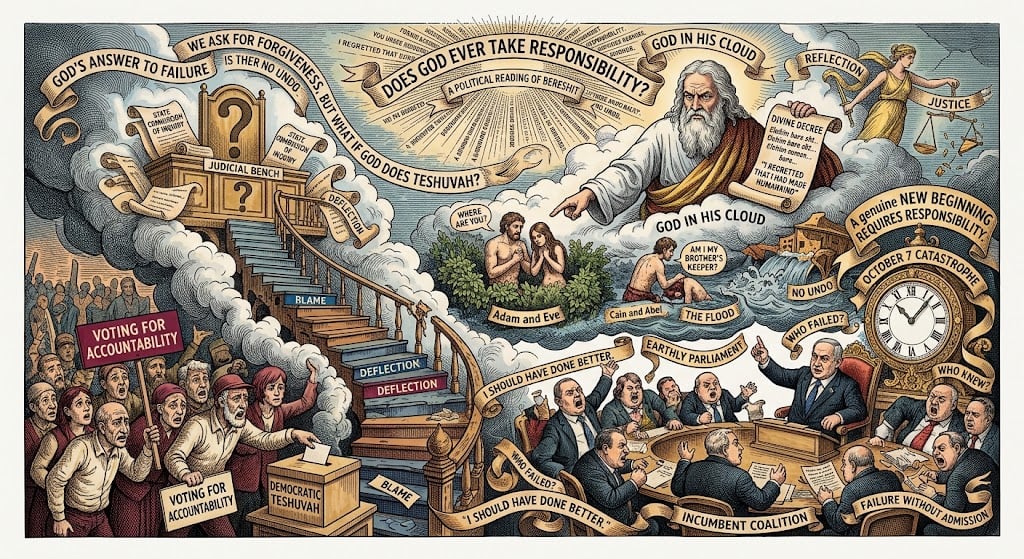
Leadership is tested not when decisions succeed, but when they fail. Three years after the catastrophe of October 7th, an urgent political question remains unanswered: Who is responsible for the failure that allowed the massacre to happen? The Israeli author, Etgar Keret, writes today that the repercussions of October 7th will never end, even if we elect a new government. He’s almost right; it took 50 years to forget the Yom Kippur War, which started on October 6th—and that’s only because of the Simchat Torah War—which is never referred to by this name. Then too, heads fell; but the difference was that our leaders then accepted responsibility for what was referred to as the mechdal. Then too, our leaders were caught with their pants down, (or perhaps in Golda’s case, with her skirt!) They too failed to act on the warnings of field scouts and intelligence reports. But they resigned. They realized that they were responsible for the strategic collapse. Today, who will stand up and say four simple words: “I failed, I resign”?
Instead, the present government and our Prime Minister have spent three years engaged in acts of obfuscation, deflecting blame, which have been directed at everyone, except themselves—the IDF high command, intelligence chiefs, political opponents, protesters, civil society, and even the victims themselves. This refusal to take responsibility mirrors a pattern which can be seen in this week’s Parashat Bereshit.
We can already ask the question, why was God so anxious to create a world in six days and then walk away from his creations? And why insert evil so early in this world? God created a world that was supposed to be good. In fact, God repeatedly declares it good. And then, after creating human beings on the sixth day: וַיַּרְא אֱלֹהִים אֶת־כָּל־אֲשֶׁר עָשָׂה וְהִנֵּה־טוֹב מְאֹד
“And God saw all that He had made, and behold, it was very good” (Genesis 1:31).
Really? Was it? Because almost immediately things begin to go wrong. Adam and Eve are placed in the Garden of Eden. They are given an extraordinary gift—but not much of a roadmap. There is one prohibition. They violate it. God discovers them, asks where they are, and then expels them from Eden. Why set up boundaries to what cannot be eaten, and then not put a fence around the forbidden fruit. And what happens after that? They are left to fend for themselves.
My love of midrash makes me ask: What if? What if Adam and Eve had not eaten the fruit? What if Cain had not killed Hevel? What if God had accepted both offerings? What if the Flood had never happened?
In my own midrash, Beginnings, which I wrote in 1985, I imagined Adam and Eve standing outside Eden, pleading with the angels:
“Give us another chance. Let us back in. We’ll be good. We won’t do it again.” But the angels refuse. Adam eventually recognizes that they must make a life on their own. They build a crude home. They learn how to find food. Eve gives birth to Cain, then Hevel. The family struggles. Cain becomes jealous. Hevel is murdered. And then the first family discovers what every bereaved family eventually discovers: there is no going back. There is no button marked Undo. There is no way to return to Eden.
Years later, I am again interested in the possibility of beginning again after catastrophe. And now, as we approach the anniversary of October 7th, I find myself asking a somewhat different question: Who was responsible for the catastrophe in the first place? Adam and Eve certainly made choices. Cain made a terrible choice. Human beings throughout Genesis made terrible choices. But what about God? God created the system. God created human beings with freedom. God placed them in the Garden. God gave them the prohibition. God expelled them when they failed. And then, when the world became increasingly violent, God did something even more drastic. God destroyed almost all of it. The Flood was God’s Answer to Failure.
Genesis tells us that humanity had become corrupt and violent. God saw what was happening and was grieved. The Hebrew is extraordinary:
וַיִּנָּחֶם יְהוָה כִּי־עָשָׂה אֶת־הָאָדָם בָּאָרֶץ
וַיִּתְעַצֵּב אֶל־לִב
“And the LORD regretted that He had made humankind on the earth, and His heart was saddened.”
God regretted making us. But notice what God does not say. God does not say: Perhaps I made a mistake. God does not say: Perhaps I did not give these creatures enough guidance. God does not say: Perhaps I bear some responsibility for the world I created. Instead, God destroys the world. The Flood is, in a sense, a divine version of starting over– a re-set as it were!
The problem is humanity. So eliminate humanity. And yet the Flood doesn’t solve the problem. Noah gets drunk. His family is dysfunctional. Human beings continue to fight for power. They build the Tower of Babel. The world goes on being the world. And eventually God makes a covenant.
But does God ever actually apologize? Does God ever say: I was wrong? My motivations in creating a world and people in my image were not altruistic, they were selfish, a product of boredom.
Does God ever do teshuvah? That question has been haunting me for a long time. We recently spent a lot of time talking about teshuvah. We confessed our sins. We beat our breasts. We said Ashamnu, bagadnu, gazalnu—we have sinned, we have betrayed, we have stolen. We asked God for forgiveness. But what if we turned the question around? What would it mean for God to do teshuvah?
BEFORE AND AFTER
Three ago, on October 7th, the world we knew changed. In the days and weeks afterward, there was enormous heroism and enormous suffering. There were murdered families, kidnapped human beings, traumatized communities, soldiers called to war, families displaced from their homes, and a country trying to comprehend how something so catastrophic could have happened. But alongside the shock and grief came another question: Who was responsible? Not responsible for the existence of Hamas or for the hatred and violence that produced the massacre. Those are separate questions. I mean responsibility for the failure that allowed such a catastrophe to occur.
Who knew? Who should have known? Who failed to act? Who made the decisions? Who was warned? Who was responsible for protecting the people who were attacked? And, perhaps most importantly: Who would stand up and say, “I failed”?
Very early after October 7th, even while the country was still under attack, I remember hearing people ask a painfully simple question: How can we trust the same people who got us into this mess to get us out of it? At the time, there was an understandable insistence that this was not the moment for political reckoning. Israel was fighting for its survival. Soldiers were being called up. Families were searching for missing relatives. Hostages were being held in Gaza. People were bringing food and clothing to evacuees. Volunteers were doing whatever they could. There would be time for a heshbon nefesh—a reckoning—later.
But eventually “later” has to arrive. Because leadership is not only about making decisions when things are going well. Leadership is about what happens when your decisions fail. And that brings me back to Bereshit.
Perhaps I have been unfair to God. After all, the biblical God is not a modern government minister. God is not a chief of staff or a military commander. God is a theological figure, and the biblical stories are not newspaper accounts.
But that is precisely why the question interests me. Because God is supposed to be our model. We have been taught to see God as the ultimate authority, the ultimate judge, the ultimate source of moral order. And yet in Genesis, God repeatedly responds to human failure with punishment: Adam and Eve fail: exile. Cain fails: exile. Humanity fails: Flood. The world fails: destruction and rebuilding. And then, in the rest of the Bible, the pattern continues. Human beings sin. God becomes angry. Humans pay a terrible cost! Human beings repent. God forgives.
But where is the reciprocal movement? Where does God say: I have something to confess too? Perhaps that is the uncomfortable theological question we need to ask. Because if God never takes responsibility, what kind of role model is God for human beings?
What happens when leaders behave as though responsibility always belongs to somebody else? The fault lies with the enemy. The fault lies with the intelligence services. The fault lies with the soldiers. The fault lies with the protesters. The fault lies with the opposition. The fault lies with the victims themselves. The fault lies everywhere—except with the person who had the authority to prevent the disaster.
That is not a particularly biblical problem. It is a very human one. And perhaps it is also a theological one. What If God Had Said: I Failed?
Imagine another version of Genesis. Imagine God looking at the destruction caused by the Flood and saying:
I created these human beings. I gave them freedom, but perhaps I did not give them enough guidance. I watched violence grow. I waited too long. And then I responded with destruction. I cannot undo what happened. But I can acknowledge my responsibility.
That would be a very different God. Not an all-powerful monarch who is never wrong. Not a parent who demands obedience but never examines His own behavior. Not a God who requires human beings to confess endlessly while remaining above confession Himself. But a God capable of reflection. A God capable of saying: I was wrong.
And perhaps that is not a diminution of God. Perhaps it is an enlargement of God. Because what is teshuvah, at its deepest level? It is not merely saying “I’m sorry.” It is recognizing that what I did had consequences. It is looking honestly at the wreckage. It is accepting responsibility. It is changing direction. It is trying to build something different. Perhaps the most radical thing we could imagine is not a God who demands teshuvah from us, but a God who models it.
There is, after all, another possibility in Bereshit. The story does not end with Cain. It does not end with Hevel’s blood crying from the ground. It does not end with the Flood. It does not even end with humanity’s repeated failures.
After Hevel is murdered, Adam and Eve have another child:
וַתִּקְרָא אֶת־שְׁמוֹ שֵׁת
“And she called his name Seth, for God has provided me with another offspring in place of Hevel.” And Seth has a son named Enosh.
The human story continues. That is the great stubbornness of Genesis. Things go terribly wrong. And still, somehow, we begin again. That is where I find hope after October 7th—not in pretending that everything will be all right, and certainly not in declaring that the past no longer matters. A new beginning does not erase responsibility. Quite the opposite. A genuine new beginning requires responsibility. We cannot build a different future if we refuse to understand what went wrong in the past. We cannot ask people to trust leaders who will not account for their failures. And we cannot create a healthier political culture if responsibility is always something demanded of somebody else.
The anniversary of October 7th is therefore not only a day to remember those who were murdered, those who were kidnapped, those who fought, those who survived, and those whose lives were permanently altered. It is also a day to ask what kind of leadership we want after catastrophe.
Do we want leaders who say, I am responsible? Leaders who can acknowledge mistakes without collapsing? Leaders who understand that accepting responsibility is not weakness? Leaders who know that sometimes the most important words a leader can say are:
I was wrong. I failed. I should have done better.
And perhaps, if we are brave enough, we should ask the same questions of God. Does God ever atone? Does God ever take responsibility? Should God? I don’t know. But I am beginning to think that asking the question may be more important than finding the answer. Because perhaps the God we need today is not the God who is always right. Perhaps we need a God who can change. A God who can listen. A God who can look at the world He created and say: This is not what I intended. And then—not destroy it, not blame it, not abandon it—but help repair it. Maybe that is what teshuvah means. Maybe that is what leadership means. And maybe that is what a new beginning requires.
Democratic Teshuvah: Voting for Accountability
Unlike the subjects of ancient absolute monarchs, modern democratic citizens are not helpless observers. As Israel prepares to go to the polls, the public faces a clear civic imperative.
If a government will not voluntarily practice teshuvah—if a Prime Minister refuses to admit error or step down after overseeing the worst security failure in the nation’s history—then we, the electorate must enforce accountability through the ballot box.
To vote out the incumbent government in the upcoming election is an act of democratic renewal. It is a collective declaration that authority without responsibility is tyranny, that failure must carry consequences, and that a nation cannot heal while its leaders treat political survival as their highest priority. Until our political leaders are held to account, the cycle of unexamined failure will continue to repeat itself.
Let us hope for an uneventful year, perhaps even a boring one!
Shabbat shalom.
Related Topics