


Stephen J Stern PhD
A question for Mayor Mamdani about Israel’s history
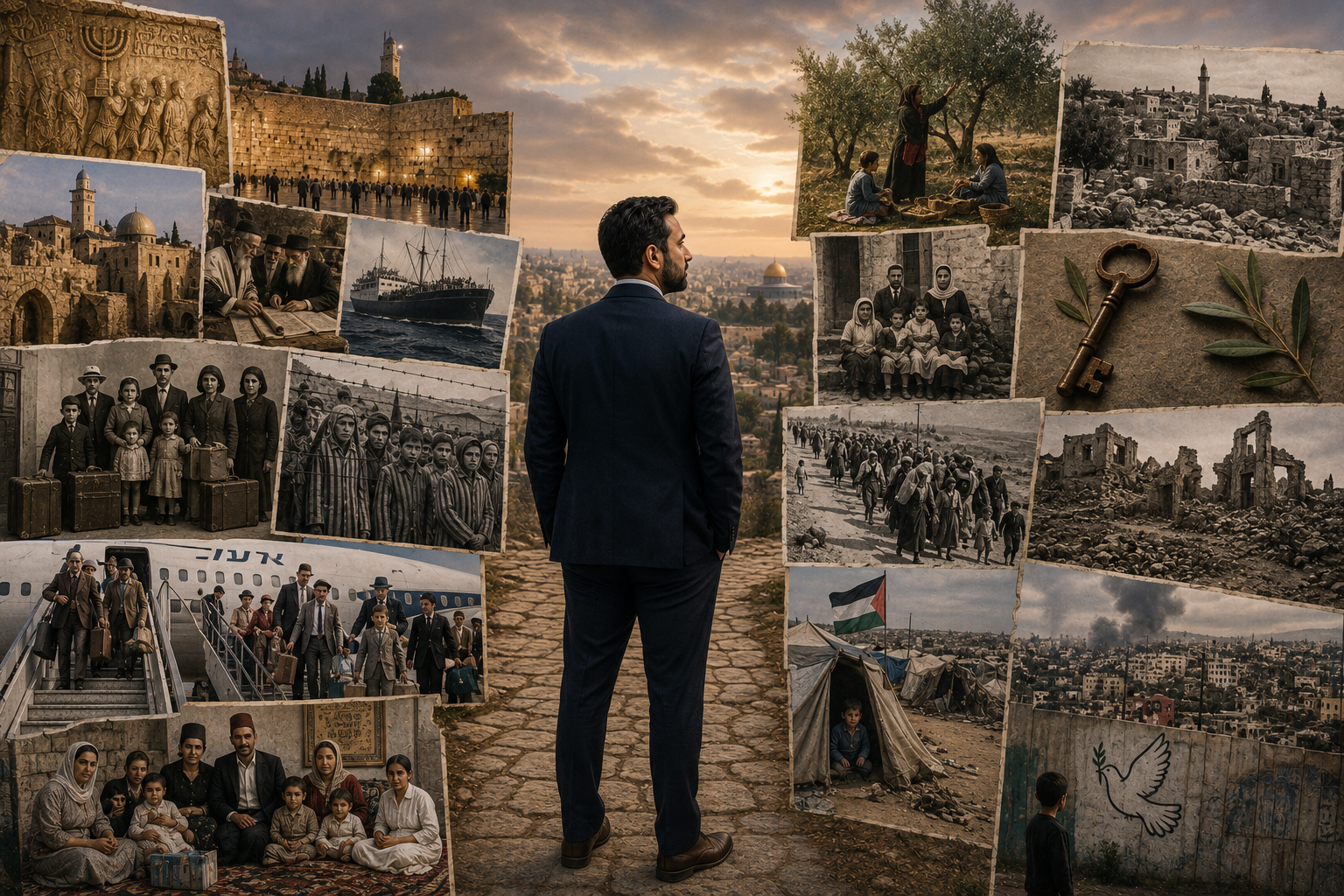
AI image created by author.
Dear Mayor Mamdani,
You have consistently described Israel as a settler-colonial state. You have also said that while you support Israel’s existence, you cannot support it as a Jewish state, only as “a state with equal rights for all its citizens.” You have further argued that Prime Minister Benjamin Netanyahu should be arrested if he comes to New York.
I am struck that the history and legitimacy of Israel have become issues for the mayor of New York. Yet because you have made them central to your public life, they deserve to be examined seriously.
I do not dispute that early Zionists described their project in colonial terms. Nor do I dispute that Benjamin Netanyahu should be held accountable for alleged war crimes. Nevertheless, I would like to ask how your framework accounts for several historical facts that are difficult to reconcile with reducing Israel’s origins to settler colonialism.
Taken together, your public positions suggest a coherent view of Israel, not as a nation-state with a legitimate claim to Jewish self-determination, but as a settler-colonial project whose legitimacy lies in its transformation into a single democratic state. It is that framework I want to examine.
How does it account for the Jews fleeing the destruction of European Jewry? Many found refuge wherever they could. Palestine was one of those places, often because so much of the world refused to take them. For many, however, it was not simply a refuge. It was the land to which Jewish history, memory, prayer, and identity had remained oriented for nearly two thousand years.
How does it distinguish their history from European colonialism? British, French, Spanish, Portuguese, and Dutch colonialism was driven by empire. Those powers conquered distant lands to expand their wealth and influence. The Jews arriving in Palestine were not building an empire. They were looking for a place to stay alive in a nation of their own. Sadly, as noted by Israeli novelist Amos Oz, the Jews were jumping out of burning buildings onto the backs of Palestinians. Nevertheless, that is a very different image from the European colonialism through which Israel is often framed.
How does it account for the role European colonial powers actually played? If European colonial powers reshaped the Middle East, then it is those powers, not Jews fleeing pogroms, racism, and extermination, who bear responsibility for that history. Yet Jews are often treated as the colonial villains, conflating criticism of Israeli government policy with the historical reasons Israel came into existence.
None of this means Israel bears no responsibility today. Historical innocence does not eliminate present-day responsibility. The fact that many Jews arrived as refugees fleeing persecution does not absolve Israel of its obligation to protect Palestinian lives, dignity, and the right to self-determination. It simply means those obligations should not be confused with responsibility for the European imperial projects that helped shape the modern Middle East.
How does it account for the way land was acquired? Early Zionist settlers did not simply seize it. Much of the land acquired before 1948 was purchased legally from absentee landowners living in cities such as Damascus and Istanbul. Whatever one thinks of Zionism, that history differs from the image of European settlers simply arriving and taking territory by force.
How does it account for the Jews who were not European, who today make up a majority of Israeli Jews? After the 1948 Arab-Israeli War, approximately 850,000 to 900,000 Jews fled or were expelled from Arab countries, with over six hundred thousand rebuilding their lives in Israel. They left behind communities that, in many cases, had existed for over a thousand years, including the approximately 2,500-year-old Jewish community in Iraq. Their history alone complicates any effort to reduce Israel’s origins to a European colonial project.
Finally, how does your framework account for the Evian Conference? In 1938, delegates from 32 countries gathered in Evian, France, to discuss the growing crisis of Jewish refugees fleeing Nazi Germany. The conference produced expressions of sympathy but almost no willingness to accept Jewish refugees. The Dominican Republic was the notable exception, offering to accept refugees, although only a small number ultimately resettled there. Long before Israel declared independence, the international community had already demonstrated how few places Jews could turn when they were desperate for refuge.
None of this excuses Israeli policies that terrorize Palestinians, deny them self-determination, and allow some settlers to terrorize them. The policies toward Palestinians are horrific. They deserve condemnation and accountability. But why do those policies call into question the existence of the state itself? States around the world have committed grave injustices against their own citizens and their neighbors. Those actions demand accountability. They do not ordinarily lead to the conclusion that the state itself should cease to exist. Why should Israel be judged by a different standard?
If your vision is a single democratic state with equal rights for Jews and Palestinians alike, how do you imagine that outcome emerging when Hamas, the governing authority in Gaza, has long rejected Israel’s legitimacy? How does that vision account for repeated Israeli governing coalitions denying Palestinian self-rule, not to mention the coalition that may follow the present one? Who are the Palestinian and Israeli political actors you believe would support and sustain the kind of democratic state you envision?
If Israel should not exist, or if Jews have lost the right to be there, what, exactly, is the alternative? Where are millions of Israeli Jews supposed to go? Who, this time, will take in the descendants of a people the world repeatedly refused when they were desperate for refuge?