Living and loving in Jerusalem
Featured Post
Simchat Torah: Where there’s change, I find hope
Dancing with the Torah was once a hard sell for many Orthodox women, but it's the default for the next generation in my shul – a quiet revolution on the women's side
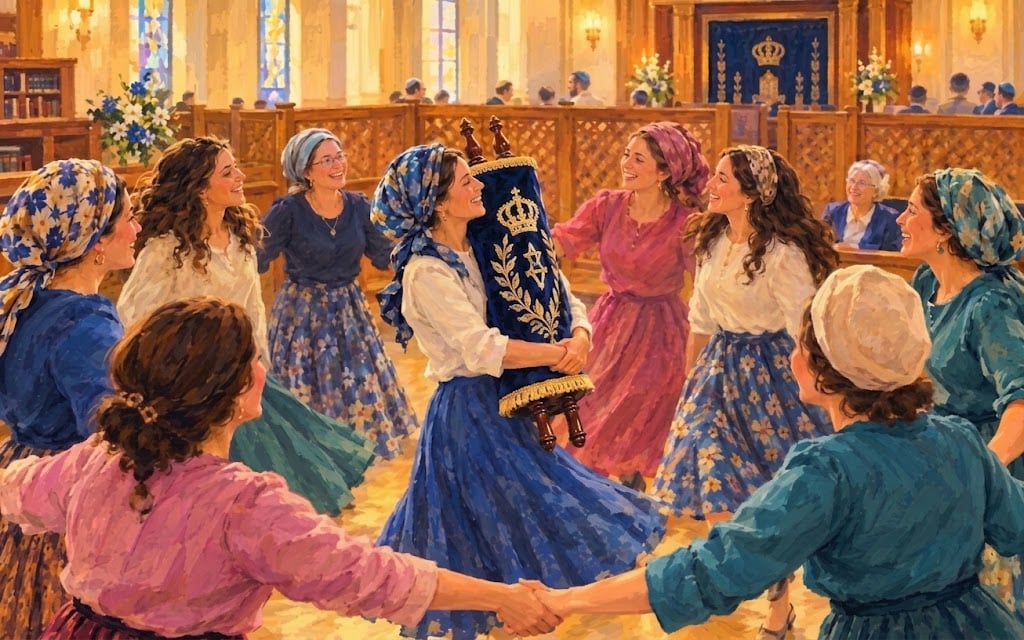
Image by the author and her AI friends
Simchat Torah was once a day of unrestrained joy. Since October 7, 2023, however, that joy has been shadowed by grief. The holiday now marks the anniversary of a catastrophe, a mass yahrzeit that reminds us of what was shattered in Israel.
Last year, in the hours leading up to the holiday, women and men across Israel cooked with one eye on their television screens, salting their food with tears as the last living hostages were returned from Gaza. We entered Simchat Torah with disbelief and relief. Our prayers had been answered. We were like dreamers.
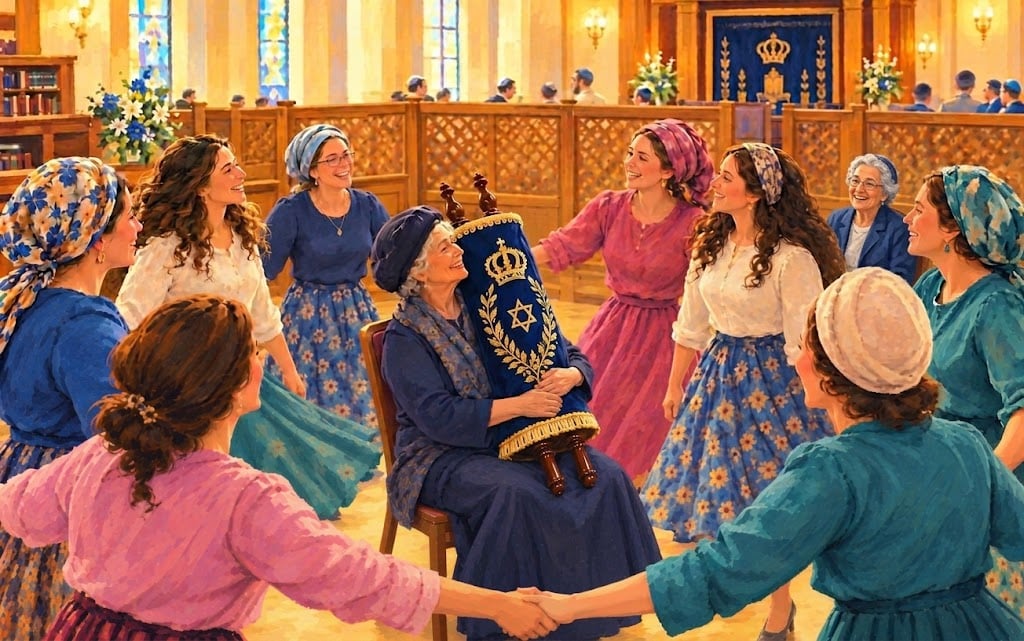
For years, I celebrated Simchat Torah at my local Jerusalem synagogue, Beit Boyer, where the rabbi had ruled that women could dance with the Torah on their side of the synagogue. But keeping the dancing going required work. I found myself coaxing women to take the scroll and continually searching for someone willing to relieve the person carrying it. Eventually, I placed a chair in the circle so that older women who could not dance could sit and hold the Torah, enabling them to participate in a celebration that would have been unthinkable in the Orthodox synagogues of their youth.
When I moved near another Orthodox synagogue where women danced with the Torah, I discovered that the dancing there sustained itself and needed no coaxing. I promptly took the easy way out and changed my holiday haunt.
But after five years away, I felt drawn back to Beit Boyer for Simchat Torah when the hostages returned. For many months before the holiday, a handful of women from the congregation had participated in a weekly Shabbat vigil in an adjoining neighborhood. In rain and extreme heat, we sat in a public square with people of varying views and beliefs, singing and praying for the hostages’ return. After the extraordinary news of the day, I wanted to be with the women with whom I had shared those long months of waiting. We greeted one another with tears and warm embraces.
Inside the sanctuary, singing and dancing filled both sides of the mechitza, the partition separating the men and women. On the women’s side, two young women, one holding the Torah, danced at the center of a large circle as women of all ages swirled around them. I joined the lively circle, while my mother, whose knees were beyond dancing, sat with a friend nearby.
Soon, someone offered me a turn, and I happily shouldered the Torah. When I began to tire, I asked my mother whether she would like to sit and hold it. It was not the first time she had done so, and she agreed with pleasure, cradling the scroll lovingly in her arms. I let her hold it for quite some time while the men on the other side of the mechitza launched into a lengthy, exuberant chant. Years of experience had taught me that women were reluctant to take the Torah, and it was a blessing to have someone seated who would happily hold it for a while.
“You know, there are other people who want a turn,” a young woman said crossly as the next song began, pointing toward my mother. I apologized and immediately handed the young woman the Torah. Her rebuke took me aback, but its significance was not lost on me. For years, I had struggled to find women willing to hold the Torah; now they were waiting for a turn.
The young woman’s rebuke may not sound momentous, but to me it was evidence of a quiet revolution. Dancing with the Torah had once depended on a few determined women to keep it going. Now, for the younger generation, taking a turn was expected. The challenge was no longer to persuade women to hold the Torah; it was to make sure that everyone who wanted to carry it had a turn.
I had expected to find the women’s section as I had left it. Instead, my five years away had given me the distance to see that the culture had shifted. A change that I had helped pioneer had taken root without fanfare, membership meetings, or sermons; it had simply become ordinary.
The next morning, I saw another shift at the separate women’s Torah reading. Many of the young women called up for an aliyah did more than recite verses before and after a section of the Torah portion; they chanted the passage themselves rather than leaving it to someone else. Having learned to read Torah for their bat mitzvah celebrations, a generation of young women had acquired the skills to read on Simchat Torah as well.
Over the years, a similar shift has taken place at Beit Boyer in one of the service’s most personal moments. Six years ago, during my year of saying the mourner’s Kaddish for my father, men who were not mourners would join me whenever no male mourners were present. Although the rabbi had ruled that a woman could say Kaddish on her own, my prayer was drowned out by people who did not share my grief. I voiced my distress to the congregation’s leadership, to no avail. At the time, there was no place for my Kaddish voice to be heard on its own at Beit Boyer. Today, however, if no male mourners are present there, it is not unusual to hear a woman say Kaddish alone in a clear, strong voice. I do not know exactly when this change took place, but what I was once unable to do has become the norm.
Over the years, other changes have taken root at Beit Boyer. The sanctuary has been redesigned so that the ark and the bima, where the prayer leader stands and the Torah is read, extend across both sides of the mechitza. For the past decade, the Torah has been brought to the front of the women’s section when it is taken out of the ark and returned, so that women can approach to kiss it; now there is even a traffic jam. Ever since the synagogue’s founding, women have given sermons. And women have served as chair of the synagogue board, more than once.
I thought of all this recently when a friend asked me in frustration whether anything is really changing for women in Orthodox synagogues. “It is,” I replied, “but sometimes we have to step back in order to see it.”
People in my community often say that change in Orthodox practice takes place through evolution rather than revolution. The problem with incremental changes is that they can be almost impossible to see at close range. Only when we step back do we recognize that these shifts, taken together, can amount to a quiet revolution. The pace can be frustrating, but seeing the change gives me hope.
I cannot say what the next change in women’s prayer at Beit Boyer will be. Based on past experience, I may recognize it only afterward, perhaps after another absence or when a young woman tells me, a bit crossly, that it is her turn. Until then, I will keep my place in the circle and try not to hold the Torah too long.
Related Topics
Related Posts