Documenting Hidden Jewish Histories and Legacies
Featured Post
A rabbi once rejected inherited guilt. Yom Kippur still does.
The idea of original sin never sat right with me. When I discovered Judaism cast aside the idea entirely, I found a path to freedom
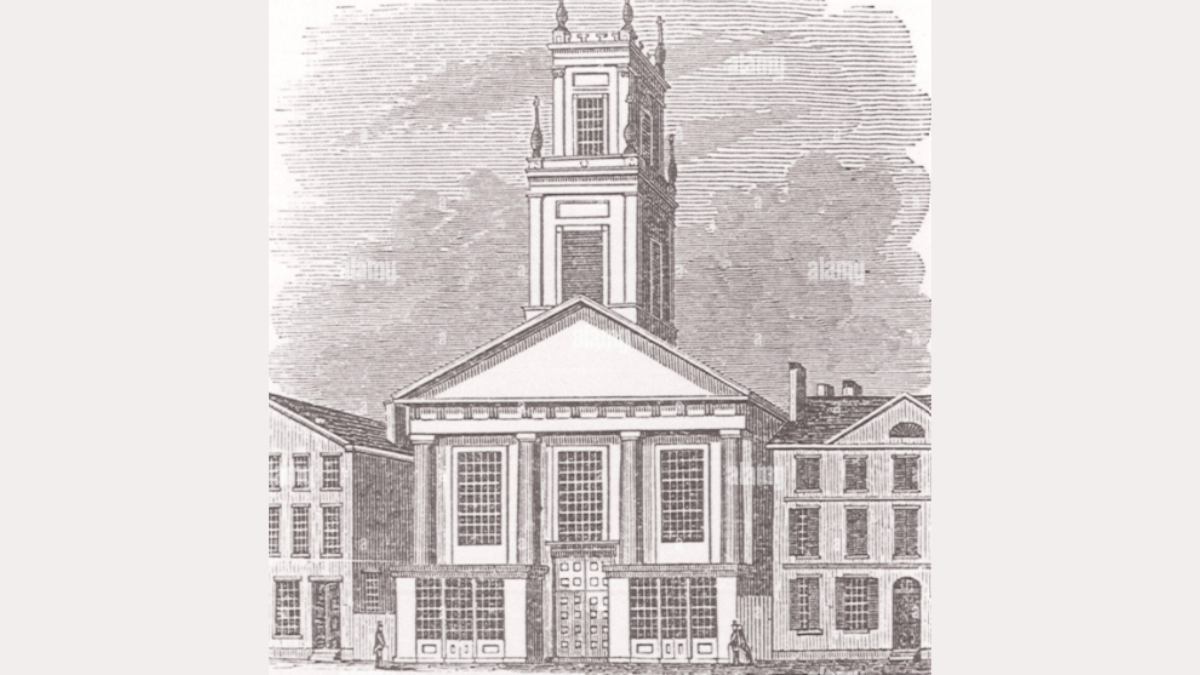
The former First Baptist Church at 36 Temple Street, Hartford. Purchased in 1856 by Congregation Beth Israel, it was renamed Touro Hall in honor of Judah Touro of New Orleans. Renovated in 1865, the hall served as both synagogue and public meeting space. Image credit: Pictures Now / Alamy Stock Photo
On a Friday afternoon in March 1865, Hartford’s Jewish community gathered to dedicate a new synagogue. The sanctuary glowed with walnut woodwork, a green carpet, and a heavy white curtain drawn across the Torah ark. Hundreds crowded inside—an assembly the congregation had prepared for by issuing tickets in advance and sending cards of welcome to “citizens of all denominations.” Nearly every church in Hartford was represented by its pastor.
At the center of the ceremony was the youngest generation: nineteen girls, dressed in white, processed up the aisle carrying wreaths and scarves. One stepped forward and presented the synagogue’s key with a poem:
Here is the key of Heaven’s gate—
For all, who for its mercy wait!
Here shall the Nations call the Lord
And enter in to hear his word!
This was not just a dedication for one community. It was a civic moment for the entire city, deliberately universal in tone. And then came the sermon.
The speaker was Rabbi Isaac Mayer Wise, a pioneering Jewish leader in America. Preaching in English, Wise rejected one of Christianity’s core doctrines: Original Sin. Humanity, he argued, was not cursed at birth but blessed with freedom. Every person, he declared, is “a free agent. He must be free to be perfect, and the powers are given him to cast off sin, to live truly, avoiding all the evil influences which corrupt society and give the world its sorrows and afflictions.”
The Hartford Courant published his words in full, adding that “its moral teachings were worthy of inculcation in every heart, whether Jew or Gentile.” Wise’s message was clear: Judaism does not teach inherited guilt. It teaches that we are responsible for our choices, and capable of repentance, repair, and renewal.
The doctrine that never fit
For me, that message is not just historical. It is personal.
Growing up in Ohio, I was baptized as a Protestant but educated Catholic. I remember watching my classmates line up for their First Communion while I stayed in the pews, unsure of where I belonged. Sometimes, despite the awkward glances, I went forward—taking a wafer and a sip of wine—with a gnawing sense that I was crossing a line I couldn’t name.
The real break came with Confirmation. Unlike Communion, this was not a sacrament I could discreetly take part in. To be confirmed meant fully entering the Catholic Church—yet I was too young to convert, and wrestling with deep questions. Chief among them was Original Sin.
The idea that humans are born guilty—marked by the failure of Adam and Eve, in need of redemption from a stain none of us chose—never sat right with me. It felt both unjust and dispiriting. And when I began to study Judaism, I discovered it rejected the idea outright. Sin, in Judaism, is not inherited but a matter of human action. Teshuvah, repentance, is always possible. Once I saw that, the road ahead became clear.
Rejecting Original Sin was the hinge. Once that doctrine fell away, the door to Judaism opened.
That is why Yom Kippur speaks so deeply to me. The Day of Atonement is not about condemning humanity as inherently broken. It is about affirming that we are capable of change. Judaism teaches that even grave wrongs can be met with repentance and forgiveness. Our failures are real, but they do not define us.
On Yom Kippur, we confess aloud, but not because we are compelled. We confess because we are free—to name our missteps, to turn, and to begin again. As Ezekiel 18:27 states: “And if someone wicked turns back from the wickedness that is practiced and does what is just and right, they shall save their life.”
This is a profoundly different vision from the one I grew up with. It is not guilt passed through generations. It is responsibility embraced.
What astonishes me is how confidently earlier generations of American Jews proclaimed this difference—not only inside synagogues, but to the wider world.
In Hartford in 1865, the new synagogue was not inaugurated in private. It was dedicated before hundreds of guests, with Christian clergy in attendance, with prayers in Hebrew and English, and with Wise’s sermon declaring Judaism’s faith in human freedom.
The Courant described the service as “of a very interesting character, the large audience remaining to the close.” It was also announced that Rabbi Wise would give a public lecture that Sunday, open to all. Judaism’s message was not obscure. It was spoken openly, printed in newspapers, and celebrated as part of Hartford’s civic life.
Over time, that confident voice faded. Waves of Jewish immigration after 1880 shifted American Judaism’s priorities to meeting the needs of newcomers. Later, the Holocaust left a profound impact even far beyond Europe. Zionism also reshaped Jewish identity toward nationalism. The idea that Judaism had something universal to say—to non-Jews as well as Jews—grew quieter.
But the theology never wavered. Judaism still teaches that sin is not inherited, that human beings are free, and that repentance is always possible.
For someone like me, a convert drawn precisely by those teachings, the words of Wise in Hartford are not relics. They are reminders. They show that Judaism has a history of proclaiming, in public, its vision of responsibility, freedom, and hope.
As Yom Kippur approaches, I find myself asking: do we still believe it?
Do we still believe that no one is trapped by fate? That sin can be turned aside by human choice and forgiveness? That Judaism has something to offer not only to Jews but to anyone who listens?
The young girls in white who carried the key to Hartford’s synagogue in 1865 declared that “the Nations” would one day enter and call on the Lord. That moment may feel distant, but the words still echo.
Judaism does not need to proselytize to reclaim that voice. It only needs to remember what it already knows: that repentance is possible, that responsibility is ours, and that our tradition has something to offer all people.
On Yom Kippur, we stand before God as free agents who can choose to return. That was the message Wise preached. That was the message Hartford’s pastors once heard. And it remains the message we most need today.
Related Topics